

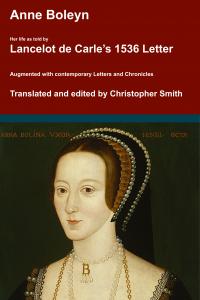
Anne Boleyn. Her Life as told by Lancelot de Carle's 1536 Letter.
In 1536, two weeks after the execution of Anne Boleyn, her brother George and four others, Lancelot du Carle, wrote an extraordinary letter that described Anne's life, and her trial and execution, to which he was a witness. This book presents a new translation of that letter, with additional material from other contemporary sources such as Letters, Hall's and Wriothesley's Chronicles, the pamphlets of Wynkyn the Worde, the Memorial of George Constantyne, the Portuguese Letter and the Baga de Secrets, all of which are provided in Appendices.
Available at Amazon in eBook and Paperback format.
Paternal Family Tree: Cragg
On 1st November 1859 Captain Wilfred Alfred Cragg was born to [his father] William Cragg (age 65) in Spanby, Lincolnshire.
On 5th August 1864 [his father] William Cragg (age 70) died.
On 22nd September 1882 Captain Wilfred Alfred Cragg (age 22) and Adelaide Alexandra Gilliat (age 18) were married in Westfield, Sussex.
In 1883 [his son] William Gilliat Cragg was born to Captain Wilfred Alfred Cragg (age 23) and [his wife] Adelaide Alexandra Gilliat (age 18).
On 21st June 1888 [his son] Lieutenant John Francis Cragg was born to Captain Wilfred Alfred Cragg (age 28) and [his wife] Adelaide Alexandra Gilliat (age 24).
On 17th December 1892 [his son] Lieutenant Noel Henry Cragg was born to Captain Wilfred Alfred Cragg (age 33) and [his wife] Adelaide Alexandra Gilliat (age 28) at Threekingham, Lincolnshire.
On 20th September 1915 [his son] Lieutenant Noel Henry Cragg (age 22) was killed in action by shell fire at Nieuport, Belgium while in charge of a naval gun. He was buried at Dunkirk. While serving on H.M.S. King Edward VII he was publicly thanked by Admiral Sir Lewis Bayley and noted by the Admiralty for saving life at sea. As Sub-Lieutenant on H.M.S. Hind T.B.D. [Torpedo Boat Destroyer] he took part in the Battle of Heligoland Bight and the Cuxhaven Raid. He was mentioned in Sir John French's despatches for gallant and distinghuished conduct in the field.
On 1st July 1916 [his son] Lieutenant John Francis Cragg (age 28) was killed in action at the Battle of Fricourt.
In 1950 Captain Wilfred Alfred Cragg (age 90) died.
Grantham Journal 1916 Oct 22. Captain And Mrs. W. A. Cragg, of Threekingham House, have suffered another heavy blow by the death of their third son, [his son] Lieut. John Francis Cragg, of the Lincolns, and the deepest sympathy is exended to them. The following letter has been received from the Officer Commanding:- "Dear Captain Cragg, – I am very sorry to inform you that your son went into action with us on July 1st and was killed. His Company was the leading one of his Battalion to go over, and all his officers were hit. He was very keen, and I much regret his loss. Lieut. Cragg was wounded in the leg in the Battle of Loos, on September 25th, 1915, but he made a good recovery, and afterwards came home on leave. In January, he was blown out of a trench, and suffered from shell shock. Captain and Mrs. Cragg had four officer sons in the Army, and this is the second to fall, the other being Lieut. Noel Henry Cragg, killed in action at Nieuport on September 15th, 1915. This gallant young officer was mentioned in a despatch from Field Marshal Sir John Frencin for gallantry and distinguished service in the field, and Captian Cragg subsequently received a communication in which the folling passage occurred: "I beg to express to you the King's high appreciation of your son's services, and to add that his Majsty trusts their public acknowledgment may be some consolation in your bereavement."
Grantham Journal 1915 Oct 16. Threekingham. Letter From The King – It having come to the knowledge of the King that Captain W. A. Cragg, of Threekingham House, had four sons serving their country, his Majesty caused the following letter to be sent conveying his appreciation:-
"Privy Purse Office, Buckingham Palace, S.W., 2nd October, 1915.
Sir,- I am commanded by the King to convey to you an expression of his Majesty's appreciation of the patriotic spirit which has prompted your four sons to give their service to the Army and Navy.The King was much gratified to hear of the manner in which they have so readily responded to the call of their Sovereign and their country, and I am to express to you and to them his Majesty's congratulations on having contributed in so full a measure to the great cause for which all people of the British Empire are so bravely fighting. I have the honour to be, sir, your obedient servant, F. M. Pomsonby, keeper of the, Privy Purse." It is only a week or two since the sad news arrived that one of these sons – Lieut. Noel H. Cragg, R.N. had been killed in action, while another Lieut. J. F. Cragg, of the 8th Lincolns, has been wounded while taking park in the recent advance on the Western front, and is now in a London hospital. Now comes the news that a third son, Capt. W. G. Cragg (Loyal Lancashire Fusiliers), has been accidentally wounded at the Dardanelles.
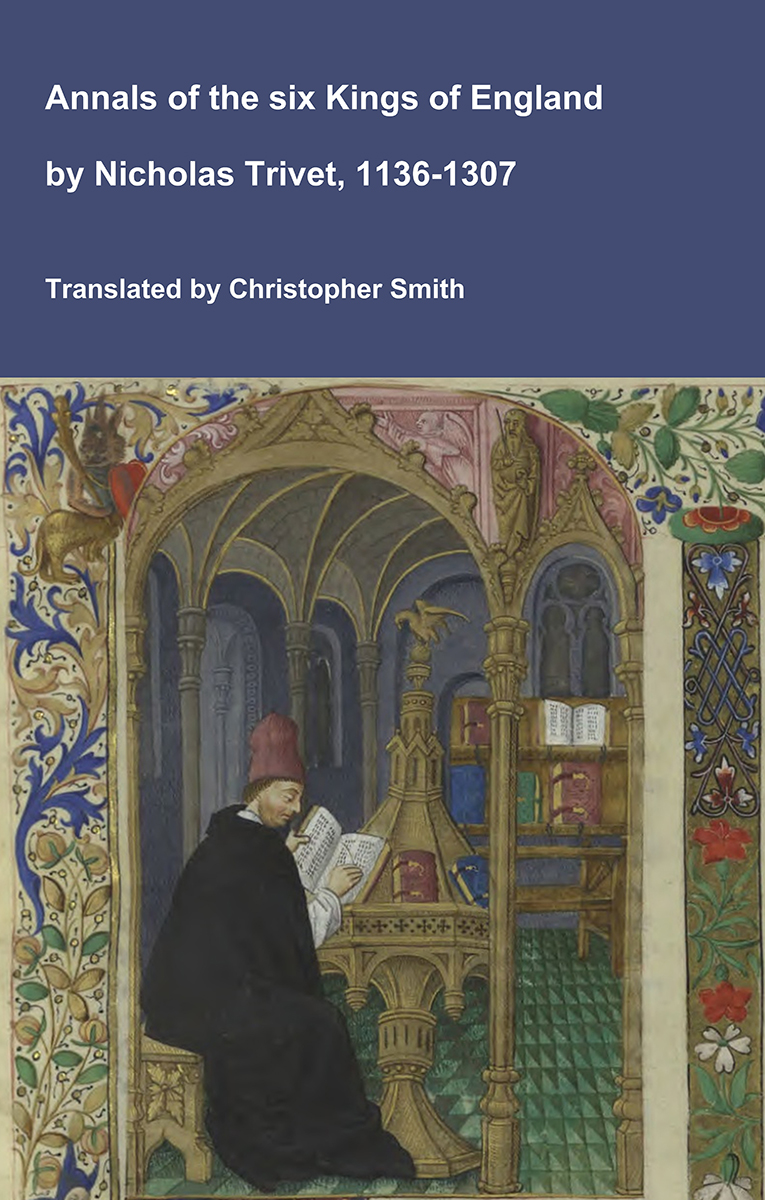
Annals of the six Kings of England by Nicholas Trivet
Translation of the Annals of the Six Kings of England by that traces the rise and rule of the Angevin aka Plantagenet dynasty from the mid-12th to early 14th century. Written by the Dominican scholar Nicholas Trivet, the work offers a vivid account of English history from the reign of King Stephen through to the death of King Edward I, blending political narrative with moral reflection. Covering the reigns of six monarchs—from Stephen to Edward I—the chronicle explores royal authority, rebellion, war, and the shifting balance between crown, church, and nobility. Trivet provides detailed insight into defining moments such as baronial conflicts, Anglo-French rivalry, and the consolidation of royal power under Edward I, whose reign he describes with particular immediacy. The Annals combines careful year-by-year reporting with thoughtful interpretation, presenting history not merely as a sequence of events but as a moral and political lesson. Ideal for readers interested in medieval history, kingship, and the origins of the English state, this chronicle remains a valuable and accessible window into the turbulent world of the Plantagenet kings.
Available at Amazon in eBook and Paperback format.
Boston Guardian 1915 Oct 16. Threekingham Family's Patriotism. The King's Appreciation. Captain W. A. Cragg, of Threekingham House, near Billingborough, has been honoured with a letter from the King expressing his Majesty's appreciation of the patriotic spirit which has prompted his four sons to give their services to the army and navy.
One of Captain Cragg's sons, [his son] Lieut. N. H. Cragg, R.N., has been killed in action, and another, Lieut. J. F. Cragg, has been wounded.