

Chronicle of Walter of Guisborough
A canon regular of the Augustinian Guisborough Priory, Yorkshire, formerly known as The Chronicle of Walter of Hemingburgh, describes the period from 1066 to 1346. Before 1274 the Chronicle is based on other works. Thereafter, the Chronicle is original, and a remarkable source for the events of the time. This book provides a translation of the Chronicle from that date. The Latin source for our translation is the 1849 work edited by Hans Claude Hamilton. Hamilton, in his preface, says: 'In the present work we behold perhaps one of the finest samples of our early chronicles, both as regards the value of the events recorded, and the correctness with which they are detailed; Nor will the pleasing style of composition be lightly passed over by those capable of seeing reflected from it the tokens of a vigorous and cultivated mind, and a favourable specimen of the learning and taste of the age in which it was framed.'
Available at Amazon in eBook and Paperback format.
Paternal Family Tree: Cavendish
On 10th April 1608 [his father] William Cavendish 2nd Earl Devonshire (age 18) and [his mother] Christian Bruce Countess Devonshire were married. He the son of [his grandfather] William Cavendish 1st Earl Devonshire (age 55) and [his grandmother] Anne Keighley (age 45).


On 30th May 1620 Charles Cavendish was born to [his father] William Cavendish 2nd Earl Devonshire (age 30) and [his mother] Christian Bruce Countess Devonshire.
On 3rd March 1626 [his grandfather] William Cavendish 1st Earl Devonshire (age 73) died. His son [his father] William (age 36) succeeded 2nd Earl Devonshire, 2nd Baron Cavendish Hardwick. [his mother] Christian Bruce Countess Devonshire by marriage Countess Devonshire. On 12th October 1616 Henry Cavendish died. Both were buried at St Peter's Church, Edensor [Map].
The monument was behind the altar in the original church but moved to a separate chapel in the new church.
Monument formed two bodies under a low four-poster with black Ionic columns and black covering slab. The monument has been attributed to Maximilian Colt (age 51).


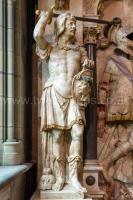


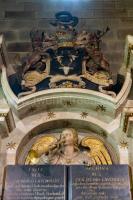
On 20th June 1628 [his father] William Cavendish 2nd Earl Devonshire (age 38) died at Devonshire House. He was buried at Derby Cathedral [Map]. His son [his brother] William (age 10) succeeded 3rd Earl Devonshire, 3rd Baron Cavendish Hardwick.


On 9th April 1632 [his brother-in-law] Robert Rich 3rd Earl Warwick (age 20) and [his sister] Anne Cavendish Countess Warwick (age 21) were married at Battersea, Surrey. She by marriage Countess Warwick. She the daughter of [his father] William Cavendish 2nd Earl Devonshire and [his mother] Christian Bruce Countess Devonshire. He the son of Robert Rich 2nd Earl Warwick (age 44) and Frances Hatton Countess Warwick.
In 1638 [his sister] Anne Cavendish Countess Warwick (age 27) died.
On 13th November 1638 [his brother] William Cavendish 3rd Earl Devonshire (age 21) was appointed Lord Lieutenant of Derbyshire in which position he remained until 22 Mar 1642.
On 4th March 1639 [his brother] William Cavendish 3rd Earl Devonshire (age 21) and [his sister-in-law] Elizabeth Cecil Countess Devonshire (age 20) were married. She by marriage Countess Devonshire. She the daughter of William Cecil 2nd Earl Salisbury (age 47) and Catherine Howard Countess Salisbury (age 49). He the son of [his father] William Cavendish 2nd Earl Devonshire and [his mother] Christian Bruce Countess Devonshire.
On 23rd October 1642 the Battle of Edge Hill was fought at Edge Hill [Map]. The Royal army was commanded by King Charles I of England, Scotland and Ireland (age 41) (with his son King Charles II of England Scotland and Ireland (age 12) present), Prince Rupert Palatinate Simmern 1st Duke Cumberland (age 22) and Richard Spencer (age 49) commanded the army that included Maurice Palatinate Simmern (age 21), Richard Byron 2nd Baron Byron (age 36), Lucius Carey 2nd Viscount Falkland (age 32), Charles Cavendish (age 22), Henry Newton aka Puckering 3rd Baronet (age 24), Spencer Compton 2nd Earl of Northampton (age 41), Thomas Salusbury 2nd Baronet (age 30), John Byron 1st Baron Byron (age 43) and William Feilding 1st Earl Denbigh (age 55).
George Stewart 9th Seigneur D'Aubigny (age 24) was killed.
Of the Parliamentary army Basil Feilding 2nd Earl Denbigh (age 34) and Robert Devereux 3rd Earl Essex (age 51). Oliver St John 5th Baron St John (age 39) was wounded.
Samuel Sandes (age 27) commanded a troop of horse.
Richard Sandes (age 26) was killed.
Thomas Strickland (age 20) was knighted on the field for his gallantry.
Henry Hunloke 1st Baronet (age 24) was knighted by King Charles I of England, Scotland and Ireland.
William Dugdale (age 37) witnessed the battle and subsequently surveyed the battlefield.
John Hinton (age 38) was present.
Edward Verney (age 52) was killed.
John Assheton (age 29) was killed.
Robert Bertie 1st Earl Lindsey (age 59) was killed. His son Montagu (age 34) succeeded 2nd Earl Lindsey, 15th Baron Willoughby de Eresby.
William Pennyman 1st Baronet (age 35) commanded a regiment, of which he served as Colonel, which he led for the King.
Edward Stradling 2nd Baronet (age 42) fought for the King, was captured imprisoned for seven months, and died a month after his release.
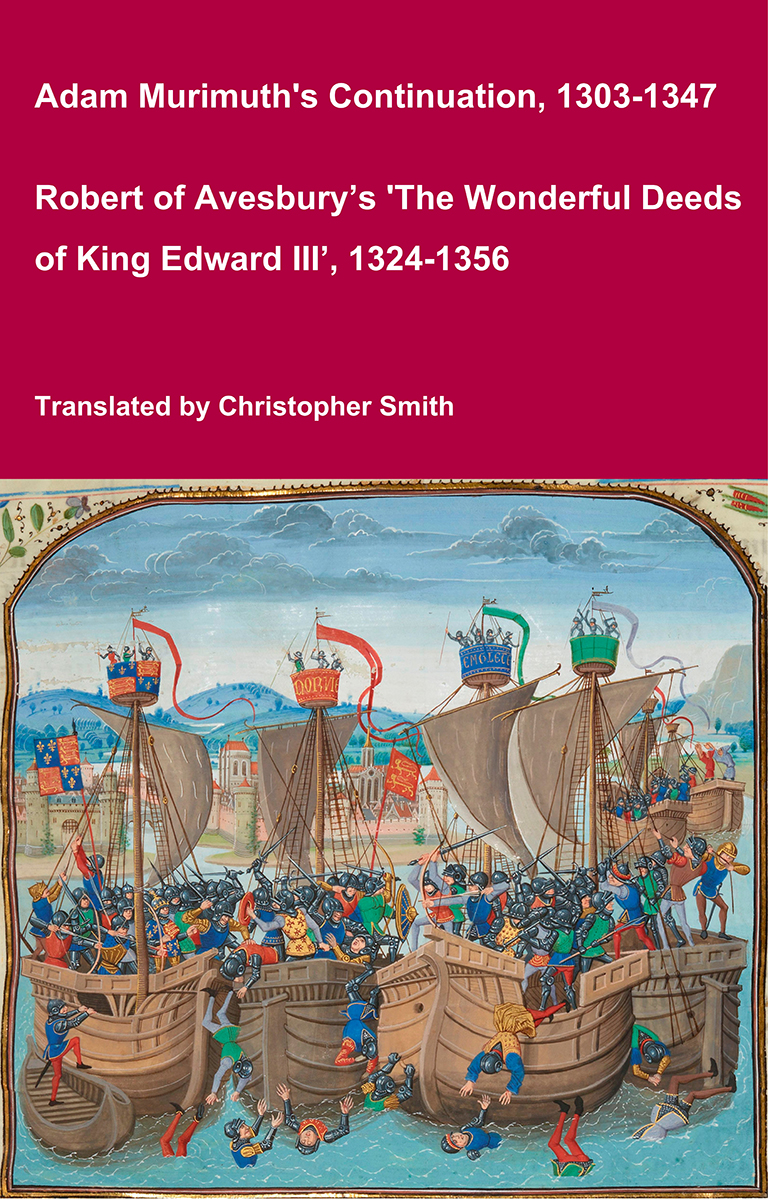
Adam Murimuth's Continuation and Robert of Avesbury’s 'The Wonderful Deeds of King Edward III'
This volume brings together two of the most important contemporary chronicles for the reign of Edward III and the opening phases of the Hundred Years’ War. Written in Latin by English clerical observers, these texts provide a vivid and authoritative window into the political, diplomatic, and military history of fourteenth-century England and its continental ambitions. Adam Murimuth Continuatio's Chronicarum continues an earlier chronicle into the mid-fourteenth century, offering concise but valuable notices on royal policy, foreign relations, and ecclesiastical affairs. Its annalistic structure makes it especially useful for establishing chronology and tracing the development of events year by year. Complementing it, Robert of Avesbury’s De gestis mirabilibus regis Edwardi tertii is a rich documentary chronicle preserving letters, treaties, and official records alongside narrative passages. It is an indispensable source for understanding Edward III’s claim to the French crown, the conduct of war, and the mechanisms of medieval diplomacy. Together, these works offer scholars, students, and enthusiasts a reliable and unembellished account of a transformative period in English and European history. Essential for anyone interested in medieval chronicles, the Hundred Years’ War, or the reign of Edward III.
Available at Amazon in eBook and Paperback format.
On 2nd July 1643 Charles Cavendish (age 23) received the Queen and escorted her to Oxford taking Burton-on-Trent on the way at Newark on Trent, Nottinghamshire [Map].

On 28th July 1643 the Parliamentary arms commanded by Oliver Cromwell (age 44) and the Royalist army commanded by Charles Cavendish (age 23) fought at the Battle of Gainsborough at North Scarle.
Charles Cavendish was killed by James Berry. He was buried at Newark on Trent, Nottinghamshire [Map].
On 4th August 1643 the Royalist Newdigate Poyntz (age 34) died probably from wounds received at the battle.
In 1675 Charles Cavendish was reburied at Derby Cathedral [Map].
Kings Wessex: Great x 18 Grand Son of King Edmund "Ironside" I of England
Kings Gwynedd: Great x 13 Grand Son of Owain "Great" King Gwynedd
Kings Seisyllwg: Great x 19 Grand Son of Hywel "Dda aka Good" King Seisyllwg King Deheubarth
Kings Powys: Great x 14 Grand Son of Maredudd ap Bleddyn King Powys
Kings England: Great x 10 Grand Son of King Edward I of England
Kings Scotland: Great x 17 Grand Son of King Duncan I of Scotland
Kings Franks: Great x 14 Grand Son of Louis VII King of the Franks
Kings France: Great x 17 Grand Son of Robert "Pious" II King of the Franks
Kings Duke Aquitaine: Great x 22 Grand Son of Ranulf I Duke Aquitaine
Great x 4 Grandfather: William Cavendish 
Great x 3 Grandfather: Thomas Cavendish
Great x 4 Grandmother: Joan Staventon
Great x 2 Grandfather: Thomas Cavendish 6 x Great Grand Son of King Edward I of England
Great x 4 Grandfather: John Scudamore
Great x 3 Grandmother: Catherine Scudamore 5 x Great Grand Daughter of King Edward I of England
Great x 4 Grandmother: Alys Mathrafal 4 x Great Grand Daughter of King Edward I of England
Great x 1 Grandfather: William Cavendish 7 x Great Grand Son of King Edward I of England
Great x 3 Grandfather: John Carrington Smith
Great x 2 Grandmother: Alice Smith
GrandFather: William Cavendish 1st Earl Devonshire 8 x Great Grand Son of King Edward I of England
Great x 3 Grandfather: John Harwick
Great x 2 Grandfather: John Hardwick 7 x Great Grand Son of King Edward I of England
Great x 4 Grandfather: Thomas Pinchbeck
Great x 3 Grandmother: Elizabeth Pinchbeck 6 x Great Grand Daughter of King Edward I of England
Great x 4 Grandmother: Anne Greene  5 x Great Grand Daughter of King Edward I of England
Great x 1 Grandmother: Bess of Hardwick Countess Shrewsbury and Waterford 8 x Great Grand Daughter of King Edward I of England
Great x 4 Grandfather: William Leeke of Lakeford
Great x 3 Grandfather: Thomas Leeke of Hasland 7 x Great Grand Son of King John of England
Great x 4 Grandmother: Catherine Chaworth  6 x Great Grand Daughter of King John of England
Great x 2 Grandmother: Elizabeth Leeke 8 x Great Grand Daughter of King John of England
Great x 4 Grandfather: William Vaux of Harrowden 
Great x 3 Grandmother: Margaret Vaux
Father: William Cavendish 2nd Earl Devonshire 9 x Great Grand Son of King Edward I of England
Great x 1 Grandfather: Henry Keighley
GrandMother: Anne Keighley
Charles Cavendish 10 x Great Grand Son of King Edward I of England
Great x 1 Grandfather: Edward Bruce
GrandFather: Edward Bruce 1st Lord Kinloss