

The History of William Marshal was commissioned by his son shortly after William’s death in 1219 to celebrate the Marshal’s remarkable life; it is an authentic, contemporary voice. The manuscript was discovered in 1861 by French historian Paul Meyer. Meyer published the manuscript in its original Anglo-French in 1891 in two books. This book is a line by line translation of the first of Meyer’s books; lines 1-10152. Book 1 of the History begins in 1139 and ends in 1194. It describes the events of the Anarchy, the role of William’s father John, John’s marriages, William’s childhood, his role as a hostage at the siege of Newbury, his injury and imprisonment in Poitou where he met Eleanor of Aquitaine and his life as a knight errant. It continues with the accusation against him of an improper relationship with Margaret, wife of Henry the Young King, his exile, and return, the death of Henry the Young King, the rebellion of Richard, the future King Richard I, war with France, the death of King Henry II, and the capture of King Richard, and the rebellion of John, the future King John. It ends with the release of King Richard and the death of John Marshal.
Available at Amazon in eBook and Paperback format.
Around 1640 Charles Harbord was born to [his father] Lieutenant Charles Harbord [aged 43].
John Evelyn's Diary. 4th June 1661. Came Sir Charles Harbord [aged 21], his Majesty's [aged 31] surveyor, to take an account of what grounds I challenged at Sayes Court [Map].
Samuel Pepys' Diary. 1st April 1662. Within all the morning and at the office. At noon my wife and I (having paid our maid Nell her whole wages, who has been with me half a year, and now goes away for altogether) to the Wardrobe, where my Lady and company had almost dined. We sat down and dined. Here was Mr. Herbert [aged 22], son to Sir Charles Herbert, that lately came with letters from my Lord Sandwich [aged 36] to the King [aged 31]. After some discourse we remembered one another to have been together at the tavern when Mr. Fanshaw took his leave of me at his going to Portugall with Sir Richard.


Samuel Pepys' Diary. 24th October 1665. I left him in discourse with Sir W. Batten [aged 64] and others, and myself to the office till about 10 at night and so, letters being done, I to him again to Captain Cocke's [aged 48], where he supped, and lies, and never saw him more merry, and here is Charles Herbert [aged 25], who the King [aged 35] hath lately knighted1. My Lord, to my great content, did tell me before them, that never anything was read to the King and Council, all the chief Ministers of State being there, as my letter about the Victualling was, and no more said upon it than a most thorough consent to every word was said, and directed, that it be pursued and practised. After much mirth, and my Lord having travelled all night last night, he to bed, and we all parted, I home.
Note 1. This person, erroneously called by Pepys Sir C. Herbert, will be best defined by subjoining the inscription on his monument in Westminster Abbey: "Sir Charles Harbord, Knight, third son of Sir Charles Harbord [aged 69], Knight, Surveyor-General, and First Lieutenant of the Royall James, under the most noble and illustrious Captaine, Edward, Earle of Sandwich, Vice-Admirall of England, which, after a terrible fight, maintained to admiration against a squadron of the Holland fleet, above six hours, neere the Suffolk coast, having put off two fireships; at last, being utterly disabled, and few of her men remaining unhurt, was, by a third, unfortunately set on fire. But he (though he swome well) neglected to save himselfe, as some did, and out of perfect love to that worthy Lord, whom, for many yeares, he had constantly accompanyed, in all his honourable employments, and in all the engagements of the former warre, dyed with him, at the age of xxxii., much bewailed by his father, whom he never offended; and much beloved by all for his knowne piety, vertue, loyalty, fortitude, and fidelity". B.
Samuel Pepys' Diary. 25th February 1666. Lord's Day. My wife up between three and four of the clock in the morning to dress herself, and I about five, and were all ready to take coach, she and I and Mercer, a little past five, but, to our trouble, the coach did not come till six. Then with our coach of four horses I hire on purpose, and Leshmore to ride by, we through the City to Branford [Map] and so to Windsor, Berkshire [Map], Captain Ferrers overtaking us at Kensington, being to go with us, and here drank, and so through, making no stay, to Cranborne, about eleven o'clock, and found my Lord and the ladies at a sermon in the house; which being ended we to them, and all the company glad to see us, and mighty merry to dinner. Here was my Lord, and Lord Hinchingbrooke [aged 18], and Mr. Sidney [aged 15], Sir Charles Herbert [aged 26], and Mr. Carteret [aged 25], my Baroness Carteret [aged 64], my Lady Jemimah, and Lady Slaning.
Samuel Pepys' Diary. 25th November 1668. Up, and by coach with W. Hewer [aged 26] to see W. Coventry [aged 40]; but he gone out, I to White Hall, and there waited on Lord Sandwich [aged 43], which I have little encouragement to do, because of the difficulty of seeing him, and the little he hath to say to me when I do see him, or to any body else, but his own idle people about him, Sir Charles Harbord [aged 28], &c.


Samuel Pepys' Diary. 18th January 1669. Up by candlelight, and with W. Hewer [aged 27] walked to the Temple [Map], and thence took coach and to Sir William Coventry's [aged 41], and there discoursed the business of my Treasurer's place, at Tangier, wherein he consents to my desire, and concurs therein, which I am glad of, that I may not be accountable for a man so far off. And so I to my Lord Sandwich's [aged 43], and there walk with him through the garden, to White Hall, where he tells me what he had done about this Treasurer's place, and I perceive the whole thing did proceed from him: that finding it would be best to have the Governor have nothing to do with the pay of the garrison, he did propose to the Duke of York [aged 35] alone that a pay-master should be there; and that being desirous to do a courtesy to Sir Charles Harbord [aged 29], and to prevent the Duke of York's looking out for any body else, he did name him to the Duke of York. That when he come the other day to move this to the Board of Tangier, the Duke of York, it seems, did readily reply, that it was fit to have Mr. Pepys satisfied therein first, and that it was not good to make places for persons. This my Lord in great confidence tells me, that he do take very ill from the Duke of York, though nobody knew the meaning of these words but him; and that he did take no notice of them, but bit his lip, being satisfied that the Duke of York's care of me was as desirable to him, as it could be to have Sir Charles Harbord: and did seem industrious to let me see that he was glad that the Duke of York and he might come to contend who shall be the kindest to me, which I owned as his great love, and so I hope and believe it is, though my Lord did go a little too far in this business, to move it so far, without consulting me. But I took no notice of that, but was glad to see this competition come about, that my Lord Sandwich is apparently jealous of my thinking that the Duke of York do mean me more kindness than him. So we walked together, and I took this occasion to invite him to dinner one day to my house, and he readily appointed Friday next, which I shall be glad to have over to his content, he having never yet eat a bit of my bread.
 Become a Member via our Buy Me a Coffee page to read more.
Samuel Pepys' Diary. 21st January 1669. Up, and walked to the Temple [Map], it being frosty, and there took coach, my boy Tom with me, and so to White Hall to a Committee of Tangier, where they met, and by and by and till twelve at noon upon business, among others mine, where my desire about being eased of appointing and standing accountable for a Treasurer there was well accepted, and they will think of some other way. This I was glad of, finding reason to doubt that I might in this (since my Lord Sandwich [aged 43] made me understand what he had said to the Duke of York [aged 35] herein) fear to offend either the Duke of York by denying it, for he seemed on Sunday night last, when I first made known my desire to him herein to be a little amused at it, though I knew not then the reason, or else offend my Lord Sandwich by accepting it, or denying it in a manner that might not forward his desire for Sir Charles Harbord [aged 29], but I thank God I did it to my great content without any offence, I think, to either.
Samuel Pepys' Diary. 23rd January 1669. So to the office, where all the morning till noon, when word brought me to the Board that my Lord Sandwich [aged 43] was come; so I presently rose, leaving the Board ready to rise, and there I found my Lord Sandwich, Peterborough, and Sir Charles Harbord [aged 29]; and presently after them comes my Lord Hinchingbrooke [aged 21], Mr. Sidney [aged 18], and Sir William Godolphin [aged 33]. And after greeting them, and some time spent in talk, dinner was brought up, one dish after another, but a dish at a time, but all so good; but, above all things, the variety of wines, and excellent of their kind, I had for them, and all in so good order, that they were mightily pleased, and myself full of content at it: and indeed it was, of a dinner of about six or eight dishes, as noble as any man need to have, I think; at least, all was done in the noblest manner that ever I had any, and I have rarely seen in my life better anywhere else, even at the Court.
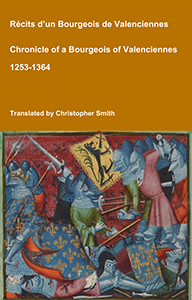
Chronicle of a Bourgeois of Valenciennes
Récits d’un bourgeois de Valenciennes aka The Chronicle of a Bourgeois of Valenciennes is a vivid 14th-century vernacular chronicle written by an anonymous urban chronicler from Valenciennes in the County of Hainaut. It survives in a manuscript that describes local and regional history from about 1253 to 1366, blending chronology, narrative episodes, and eyewitness-style accounts of political, military, and social events in medieval France, Flanders, and the Low Countries. The work begins with a chronological framework of events affecting Valenciennes and its region under rulers such as King Philip VI of France and the shifting allegiances of local nobility. It includes accounts of conflicts, sieges, diplomatic manoeuvres, and the impact of broader struggles like the Hundred Years’ War on urban life in Hainaut. Written from the perspective of a burgher (bourgeois) rather than a monastery or royal court, the chronicle offers a rare lay viewpoint on high politics and warfare, reflecting how merchants, townspeople, and civic institutions experienced the turbulence of the 13th and 14th centuries. Its narrative style combines straightforward reporting of events with moral and civic observations, making it a valuable source for readers interested in medieval urban society, regional politics, and the lived experience of war and governance in pre-modern Europe.
Available at Amazon in eBook and Paperback format.
Samuel Pepys' Diary. 2nd May 1669. Lord's Day. Up, and by water to White Hall, and there visit my Lord Sandwich [aged 43], who, after about two months' absence at Hinchingbroke [Map], come to town last night. I saw him, and very kind; and I am glad he is so, I having not wrote to him all the time, my eyes indeed not letting me. Here with Sir Charles Herbert [Harbord] [aged 29], and my Lord Hinchingbrooke [aged 21], and Sidney [aged 18], we looked upon the picture of Tangier, designed: by Charles Herbert [Harbord], and drawn by Dancre [aged 44], which my Lord Sandwich admires, as being the truest picture that ever he's saw in his life: and it is indeed very pretty, and I will be at the cost of having one of them.
Samuel Pepys' Diary. 12th May 1669. Up, and to Westminster Hall [Map], where the term is, and this the first day of my being there, and here by chance met Roger Pepys [aged 52], come to town the last night: I was glad to see him. After some talk with him and others, and among others Sir Charles Harbord [aged 29] and Sidney Montagu [aged 18], the latter of whom is to set out to-morrow towards Flanders and Italy, I invited them to dine with me to-morrow, and so to Mrs. Martin's lodging, who come to town last night, and there je did hazer her, she having been a month, I think, at Portsmouth, Hampshire [Map] with her husband, newly come home from the Streights. But, Lord! how silly the woman talks of her great entertainment there, and how all the gentry come to visit her, and that she believes her husband is worth £6 or £700, which nevertheless I am glad of, but I doubt they will spend it a fast.
Samuel Pepys' Diary. 13th May 1669. Up, and to the office, where all the morning, it being a rainy foul day. But at noon comes my Lord Hinchingbrooke [aged 21], and Sidney [aged 18], and Sir Charles Harbord [aged 29], and Roger Pepys [aged 52], and dined with me; and had a good dinner, and very merry with; us all the afternoon, it being a farewell to Sidney; and so in the evening they away, and I to my business at the Office and so to supper, and talk with my brother, and so to bed.
On 28th May 1672 Philip Carteret [aged 31] and Winston Churchill were killed at Solebay, Southwold [Map].
Edward Montagu 1st Earl Sandwich [aged 46] was killed. His son Edward [aged 24] succeeded 2nd Earl Sandwich.
George Legge 1st Baron Dartmouth [aged 25] fought.
Charles Harbord [aged 32] was killed. The inscription on his. Monument in Westminster Abbey [Map] reads... Sr. Charles Harbord Knt. his Majesties Surveyor General, and First Lieutenant of the Royall James, under the most noble and illustrious captain Edward, Earle of Sandwich, Vice Admirall of England, which after a terrible fight maintained to admiration against a squadron of the Holland fleet for above six houres, neere the Suffolk coast, having put off two fireships, at last being utterly dissabled and few of her men remaining unhurt, was by a third unfortunately set on fire: but he (though he swam well) neglected to save himselfe as some did, and out of the perfect love to that worthy lord (whom for many yeares he had constantly accompanyed in all his honourable imployments, and in all the engagements of the former warr) dyed with him at the age of XXXIII, much bewailed of his father whom he never offended, and much beloved of all for his knowne piety, vertue, loyalty, fortitude and fidelity.
Captain John Cox was killed in action.
Admiral John Holmes [aged 32] fought as commander of Rupert.
The Gloucester took part.
Become a Member via our Buy Me a Coffee page to read more.

John Evelyn's Diary. 31st May 1672. I received another command to repair to the seaside; so I went to Rochester, Kent [Map], where I found many wounded, sick, and prisoners, newly put on shore after the engagement on the 28th, in which the Earl of Sandwich [deceased], that incomparable person and my particular friend, and divers more whom I loved, were lost. My Lord (who was Admiral of the Blue) was in the "Prince", which was burnt, one of the best men-of-war that ever spread canvas on the sea. There were lost with this brave man, a son of Sir Charles Cotterell [aged 57] (Master of the Ceremonies), and a son [aged 32] of Sir Charles Harbord (his Majesty's [aged 42] Surveyor-General), two valiant and most accomplished youths, full of virtue and courage, who might have saved themselves; but chose to perish with my Lord, whom they honored and loved above their own lives.
John Evelyn's Diary. 1st October 1692. This season was so exceedingly cold, by reason of a long and tempestuous northeast wind, that this usually pleasant month was very uncomfortable. No fruit ripened kindly. Harbord [aged 52] dies at Belgrade; Lord Paget sent Ambassador in his room.