

Abbot John Whethamstede’s Chronicle of the Abbey of St Albans
Abbot John Whethamstede's Register aka Chronicle of his second term at the Abbey of St Albans, 1451-1461, is a remarkable text that describes his first-hand experience of the beginning of the Wars of the Roses including the First and Second Battles of St Albans, 1455 and 1461, respectively, their cause, and their consequences, not least on the Abbey itself. His text also includes Loveday, Blore Heath, Northampton, the Act of Accord, Wakefield, and Towton, and ends with the Coronation of King Edward IV. In addition to the events of the Wars of the Roses, Abbot John, or his scribes who wrote the Chronicle, include details in the life of the Abbey such as charters, letters, land exchanges, visits by legates, and disputes, which provide a rich insight into the day-to-day life of the Abbey, and the challenges faced by its Abbot.
Available at Amazon in eBook and Paperback format.
On 29th December 1615 Charles Scarburgh was born to [his father] Edmund Scarburgh at St Martin in the Fields Church [Map].
In 1660 Charles Scarburgh (age 44) was appointed physician to King Charles II of England Scotland and Ireland (age 29).


Samuel Pepys' Diary. 27th February 1663. After dinner Dr. Scarborough (age 47) took some of his friends, and I went along with them, to see the body alone, which we did, which was a lusty fellow, a seaman, that was hanged for a robbery. I did touch the dead body with my bare hand: it felt cold, but methought it was a very unpleasant sight. It seems one Dillon, of a great family, was, after much endeavours to have saved him, hanged with a silken halter this Sessions (of his own preparing), not for honour only, but it seems, it being soft and sleek, it do slip close and kills, that is, strangles presently: whereas, a stiff one do not come so close together, and so the party may live the longer before killed. But all the Doctors at table conclude, that there is no pain at all in hanging, for that it do stop the circulation of the blood; and so stops all sense and motion in an instant.
Samuel Pepys' Diary. 27th February 1663. Thence we went into a private room, where I perceive they prepare the bodies, and there were the kidneys, ureters [&c.], upon which he read to-day, and Dr. Scarborough (age 47) upon my desire and the company's did show very clearly the manner of the disease of the stone and the cutting and all other questions that I could think of... how the water [comes] into the bladder through the three skins or coats just as poor Dr. Jolly has heretofore told me.
In 1669 Charles Scarburgh (age 53) was knighted by King Charles II of England Scotland and Ireland (age 38).
John Evelyn's Diary. 21st May 1670. Came to visit me Mr. Henry Saville (age 28), and Sir Charles Scarborough (age 54).
In 1685 Charles Scarburgh (age 69) was elected MP Camelford.
On 6th February 1685 King Charles II of England Scotland and Ireland (age 54) died around midday the morning at Whitehall Palace [Map] attended by Charles Scarburgh (age 69). His brother James (age 51) succeeded II King England Scotland and Ireland. Duke York merged with the Crown. Mary of Modena Queen Consort England Scotland and Ireland (age 26) by marriage Queen Consort England Scotland and Ireland. His brother King James II of England Scotland and Ireland, William Chiffinch (age 83), Richard Mason (age 52) and Archbishop William Sancroft (age 68) were present.
The time of his death reported differtently by different contemporary sources: John Evelyn's Diary 'at halfe an houre after eleven in the morning', the Anonymous Letter to Reverend Roper: 'Yesterday noon', Ambassador Barillon's Account: 'and at noon, he died without any struggle or convulsion.' and Charl;es Scarburgh's Manuscript: 'He expired on February the Sixth soon after noon'.
According to Mark Bryant's book "Private Lives: Curious Facts about the Famous and Infamous' King Charles is supposed to have said the much repested phrase: "I am sorry, gentlemen, for being such a time a-dying." This doesn't appear to come from a contemporary source. Macaulay in his 'History of England', writing much later has "He apologised to those who had stood round him all night for the trouble which he had caused. He had been, he said, a most unconscionable time dying; but he hoped that they would excuse it." Perhaps the nearest we can find in a contemporary source is the Anonymous Letter to Reverend Roper: 'and beg the pardon of the standers by, and those that were employed about him, that he gave them so much trouble: that he hoped the work was almost over...'
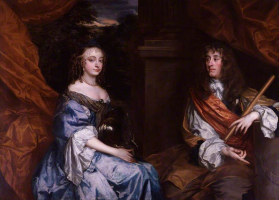


Before 26th February 1694 Charles Scarburgh (age 78) and Mary Daniell were married.
On 26th February 1694 Charles Scarburgh (age 78) died. He was buried at St Dunstan Church, Cranford where his wife [his wife] Mary Daniell commissioned a memorial.
John Evelyn's Diary. 10th March 1695. I dined at the Earl of Sunderland's (age 53) with Lord Spencer (age 19). My Lord showed me his library, now again improved by many books bought at the sale of Sir Charles Scarborough, an eminent physician, which was the very best collection, especially of mathematical books, that was I believe in Europe, once designed for the King's Library at St. James's; but the Queen dying, who was the great patroness of that design, it was let fall, and the books were miserably dissipated.

