

Jean de Waurin's Chronicle of England Volume 6 Books 3-6: The Wars of the Roses
Jean de Waurin was a French Chronicler, from the Artois region, who was born around 1400, and died around 1474. Waurin’s Chronicle of England, Volume 6, covering the period 1450 to 1471, from which we have selected and translated Chapters relating to the Wars of the Roses, provides a vivid, original, contemporary description of key events some of which he witnessed first-hand, some of which he was told by the key people involved with whom Waurin had a personal relationship.
Available at Amazon in eBook and Paperback format.

On 19th May 1818 [his father] Arthur Miller Rose (age 21) and [his mother] Susanna Rose nee Anderson (age 23) were married at St Leonard's Church, Shoreditch.
On 16th August 1820 Colonel William Anderson Rose was born to [his father] Arthur Miller Rose (age 23) and [his mother] Susanna Rose nee Anderson (age 25) at Shoreditch [Map].
In 1855 Colonel William Anderson Rose (age 34) was elected Sheriff of London.
In 1862 Colonel William Anderson Rose (age 41) was elected Lord Mayor of London.
In 1862 Colonel William Anderson Rose (age 41) was elected MP Southampton.
On 12th July 1864 [his father] Arthur Miller Rose (age 67) died.

Before 1866 Colonel William Anderson Rose (age 45) and Grace Charlotte Snow were married.
1867. Frederick Sandes (age 37). "[his wife] Grace Rose". Lady Grace Charlotte Rose was the daughter of Captain Winterton Snow of the Madras Army and the wife of Sir William Anderson Rose (age 46), whose portrait Frederick Sandys also painted, along with several other members of the family. The armorial shield and crest in the top right of this picture carries the Rose family motto: "Constant and true."
Grace Charlotte Snow: she was born to Captain Winterton Snow. Before 1866 Colonel William Anderson Rose and she were married.
In 1870 [his mother] Susanna Rose nee Anderson (age 75) died.
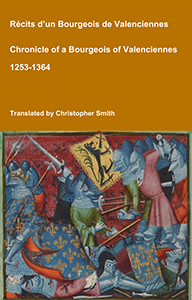
Chronicle of a Bourgeois of Valenciennes
Récits d’un bourgeois de Valenciennes aka The Chronicle of a Bourgeois of Valenciennes is a vivid 14th-century vernacular chronicle written by an anonymous urban chronicler from Valenciennes in the County of Hainaut. It survives in a manuscript that describes local and regional history from about 1253 to 1366, blending chronology, narrative episodes, and eyewitness-style accounts of political, military, and social events in medieval France, Flanders, and the Low Countries. The work begins with a chronological framework of events affecting Valenciennes and its region under rulers such as King Philip VI of France and the shifting allegiances of local nobility. It includes accounts of conflicts, sieges, diplomatic manoeuvres, and the impact of broader struggles like the Hundred Years’ War on urban life in Hainaut. Written from the perspective of a burgher (bourgeois) rather than a monastery or royal court, the chronicle offers a rare lay viewpoint on high politics and warfare, reflecting how merchants, townspeople, and civic institutions experienced the turbulence of the 13th and 14th centuries. Its narrative style combines straightforward reporting of events with moral and civic observations, making it a valuable source for readers interested in medieval urban society, regional politics, and the lived experience of war and governance in pre-modern Europe.
Available at Amazon in eBook and Paperback format.
On 16th November 1870 Colonel William Anderson Rose (age 50) was appointed Colonel of the Royal London Militia.
On 9th June 1881 Colonel William Anderson Rose (age 60) died.
1st July 1881. British Mail. Alderman Sir William Rose.
Colonel and Alderman Sir William Anderson Rose (deceased), one of the senior magistraies of the City of London, died very suddenly on Friday, the 10th ult., from heart disease, while driving from his residence in Upper Tooting to his place of business at Queenhithe. The deceased Alderman had been ailing for some time past, and had recently obtained leave of absence for six months from his magisterial and civic functions. on the imperative advice of his doctors, who had ordered him to one of the German spas. His tenacity for work kept him, however, to his duties to the very last, and he died on his way to his warehouse in the city. Sir William Rose was elected Alderman of the ward of Queenhithe on the death of Mr. Alderman Hooper in 1854, being then but thirty-four years of age, and in the following year, in the mayorality of Mr. Alderman Salomons, he served the office of Sheriff of London and Middlesex in conjunction with Mr. Alderman Kennedy. In 1863 he succeeded Mr. Alderman Cubitt, M.P., after the latter's mayorality of two vears, as Lord Mayor, and it fell to his duty to receive in the City of London the Princess Alexandra on her entry there prior to her marriage with the Prince of Wales; and later on to head the deputation which presented Her Royal Highness with the splendid wedding gift of the Corporation. From 1862 to 1865 he represented Southampton in the House of Commons in the Conservative interest, and in 1867 he received the honour of knighthood. For many years he was the Governor of the Irish Society, a body which controls the management of the extensive estates of the Corporation in Ireland, and from 1870 until last year, when he retired, he was the Colonel of the Royal Lo:adon Militia. He was sixty years of age.
GrandFather: James Rose
Father: Arthur Miller Rose
GrandFather: William Anderson
Mother: Susanna Rose nee Anderson