

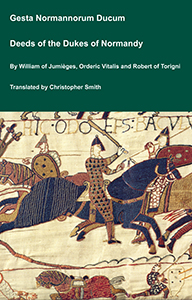
The Deeds of the Dukes of Normandy
The Gesta Normannorum Ducum [The Deeds of the Dukes of Normandy] is a landmark medieval chronicle tracing the rise and fall of the Norman dynasty from its early roots through the pivotal events surrounding the Norman Conquest of England. Originally penned in Latin by the monk William of Jumièges shortly before 1060 and later expanded at the behest of William the Conqueror, the work chronicles the deeds, politics, battles, and leadership of the Norman dukes, especially William’s own claim to the English throne. The narrative combines earlier historical sources with firsthand information and oral testimony to present an authoritative account of Normandy’s transformation from a Viking settlement into one of medieval Europe’s most powerful realms. William’s history emphasizes the legitimacy, military prowess, and governance of the Norman line, framing their expansion, including the conquest of England, as both divinely sanctioned and noble in purpose. Later chroniclers such as Orderic Vitalis and Robert of Torigni continued the history, extending the coverage into the 12th century, providing broader context on ducal rule and its impact. Today this classic work remains a foundational source for understanding Norman identity, medieval statesmanship, and the historical forces that reshaped England and Western Europe between 800AD and 1100AD.
Available at Amazon in eBook and Paperback format.
On 23rd January 1865 Constance MacDonald "Connie" Gilchrist Countess Orkney was born to [her father] David Gilchrist in Agar Town, London.

1872 to 1874. James Abbott McNeill Whistler (age 37). "Blue Girl". Model Connie Gilchrist (age 6).
In 1873 Constance MacDonald "Connie" Gilchrist Countess Orkney (age 7) performed at the Drury Lane Theatre playing the Prince of Mushrooms in a play entitled, Jack in the Box.

Around 1873. James Abbott McNeill Whistler (age 38). "Harmony in Yellow and Gold". Model Connie Gilchrist (age 7) performing her skipping rope stage act.

1875. Frederick Leighton 1st Baron Leighton (age 44). "Little Fatima". Model Connie Gilchrist (age 9).

1876. Frederick Leighton 1st Baron Leighton (age 45). "The Daphnephoria". The model for all five girls centre Connie Gilchrist (age 10).

Around 1876. Frederick Leighton 1st Baron Leighton (age 45). "Study: At a Reading Desk". Model Connie Gilchrist (age 10).

Frederick Leighton Biography. 1877. Frederick Leighton 1st Baron Leighton (age 46). "The Music Lesson". Model originally Connie Gilchrist (age 11) who was replaced by Isabella Helena "Lena" Pullen (age 4). See The Life, Letters and Work of Frederic Leighton.

Around 1878. Bassano Ltd. Photograph of Constance MacDonald "Connie" Gilchrist Countess Orkney (age 12).
Before 1882 George Henry Lowther 4th Earl Lonsdale (age 26) purchased a house for Connie Gilchrist (age 16) and other girls of the Gaiety Theatre.
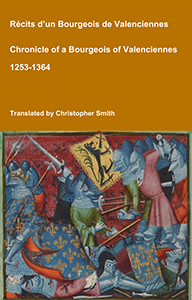
Chronicle of a Bourgeois of Valenciennes
Récits d’un bourgeois de Valenciennes aka The Chronicle of a Bourgeois of Valenciennes is a vivid 14th-century vernacular chronicle written by an anonymous urban chronicler from Valenciennes in the County of Hainaut. It survives in a manuscript that describes local and regional history from about 1253 to 1366, blending chronology, narrative episodes, and eyewitness-style accounts of political, military, and social events in medieval France, Flanders, and the Low Countries. The work begins with a chronological framework of events affecting Valenciennes and its region under rulers such as King Philip VI of France and the shifting allegiances of local nobility. It includes accounts of conflicts, sieges, diplomatic manoeuvres, and the impact of broader struggles like the Hundred Years’ War on urban life in Hainaut. Written from the perspective of a burgher (bourgeois) rather than a monastery or royal court, the chronicle offers a rare lay viewpoint on high politics and warfare, reflecting how merchants, townspeople, and civic institutions experienced the turbulence of the 13th and 14th centuries. Its narrative style combines straightforward reporting of events with moral and civic observations, making it a valuable source for readers interested in medieval urban society, regional politics, and the lived experience of war and governance in pre-modern Europe.
Available at Amazon in eBook and Paperback format.

On 8th February 1882 George Henry Lowther 4th Earl Lonsdale (age 26) died at a house in London he had purchased for Connie Gilchrist (age 17) and other girls of the Gaiety Theatre. He bequeathed the house, and a sizeable legacy, to Gilchrist. His brother Hugh (age 25) succeeded 5th Earl Lonsdale, 6th Viscount Lowther, 6th Baron Lowther. Grace Cecilie Gordon Countess Lonsdale (age 27) by marriage Countess Lonsdale.
On 21st October 1889 George FitzMaurice 6th Earl of Orkney (age 62) died. [her future husband] Edmond Fitzmaurice 7th Earl of Orkney (age 22) succeeded 7th Earl Orkney.
On 19th July 1892 Edmond Fitzmaurice 7th Earl of Orkney (age 25) and Constance MacDonald "Connie" Gilchrist Countess Orkney (age 27) were married.
On 9th May 1946 Constance MacDonald "Connie" Gilchrist Countess Orkney (age 81) died at his her Tythe House, Stewkley.
On 21st August 1951 [her former husband] Edmond Fitzmaurice 7th Earl of Orkney (age 84) died.
Frederick Leighton Biography. Meanwhile four of these beautiful children became useful to him as models. From the second daughter [Edith Ellen Pullen], who afterwards married an artist, Leighton painted "Memories," reproduced here; from the third, Hetty, he painted "Simœtha the Sorceress" and "Farewell"; but it was the youngest, Lina, quite a small child, who delighted him most, and who had a rare, refined charm which must have captivated any child-lover. She took the place of little Connie Gilchrist of the "Cleobouline," the "Music Lesson," and other of the earlier paintings, in the later pictures. She sat for "Sister's Kiss," "The Light of the Harem," "Letty," the sleeping group in "Cymon and Iphigenia," "Kittens," in the friezes "The Dance" and "Music," and "A little girl with golden hair and pale blue eyes" -
"Yellow and pale as ripened corn
Which Autumn's kiss frees—grain from sheath
Such was her hair, while her eyes beneath,
Showed Spring's faint violets freshly born."
Robert Browning.