

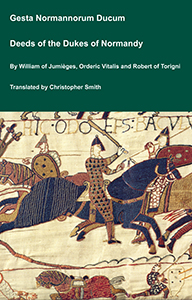
The Deeds of the Dukes of Normandy
The Gesta Normannorum Ducum [The Deeds of the Dukes of Normandy] is a landmark medieval chronicle tracing the rise and fall of the Norman dynasty from its early roots through the pivotal events surrounding the Norman Conquest of England. Originally penned in Latin by the monk William of Jumièges shortly before 1060 and later expanded at the behest of William the Conqueror, the work chronicles the deeds, politics, battles, and leadership of the Norman dukes, especially William’s own claim to the English throne. The narrative combines earlier historical sources with firsthand information and oral testimony to present an authoritative account of Normandy’s transformation from a Viking settlement into one of medieval Europe’s most powerful realms. William’s history emphasizes the legitimacy, military prowess, and governance of the Norman line, framing their expansion, including the conquest of England, as both divinely sanctioned and noble in purpose. Later chroniclers such as Orderic Vitalis and Robert of Torigni continued the history, extending the coverage into the 12th century, providing broader context on ducal rule and its impact. Today this classic work remains a foundational source for understanding Norman identity, medieval statesmanship, and the historical forces that reshaped England and Western Europe between 800AD and 1100AD.
Available at Amazon in eBook and Paperback format.
Paternal Family Tree: Bedingfield

Around 1467 [his uncle] Edmund Bedingfield (age 17) and [his step-mother] Alice Shelton were married.
Around 1470 [his uncle] Edmund Bedingfield (age 20) and [his mother] Margaret Scott (age 17) were married.
Around 1479 Edmund Bedingfield was born to [his uncle] Edmund Bedingfield (age 29) and [his mother] Margaret Scott (age 26).
On 15th October 1496 [his uncle] Edmund Bedingfield (age 46) died.
Before 1509 Edmund Bedingfield (age 29) and Grace Marney (age 21) were married.
Around 1509 [his son] Henry Bedingfield was born to Edmund Bedingfield (age 30).
On 29th January 1514 [his mother] Margaret Scott (age 61) died.
Testamenta Vetusta Volume 2. [his brother-in-law] John Lord Marney (age 41).
John Marney, Knt. Lord Marney, of Marney, in the County of Essex, 10th March, 1524 [1525]. My body to be buried in the new aisle on the North side of the Parish Church of Leyr Marney [Map], in the midst of the said aisle, directly against the midst of the said new Chapel, six feet from the partition betwixt the Chapel and aisle, in a vault of brick, so large that two bodies may be laid therein; over the which vault I will that a tomb shall be set, and made of such stone as my father's tomb was made, if it can be gotten, else of grey marble, and to be eight feet in length and five in breadth, and four feet high, to be wrought in like sort as my father's tomb, except the vault above and the arms about the tomb, which I will be changed according to the direction of the Herald; also I will that about the said tomb there shall be made a grate of wainscot, and at every corner thereof a principal pillar, with a white lybard upon the top thereof, and upon it an image of myself, like unto that upon my father's tomb, and pourtrayed in coat armour, with my helmet and crest at the head, and a white leopard at the feet, and on either side of my image one image of brass for each of my two wives, Dame Christian and Dame Bridget (age 35), with their coat armours; also I will that at the West end thereof there shall be an altar whereat a priest to sing for me perpetually; whereas I am sole executor to Sir Roger Newburgh, who willed that all his cattle unbequeathed to me and my wife, should be divided betwixt John Pytt, Henry Combe, and John Doble, by the discretion of me and my wife Christian his daughter; Katherine (age 10) and Elizabeth my daughters; I will that Dame Bridget my wife have £100 in plate, with remainder to my brother Sir Edmund Bedingfield (age 46) and my sister Dame [his wife] Grace (age 38) his wife: my brother Thomas Bonham (age 43), Esquire, and my sister [his sister-in-law] Katherine (age 55) his wife; I bequeath £200 sterling towards the new building of the Church at Leyr Marney, and I will that my executors find an honest priest to pray for me and those after named, within that parish Church for ever; as also to say mass at my chauntry altar at the end of my tomb, and there to pray for my soul and for the souls of Sir [his father-in-law] Henry Marney late Lord Marney my father, of Dame Thomazine my mother, and also for the souls of my wives Dame Bridget, Dame Christian, and Amy Marney, and for the soul of my brother Thomas Marney. And I constitute Sir Robert Dymock (age 64), Chancellor to the Queen's Grace, Sir William Walgrave (age 60), Knight, and Sir Roger Wentworth (age 65), Knight, Overseers of this my will. Proved 28th January 1523.
 Become a Member via our Buy Me a Coffee page to read more.
Letters and Papers. 7th January 1536. R. O. St. P. I. 452. 37. Sir Edward Chamberleyn (age 52) and Sir Edm. Bedyngfeld (age 57) to Cromwell (age 51).
This 7th Jan., about 10 a.m., the Lady Dowager (age 50) was annealed with the Holy ointment, Chamberleyn and Bedyngfeld being summoned, and before 2 p.m. she died. Wishes1 to know the King's (age 44) pleasure concerning the house, servants, and other things. The groom of the Chamber here can cere her. Will send for a plumber to close the body in lead.
Note 1. The letter, though signed by two, is written throughout in the first person singular,— apparently by Bedingfield, who was steward of Catharine's household, though he signs second.


Letters and Papers. After 7th January 1536. Jan. Otho. C. x. 219b. B. M. 41. [Sir Edmund Bedyngfeld (age 57)] to Cromwell.
The bowelling and cering is already done in the best manner. The leading and chesting is prepared for, and shall be finished with all speed. We are glad of the coming of the Comptroller hither by the King's commandment to order all things for the interring, which is directed to be at Peterborough.
To the best of our power we have commanded the safe custody of the gates so that nothing can issue. The persons who had the custo[dy of her] jewels, plate, and apparel, have given us a just and plain declaration, containing much more than [we could] see or know before. Will do all we can for the entertainment of such personages of honour as repair hither by commandment. [We have] declared to the servants how good and [gracious] master you have been in obtaining the King's favour towa[rds them. They are] greatly comforted with his gracious pro[mise]. "Further[more as for] the preparation of the house, it shall be d[one] . . . . and likewise the prelates and priests s . . . . . repair for the execution of all manner c[eremonies ap]pertaining for the funerals and a . . . [acco]rding to your mastership's command."
P. 1. Mutilated.
On 9th August 1552 Edmund Bedingfield (age 73) died.
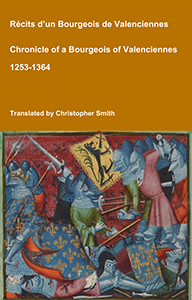
Chronicle of a Bourgeois of Valenciennes
Récits d’un bourgeois de Valenciennes aka The Chronicle of a Bourgeois of Valenciennes is a vivid 14th-century vernacular chronicle written by an anonymous urban chronicler from Valenciennes in the County of Hainaut. It survives in a manuscript that describes local and regional history from about 1253 to 1366, blending chronology, narrative episodes, and eyewitness-style accounts of political, military, and social events in medieval France, Flanders, and the Low Countries. The work begins with a chronological framework of events affecting Valenciennes and its region under rulers such as King Philip VI of France and the shifting allegiances of local nobility. It includes accounts of conflicts, sieges, diplomatic manoeuvres, and the impact of broader struggles like the Hundred Years’ War on urban life in Hainaut. Written from the perspective of a burgher (bourgeois) rather than a monastery or royal court, the chronicle offers a rare lay viewpoint on high politics and warfare, reflecting how merchants, townspeople, and civic institutions experienced the turbulence of the 13th and 14th centuries. Its narrative style combines straightforward reporting of events with moral and civic observations, making it a valuable source for readers interested in medieval urban society, regional politics, and the lived experience of war and governance in pre-modern Europe.
Available at Amazon in eBook and Paperback format.
In or after 1553 [his former wife] Grace Marney (deceased) died.
GrandFather: Thomas Bedingfield
Father: Edmund Bedingfield
Great x 1 Grandfather: William Scott 
GrandFather: John Scott
Mother: Margaret Scott
Great x 1 Grandfather: William Beaufitz of The Grange in Gillingham in Kent
GrandMother: Agnes Beaufitz