

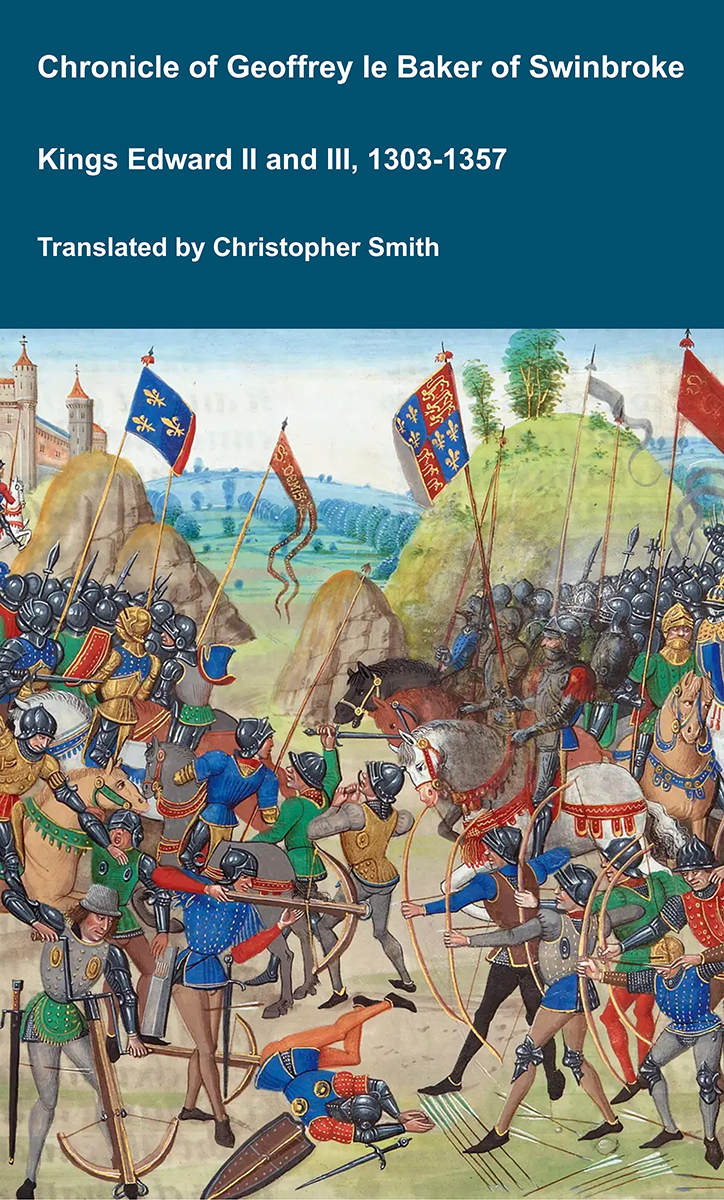
Chronicle of Geoffrey le Baker of Swinbroke
Baker was a secular clerk from Swinbroke, now Swinbrook, an Oxfordshire village two miles east of Burford. His Chronicle describes the events of the period 1303-1356: Gaveston, Bannockburn, Boroughbridge, the murder of King Edward II, the Scottish Wars, Sluys, Crécy, the Black Death, Winchelsea and Poitiers. To quote Herbert Bruce 'it possesses a vigorous and characteristic style, and its value for particular events between 1303 and 1356 has been recognised by its editor and by subsequent writers'. The book provides remarkable detail about the events it describes. Baker's text has been augmented with hundreds of notes, including extracts from other contemporary chronicles, such as the Annales Londonienses, Annales Paulini, Murimuth, Lanercost, Avesbury, Guisborough and Froissart to enrich the reader's understanding. The translation takes as its source the 'Chronicon Galfridi le Baker de Swynebroke' published in 1889, edited by Edward Maunde Thompson.
Available at Amazon in eBook and Paperback format.
On 12th April 1696 Henry Bourchier Fane [aged 27] was killed in a duel by Elizeus Burges at Leicester Fields Leicester Square.
On 19th May 1696 Elizeus Burges, along with several other persons of distinction, became involved in a frivolous, rash and accidental quarrel at the bar of the Rose Tavern, a notorious haunt of gamblers and ruffians in Russell Street, Covent Garden. He ended up killing a well-known comic actor, named Hildebrand Horden, from the Playhouse. With his companions, he was arrested for manslaughter and committed to the Gatehouse Gaol in Westminster. A week later, there was an organised gaol-break and Burges escaped. By the end of November 1697, he had obtained the King’s pardon. His accomplices stood trial at the Old Bailey but were acquitted.

In 1705, Elizeus Burges was made adjutant-general – the chief administrative officer – to Charles Mordaunt 3rd Earl Peterborough 1st Earl Monmouth [aged 47].
In correspondence dated 15th February 1715, Jeremiah Dummer wrote, "I am taking all the pains I can to prevent the new Governor’s [Elizeus Burges] voyage, and continue the old one in his post", but the commission was finalized on 17th March. However, Burges never did cross the Atlantic. He resigned his American commission in the April, apparently because Dummer had managed to raise £1,000 to pay him off; and Dummer never did revealed the full extent of what he knew of Burges’ more shameful activities.
In May 1719 Elizeus Burges was appointed English 'Resident' in the Republic of Venice, a post similar to an ambassador, but with less prestige. This was the start of a period of decline for the Republic after the Turkish-Venetian War. Burges stayed there for two-and-a-half years before being recalled to England by Lard Carteret around September 1721.
In 1727 Elizeus Burges was again appointed English 'Resident' in the Republic of Venice, leaving England in the following March.
On 14th November 1736 Elizeus Burges died in Venice.