

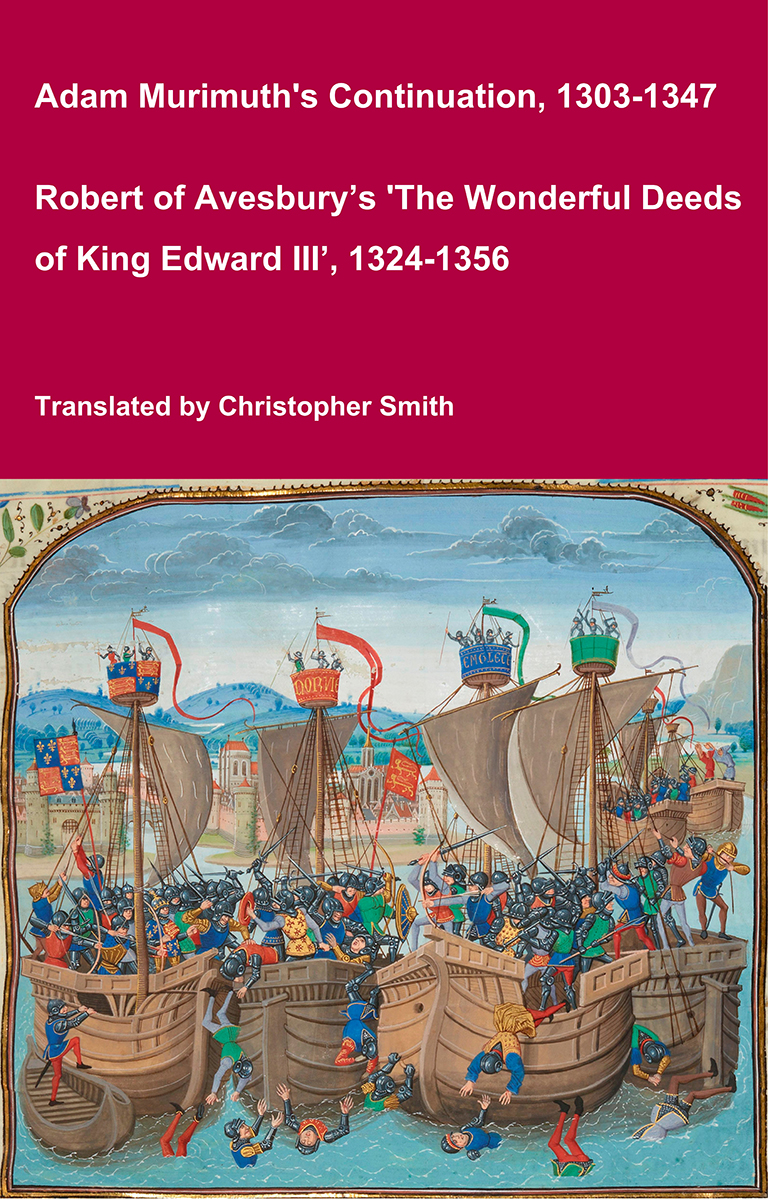
Adam Murimuth's Continuation and Robert of Avesbury’s 'The Wonderful Deeds of King Edward III'
This volume brings together two of the most important contemporary chronicles for the reign of Edward III and the opening phases of the Hundred Years’ War. Written in Latin by English clerical observers, these texts provide a vivid and authoritative window into the political, diplomatic, and military history of fourteenth-century England and its continental ambitions. Adam Murimuth Continuatio's Chronicarum continues an earlier chronicle into the mid-fourteenth century, offering concise but valuable notices on royal policy, foreign relations, and ecclesiastical affairs. Its annalistic structure makes it especially useful for establishing chronology and tracing the development of events year by year. Complementing it, Robert of Avesbury’s De gestis mirabilibus regis Edwardi tertii is a rich documentary chronicle preserving letters, treaties, and official records alongside narrative passages. It is an indispensable source for understanding Edward III’s claim to the French crown, the conduct of war, and the mechanisms of medieval diplomacy. Together, these works offer scholars, students, and enthusiasts a reliable and unembellished account of a transformative period in English and European history. Essential for anyone interested in medieval chronicles, the Hundred Years’ War, or the reign of Edward III.
Available at Amazon in eBook and Paperback format.
Around February 1811 Ellen Turner was born to [her father] William Turner of Pott Shrigley.
In 1816 [her future husband] Edward Gibbon Wakefield (age 19) and Eliza Pattle (age 16) were married. She died four years later. He, thereafter, lived off her fortune in Paris.
On 14th May 1826 [her future husband] Edward Gibbon Wakefield (age 29) and his brother William were found guilty of abduction and both were sentenced to three years in prison. Edward's marriage to Ellen Turner (age 15) was annulled by Act of Parliament.
On 7th March 1827 Ellen Turner (age 16) was abducted from Margaret Daulby's elite boarding school for girls in Liverpool by, Edward Thevenot, a servant of Edward Gibbon Wakefield (age 30). Edward Gibbon Wakefield and Ellen Turner were married at Gretna Green, Dumfrieshire, she believing she was marrying to protect her father from financial ruin. After the marriage they set out for France, another jurisdiction, where he intended they settle as man and wife. He was subsequently arrested, tried and imprisoned.
On 14th January 1828 Thomas Legh (age 35) and Ellen Turner (age 16) were married.
On 20th February 1830 [her daughter] Ellen Jane Legh was born to [her husband] Thomas Legh (age 37) and Ellen Turner (age 19). She married 22nd January 1847 Reverend Brabazon Lowther.
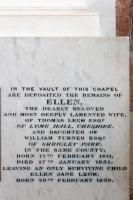
On 17th January 1831 Ellen Turner (age 19) died from childbirth at Lyme Hall, Cheshire [Map].
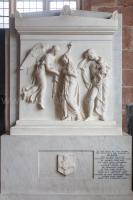
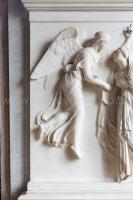
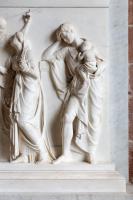
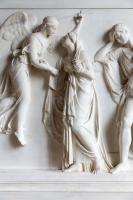
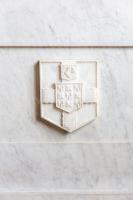
On 27th January 1831 Ellen Turner (deceased) was buried at St Oswald's Church, Winwick [Map]. The service was performed by Reverend Thomas Hinde. Monument sculpted by Richard James Wyatt (age 35).
On 3rd October 1843 [her former husband] Thomas Legh (age 50) and Maud Lowther were married.

On 8th May 1857 [her former husband] Thomas Legh (age 64) died at Milford Lodge, Lymington. His nephew William John Legh 1st Baron Newton (age 28) inherited his estates including Lyme Hall, Cheshire [Map].