

Abbot John Whethamstede’s Chronicle of the Abbey of St Albans
Abbot John Whethamstede's Register aka Chronicle of his second term at the Abbey of St Albans, 1451-1461, is a remarkable text that describes his first-hand experience of the beginning of the Wars of the Roses including the First and Second Battles of St Albans, 1455 and 1461, respectively, their cause, and their consequences, not least on the Abbey itself. His text also includes Loveday, Blore Heath, Northampton, the Act of Accord, Wakefield, and Towton, and ends with the Coronation of King Edward IV. In addition to the events of the Wars of the Roses, Abbot John, or his scribes who wrote the Chronicle, include details in the life of the Abbey such as charters, letters, land exchanges, visits by legates, and disputes, which provide a rich insight into the day-to-day life of the Abbey, and the challenges faced by its Abbot.
Available at Amazon in eBook and Paperback format.
In 1782 Frederick Nash was born.
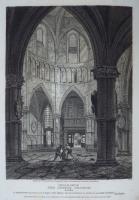
1805. Frederick Nash (age 23). "View of the Circular part of Temple Church, London [Map]".
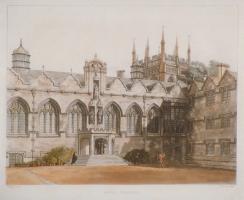
Around 1813. Frederick Nash (age 31). "Oriel College, Oxford University.
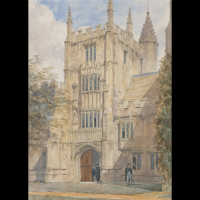
1813. Frederick Nash (age 31). "Founders Tower, Magdalen College.
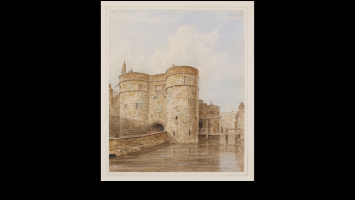
Around 1821. Frederick Nash (age 39). "Byward Tower, Tower of London [Map]".
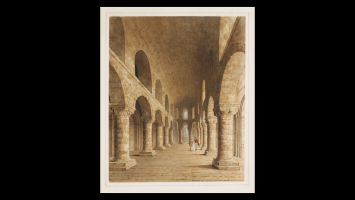
Around 1821. Frederick Nash (age 39). "Chapel in the White Tower [Map]".
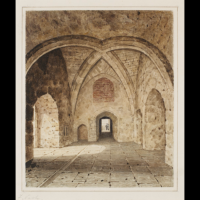
Around 1821. Frederick Nash (age 39). "Bowyer Tower, Tower of London [Map].
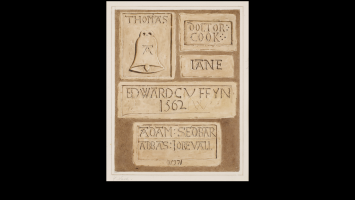
Around 1821. Frederick Nash (age 39). "Inscriptions in the Prison Room, Beauchamp Tower, Tower of London [Map].
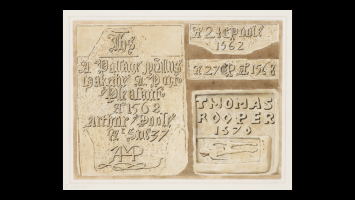
Around 1821. Frederick Nash (age 39). "Inscriptions in the Prison Room, Beauchamp Tower, Tower of London [Map].
William of Worcester's Chronicle of England
William of Worcester, born around 1415, and died around 1482 was secretary to John Fastolf, the renowned soldier of the Hundred Years War, during which time he collected documents, letters, and wrote a record of events. Following their return to England in 1440 William was witness to major events. Twice in his chronicle he uses the first person: 1. when writing about the murder of Thomas, 7th Baron Scales, in 1460, he writes '… and I saw him lying naked in the cemetery near the porch of the church of St. Mary Overie in Southwark …' and 2. describing King Edward IV's entry into London in 1461 he writes '… proclaimed that all the people themselves were to recognize and acknowledge Edward as king. I was present and heard this, and immediately went down with them into the city'. William’s Chronicle is rich in detail. It is the source of much information about the Wars of the Roses, including the term 'Diabolical Marriage' to describe the marriage of Queen Elizabeth Woodville’s brother John’s marriage to Katherine, Dowager Duchess of Norfolk, he aged twenty, she sixty-five or more, and the story about a paper crown being placed in mockery on the severed head of Richard, 3rd Duke of York.
Available at Amazon in eBook and Paperback format.
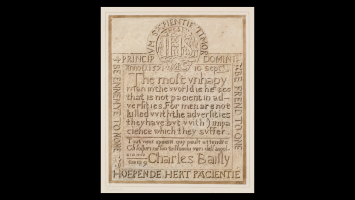
Around 1821. Frederick Nash (age 39). "Inscriptions in the Prison Room, Beauchamp Tower, Tower of London [Map].
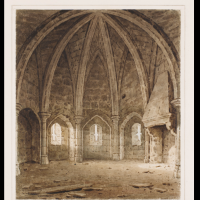
Around 1821. Frederick Nash (age 39). "Inside the Byward Tower, Tower of London [Map].
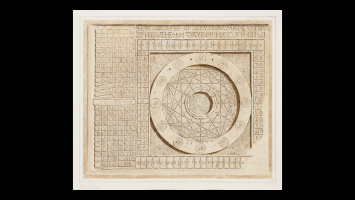
Around 1821. Frederick Nash (age 39). "Inscription inside the Salt Tower, Tower of London [Map].
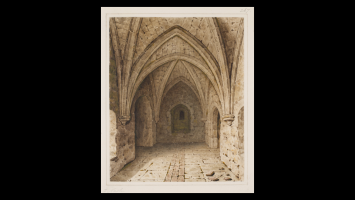
Around 1821. Frederick Nash (age 39). "Inside the Well Tower, Tower of London [Map].

Around 1821. Frederick Nash (age 39). "Inscriptions in Prison Room, Beauchamp Tower, Tower of London [Map]", probably by John Dudley 1st Duke Northumberland.
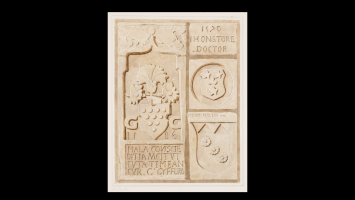
Around 1821. Frederick Nash (age 39). "Inscriptions in Prison Room, Beauchamp Tower, Tower of London [Map]".

Around 1821. Frederick Nash (age 39). "Entrance under the Bloody Tower, Tower of London [Map]".
6th March 1821. Frederick Nash (age 39). "Bloody Tower, Tower of London [Map].
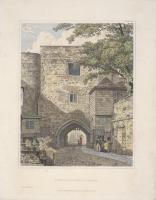
28th May 1821. Frederick Nash (age 39). "View of the Bloody Tower, Tower of London [Map]".

1822. Frederick Nash (age 40). "View of Berry Pomeroy Castle [Map]".
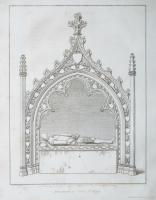
1822. Frederick Nash (age 40). "Monument at St Mary's Church, Ottery St Mary".
William of Worcester's Chronicle of England
William of Worcester, born around 1415, and died around 1482 was secretary to John Fastolf, the renowned soldier of the Hundred Years War, during which time he collected documents, letters, and wrote a record of events. Following their return to England in 1440 William was witness to major events. Twice in his chronicle he uses the first person: 1. when writing about the murder of Thomas, 7th Baron Scales, in 1460, he writes '… and I saw him lying naked in the cemetery near the porch of the church of St. Mary Overie in Southwark …' and 2. describing King Edward IV's entry into London in 1461 he writes '… proclaimed that all the people themselves were to recognize and acknowledge Edward as king. I was present and heard this, and immediately went down with them into the city'. William’s Chronicle is rich in detail. It is the source of much information about the Wars of the Roses, including the term 'Diabolical Marriage' to describe the marriage of Queen Elizabeth Woodville’s brother John’s marriage to Katherine, Dowager Duchess of Norfolk, he aged twenty, she sixty-five or more, and the story about a paper crown being placed in mockery on the severed head of Richard, 3rd Duke of York.
Available at Amazon in eBook and Paperback format.
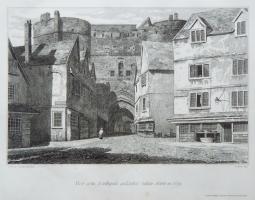
1822. Frederick Nash (age 40). "View of the Southgate at Exeter, taken down in 1819".
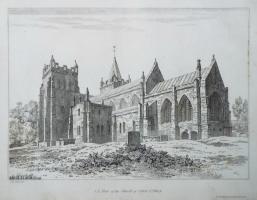
1822. Frederick Nash (age 40). "St Mary's Church, Ottery St Mary".
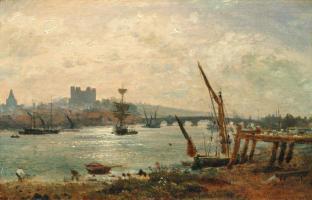
Around 1825. Frederick Nash (age 43). "Rochester Cathedral [Map] and Castle [Map].
1829. Frederick Nash (age 47). View of the Ruins adjoining the South Transept of the Church [St Mary's Abbey, York [Map]], with the Palace of K. James 2nd and the Tower of the Minster in the Back Ground.".

Before 1856. Frederick Nash (age 73). "Interior of Chapter House, Salisbury Cathedral [Map]".

Before 1856. Frederick Nash (age 73). "The Choir of Salisbury Cathedral [Map]".
In 1856 Frederick Nash (age 74) died.