

Chronicle of Walter of Guisborough
A canon regular of the Augustinian Guisborough Priory, Yorkshire, formerly known as The Chronicle of Walter of Hemingburgh, describes the period from 1066 to 1346. Before 1274 the Chronicle is based on other works. Thereafter, the Chronicle is original, and a remarkable source for the events of the time. This book provides a translation of the Chronicle from that date. The Latin source for our translation is the 1849 work edited by Hans Claude Hamilton. Hamilton, in his preface, says: 'In the present work we behold perhaps one of the finest samples of our early chronicles, both as regards the value of the events recorded, and the correctness with which they are detailed; Nor will the pleasing style of composition be lightly passed over by those capable of seeing reflected from it the tokens of a vigorous and cultivated mind, and a favourable specimen of the learning and taste of the age in which it was framed.'
Available at Amazon in eBook and Paperback format.
Paternal Family Tree: Villiers
Maternal Family Tree: Anne Armstrong 1544
 George Villiers 1st Duke of Buckingham 1592 1628 Arms.George Villiers 1st Duke of Buckingham. Top Row: 1
  Villiers Arms differenced with a martlet 2
  Manners Arms 3
  Ros Arms 4 Unknown 5 Unknown 6
  Beauchamp Arms 7
  Beaumont Arms 8
  Berkeley Arms 9
  Lisle Arms 10 Unknown 11
  Wake Arms 12 Villiers Arms differenced with a martlet. Source.
Before 1587 [his father] George Villiers of Brokesby [aged 42] and Audrey Saunders [aged 35] were married.
After 1590 [his father] George Villiers of Brokesby [aged 46] and Mary Beaumont 1st Countess Buckingham [aged 20] were married. Some sources describe their relationship as being half-first cousin? His mother Collette Clarke was first married to her uncle Richard Beaumont so there is no relationship between George Villiers of Brokesby and Mary Beaumont 1st Countess Buckingham. The difference in their ages was 26 years.
On 28th August 1592 George Villiers 1st Duke of Buckingham was born to [his father] George Villiers of Brokesby [aged 48] and [his mother] Mary Beaumont 1st Countess Buckingham [aged 22] at Brooksby, Leicestershire.
In 1606 [his brother-in-law] William Feilding 1st Earl Denbigh [aged 19] and [his sister] Susan Villiers Countess Denbigh [aged 23] were married. She the daughter of [his father] George Villiers of Brokesby [aged 62] and [his mother] Mary Beaumont 1st Countess Buckingham [aged 36].

After 1606 Thomas Compton and [his mother] Mary Beaumont 1st Countess Buckingham [aged 36] were married. He the son of Henry Compton 1st Baron Compton and Anne Spencer Countess Dorset. They were half fifth cousin once removed.
On 4th January 1606 [his father] George Villiers of Brokesby [aged 62] died. He was buried at the Chapel of St Nicholas, Westminster Abbey [Map].
In August 1614 George Villiers 1st Duke of Buckingham [aged 21] caught the eye of King James I of England and Ireland and VI of Scotland [aged 48] at hunt at Apethorpe, Northamptonshire. Opponents of the king's favourite Robert Carr, Earl of Somerset [aged 27], saw an opportunity to displace Somerset and began promoting Villiers. Money was raised to purchase Villiers a new wardrobe.


After August 1614 George Villiers 1st Duke of Buckingham [aged 21] was appointed Cupbearer to King James I of England and Ireland and VI of Scotland [aged 48].
Anne Boleyn. Her Life as told by Lancelot de Carle's 1536 Letter.
In 1536, two weeks after the execution of Anne Boleyn, her brother George and four others, Lancelot du Carle, wrote an extraordinary letter that described Anne's life, and her trial and execution, to which he was a witness. This book presents a new translation of that letter, with additional material from other contemporary sources such as Letters, Hall's and Wriothesley's Chronicles, the pamphlets of Wynkyn the Worde, the Memorial of George Constantyne, the Portuguese Letter and the Baga de Secrets, all of which are provided in Appendices.
Available at Amazon in eBook and Paperback format.
In 1616 George Villiers 1st Duke of Buckingham [aged 23] was appointed 413th Knight of the Garter by King James I of England and Ireland and VI of Scotland [aged 49]. Aged twenty-four. He had become the King's favourite.
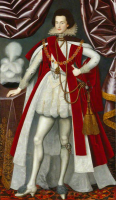
In 1616 William Larkin [aged 34]. Portrait of George Villiers 1st Duke of Buckingham [aged 23] wearing his Garter Robes and Leg Garter.
On 1st January 1616 George Villiers 1st Duke of Buckingham [aged 23] was appointed Master of the Horse. See Diary of Anne Clifford.
Letters of John Chamberlain Volume 2.243. 243. To Sir Dudley Carleton [aged 43]. [S. P. Dom., Jac. I, lxxxvii, 51.] London, June 8, 1616.
My very goode Lord: When I wrote last I left the earle of Somerset [aged 29] pleading for his life, but that he saide for himself was so litle that he was found guilty by all his peeres: which did so litle appall him that when he was asked what he could say why sentence shold not be pronounced, he stoode still upon his innocence, and could hardly be brought to refer himself to the Kinges mercie: upon which termes he stands still, and having leave to write to the King, hath only required that his judgement of hanging shold be chaunged to heading, and that his daughter might have such of his lands as the King doth not resume and reserve in his owne handes. The Lady Knolles [aged 33] and some other frends have had accesse to the Lady [aged 26] divers times since her conviction, and caried her younge daughter to her twise or thrise; but I heare not of any that comes at him. He hath ben much urged and fayre offered to confesse the offence both before his arraignment and since, but he stands firme in denial: though by all circumstances and most pregnant, (yea almost infallible) probabilities he be more faulty and fowle then any of the companie, which makes the King marvayle that all the rest that have gon before having so franckly confessed the matter after theyre condemnation, he only shold continue so confident. Whether this or any other reason be the cause of stay of execution I know not, but they live yet and for ought I can learne so are like to do many a day. Sir Thomas Mounsons [aged 51] arraignment which shold have ben yesterday, was then put of again till the Tewsday after the terme, which procrastination from time to time makes the world thincke we shall heare no more of this busines, the rather for that the Lord Cooke [aged 64] of late is fallen (I know not how) into disfavor, so far foorth that the King hath ben very bitter to him, both in privat and publike, as upon Thursday last when all the Judges were called before the King at Whitehall, to geve a reason of theyre proceeding in the exchecquer chamber to argue a case of commendams contrarie to his commaundment by expresse message, and sending a letter subscribed by them all, not so respectively and reverently written as might become them, they all stoode upon the very words and termes of law and statutes and upon the strictnes of theyre oath: but the heaviest burthen lighted on him, wherin he behaved and caried himself so well and confidently, that the matter goes on, and they argue yt again this day, contrarie to the expectation and hope of all the bishops. But the worst is that the Lord Chauncellor [aged 76], the atturny [aged 55] and sollicitor [aged 49] prosecute him implacablie, and have won so much ground upon him, that there is a commission graunted to the Lord Archbishop, the Lord Knollis [aged 72], Sir Thomas Lake [aged 48] and Sir Fulke Grivell to call him before them and examine him upon articles and points touching the premunire: and withall, the whole course of his life is like to be ript up and looked into which yf yt be severely followed many men feare yt may be his utter overthrow. But he holdes up his head, and geves no way, which makes his frends thincke he will passe over this storme and tempest well enough. Our goode frend [aged 53] stands only firme to him in what he may, which many marvayle at, and sticke not to say he is corrupted, which I thincke is as far from the one as the other: but howsoever, I could wish he shold not presume so much on the strength of his shoulders, as to thincke he alone were able to beare up the ruines of a building that is falling: and to say truth in many such cases I observe he hath more courage then needs, not weighing his owne strength, nor that yt is soma d'altri homeri [the burden of other men], for I perceve he hath litle appoggio [support, baking] to the maine piller [aged 23] that now stands upright.


On 5th January 1617 George Villiers 1st Duke of Buckingham [aged 24] was created 1st Earl Buckingham by King James I of England and Ireland and VI of Scotland [aged 50]; his favourite.

On 29th September 1617 [his brother] John Villiers 1st Viscount Purbeck [aged 26] and [his sister-in-law] Frances Coke Viscountess Purbeck [aged 15] were married at Hampton Court Palace, Richmond [Map]. King James I of England and Ireland and VI of Scotland [aged 51] gave away the bride. He the son of [his father] George Villiers of Brokesby and [his mother] Mary Beaumont 1st Countess Buckingham [aged 47].
In 1618 George Villiers 1st Duke of Buckingham [aged 25] was created 1st Marquess of Buckingham.
Around 13th August 1618 [his mother] Mary Beaumont 1st Countess Buckingham [aged 48] was created 1st Countess Buckingham. It appears this title was for life only since her sons did not inherit it?
Letters of the Court of James I 1618. [5th October 1618]. The current runs strong here, that Sir Fulk Greville [aged 64] shall be treasurer, but the grounds of that conjecture are not certain. An assured thing they say it is, that the Marquis of Buckingham [aged 26] hath gotten the survivance of the Admiralty granted him, in a joint patent with the lord admiral that is; and the same hath passed the seals already. Sir Robert Cary [aged 58] hath now perfected his suit concerning Killingworth [Map], and intends a new voyage thither soon after Allhallowtide. I have renewed my former motions concerning you, and he promises the accomplishment.

In 1619 Cornelius Janssens aka Johnson [aged 25]. Portrait of George Villiers 1st Duke of Buckingham [aged 26].
This is a translation of the 'Memoires of Jacques du Clercq', published in 1823 in two volumes, edited by Frederic, Baron de Reissenberg. In his introduction Reissenberg writes: 'Jacques du Clercq tells us that he was born in 1424, and that he was a licentiate in law and a counsellor to Philip the Good, Duke of Burgundy, in the castellany of Douai, Lille, and Orchies. It appears that he established his residence at Arras. In 1446, he married the daughter of Baldwin de la Lacherie, a gentleman who lived in Lille. We read in the fifth book of his Memoirs that his father, also named Jacques du Clercq, had married a lady of the Le Camelin family, from Compiègne. His ancestors, always attached to the counts of Flanders, had constantly served them, whether in their councils or in their armies.' The Memoires cover a period of nineteen years beginning in in 1448, ending in in 1467. It appears that the author had intended to extend the Memoirs beyond that date; no doubt illness or death prevented him from carrying out this plan. As Reissenberg writes the 'merit of this work lies in the simplicity of its narrative, in its tone of good faith, and in a certain air of frankness which naturally wins the reader’s confidence.' Du Clercq ranges from events of national and international importance, including events of the Wars of the Roses in England, to simple, everyday local events such as marriages, robberies, murders, trials and deaths, including that of his own father in Book 5; one of his last entries.
Available at Amazon in eBook and Paperback format.

On 10th February 1619 James Howard 3rd Earl Suffolk was born to Theophilus Howard 2nd Earl Suffolk [aged 36] and Elizabeth Home Countess Suffolk [aged 20]. His godfathers were King James I of England and Ireland and VI of Scotland [aged 52] and George Villiers 1st Duke of Buckingham [aged 26]. He married (1) 1st December 1640 his fifth cousin Susannah Rich Countess Suffolk, daughter of Henry Rich 1st Earl Holland and Isabel Cope Countess Holland, and had issue (2) February 1650 Barbara Villiers Countess Suffolk and had issue (3) before 8th May 1682 Anne Montagu Countess Suffolk, daughter of Robert Montagu 3rd Earl Manchester and Anne Yelverton Countess Manchester.
On 19th July 1619 [his brother] John Villiers 1st Viscount Purbeck [aged 28] was created 1st Viscount Purbeck. [his sister-in-law] Frances Coke Viscountess Purbeck [aged 16] by marriage Viscountess Purbeck.

Around 1620 Daniel Mijtens [aged 30]. Portrait of George Villiers 1st Duke of Buckingham [aged 27].
In 1620 Lucy Harrington Countess Bedford [aged 40] sold Burley-on-the-Hill House to George Villiers 1st Duke of Buckingham [aged 27] for £28,000.


On 16th May 1620 George Villiers 1st Duke of Buckingham [aged 27] and Katherine Manners Duchess Buckingham [aged 18] were married. She by marriage Countess Buckingham. She the daughter of Francis Manners 6th Earl of Rutland [aged 42] and Frances Knyvet Lady Bevill. He the son of George Villiers of Brokesby and Mary Beaumont 1st Countess Buckingham [aged 50].
Autobiography Simon D'Ewes. The beloved Marquis of Buckingham [aged 28], not yet satisfied with the censure of Sir Henry Yelverton [aged 54], Knt., late the Attorney-General, passed against him in the Star-Chamber, upon the 10th day of November last foregoing, in 1620, which I have there more fully touched upon, was the means, this Easter Term, to have him called in question for new matters in the Upper House of Parliament. Here he laid open, upon Monday, the 30th day of April, so many of the Marquis's inordinate actions, comparing him to the Spencers, that misled King Edward the Second, of England; as his Lordship had been much better to have let him alone in the Tower, where he still remained prisoner since his former censure, than to have brought him upon the stage again, where his revenge might have cost him dear, had not the King himself, in person, and Prince Charles also appeared in the Upper House against Sir Henry Yelverton; so as the Lords, out of their great wisdoms, fearing at this time to irritate the King by their further questioning the Marquis, his favourite, remitted all further prosecution of those accusations; but sent back Sir Henry Telverton to the Tower1, where he remwned awhile close prisoner.
Note 1. "On Wednesday was Sir Henry Yelverton censured by Parligment, fined ten thousand marks to the King, and five thousand marks to the Marquis of Buckingham, to make hia submission at the bar, and be imprisoned during pleasure. The Lord Marquis remitted the fine unto him, and offered to join with the Lords to his Majesty For mitigation of the rest." - Letter dated May 18th, Harl. MS
On 30th December 1620 [his brother-in-law] William Feilding 1st Earl Denbigh [aged 33] was created 1st Viscount Feilding, 1st Baron Feilding of Newnham Paddocks in Warwickshire. [his sister] Susan Villiers Countess Denbigh [aged 37] by marriage Viscountess Feilding.
In 1621 George Villiers 1st Duke of Buckingham [aged 28] produced Ben Johnson's [aged 49] masque The Gypsies Metamorphosed to celebrate his marriage to [his wife] Katherine Manners Duchess Buckingham [aged 18].

Autobiography Simon D'Ewes. 3rd May 1621. Never had any man in those great places of gain he had gone through, having been Attorney Greneral before he was Lord Chancellor, so ill-husbanded the time, or provided for himself. His vast prodigality had eaten up all his gains; for it was agreed by all men, that he owed at this present at least £20,000 more than he was worth. Had he followed the just and virtuous steps of Sir Nicholas Bacon, Knt., his father, that continued Lord Keeper of the Great Seal some eighteen years under Queen Elizabeth, of ever blessed memory, his life might have been as glorious as by his many vices it proved infamous. For though he were an eminent scholar imd a reasonable good lawyer, both which he much adorned with his eloquent expression of himself and his graced delivery, yet his vices were so stupendous and great, as they utterly obscured and out-poised his virtues. He was immoderately ambitious and excessively proud, to maintain which he was necessitated to injustice and bribery, taking sometimes most basely of both sides. To this latter wickedness the favour he had with the beloved Marquis of Buckingham [aged 28] emboldened him, as I learned in discourse from a gentleman of his bedchamber, who told me he was sure his lord should never fall as long as the said Marquis continued in favour. His most abominable and darling sin, I should rather bury in silence than mention it, were it not a most admirable instance how men are inflamed by wickedness, and held captive by the devil1. He lived, many years after his fall, in his lodgings in Gray's Inn, in Holborn, in great want and penury.
Note 1. D'Ewes here specifically charges Bacon with on abominable offence, in language too gross for publication. He states that it was supposed by some, that he would have been tried at the bar of justice for it; and says, that his guilt was so notorious while he was at York House [Map], in the Strand, and at his lodgings in Gray's Inn, Holborn, that the following verses were cast into his rooms:
Note 2. Within this sty a hog3 doth lie. That must be hang'd for villany." It is but right to add, that D'Ewes is the only authority for this imputation.
Note 3. Alluding, of course, to his surname of Bacon.
Autobiography Simon D'Ewes. 22nd June 1621. About Friday the 22nd of this month was Doctor Williams [aged 39], Dean of Westminster, sworn of the Privy Council, after he bad been first made Bishop of Lincoln; and the Earl of Southampton [aged 47] was committed prisoner to him at his Deanery of Westminster1. For what cause none of his own servants yet knew, from which imprisonment he was again awhile after freed by the mediation of some noble persons with the beloved Marquis of Buckingham [aged 28], whom the issue showed he had only offended, crossing him often during the continuance of Parliament, and answering him shortly since it had been adjourned.
Note 1. "The Earl of Southampton is committed to Dr. Dean of Westminster, his keeper being Sir Richard Weston [aged 44]. The Earl desired three things of the Lords, 1. That in regard his lady [aged 49] was much subject unto sudden grief and passion, his letter might be the first messenger of his detainment, 2. That because his son [aged 16] was ready to go to travel, he might first speak with him and give some directions. 3. That he might be permitted, in his Majesty's presence, to answer all that should be objected against him. The two former were granted conditionally, that Sir Richard Weston might see the one and hear the other; which were accordingly performed. The third was not in them to grant, but in his Majesty, and therefore put it off." - HarL MSS,


In 1622 [his daughter] Mary Villiers Duchess Lennox Duchess Richmond was born to George Villiers 1st Duke of Buckingham [aged 29] and [his wife] Katherine Manners Duchess Buckingham [aged 19]. She married (1) 8th January 1634 Charles Herbert, son of Philip Herbert 4th Earl Pembroke 1st Earl Montgomery and Susan Vere Countess Montgomery (2) 3rd August 1637 her half fifth cousin once removed James Stewart 4th Duke Lennox 1st Duke Richmond, son of Esmé Stewart 3rd Duke Lennox and Katherine Clifton Duchess Lennox, and had issue (3) November 1664 her fifth cousin once removed Captain Thomas Howard.
Chronicle of Walter of Guisborough
A canon regular of the Augustinian Guisborough Priory, Yorkshire, formerly known as The Chronicle of Walter of Hemingburgh, describes the period from 1066 to 1346. Before 1274 the Chronicle is based on other works. Thereafter, the Chronicle is original, and a remarkable source for the events of the time. This book provides a translation of the Chronicle from that date. The Latin source for our translation is the 1849 work edited by Hans Claude Hamilton. Hamilton, in his preface, says: 'In the present work we behold perhaps one of the finest samples of our early chronicles, both as regards the value of the events recorded, and the correctness with which they are detailed; Nor will the pleasing style of composition be lightly passed over by those capable of seeing reflected from it the tokens of a vigorous and cultivated mind, and a favourable specimen of the learning and taste of the age in which it was framed.'
Available at Amazon in eBook and Paperback format.

In March 1622 Henry Carey 1st Viscount Falkland [aged 47] was appointed Lord Deputy of Ireland through the favour of George Villiers 1st Duke of Buckingham [aged 29].
On 27th March 1622 Edward Wray and Elizabeth Norreys 3rd Baroness Norreys Rycote [aged 19] were married at Church of St Mary Aldermary. Christopher Villiers [aged 29], brother of George, Duke of Buckingham [aged 29], had, with Royal encouragement, sought her hand. To avoid being forced into a marriage with him she eloped with Edward Wray. She the daughter of Francis Norreys 1st Earl Berkshire and Bridget Vere Baroness Norreys Rycote [aged 37].
On 14th September 1622 [his brother-in-law] William Feilding 1st Earl Denbigh [aged 35] was created 1st Earl Denbigh. [his sister] Susan Villiers Countess Denbigh [aged 39] by marriage Countess Denbigh.
On 7th March 1623 King Charles I of England, Scotland and Ireland [aged 22], accompanied by George Villiers 1st Duke of Buckingham [aged 30], Endymion Porter [aged 36] and Richard Wynn 2nd Baronet [aged 35], arrived in Madrid [Map], incognito, in an attempt to bring to a conclusion his betrothal to Maria Anna of Spain Holy Roman Empress [aged 16], much to the surprise of her brother Philip IV King Spain [aged 17] and the English ambassador John Digby 1st Earl Bristol [aged 43]. The negotiations ultimately failed.
Autobiography Simon D'Ewes. 17th February 1623. There happened on Monday, the 17th day of the month, so strange an accident as after ages will scarce believe it. For Charles Prince of Wales [aged 22] began his journey from London into Spain on Monday, the 17th day of February, with the beloved Marquis of Buckingham [aged 30], Sir Francis Cottington [aged 44], and Mr. Endimion Porter [aged 36], only in his campaign; who only, besides the King himself, were the alone men aquainted with the Prince's resolution. Their going was so secretly carried as none, I believe, knew of it in England till they were landed in France, through which kingdom they passed by posthorse into Spain.1 The journey was thought so dangerous, being above 1100 English miles by land, besides the crossing of the seas between Dover and Calais, as all men were generally ensaddened at the ad- venture, often wishing it had been better advised upon; although they knew the Spaniards durst do the Prince no harm, so long as his royal sister and her illustrious oflspring survived. Soon after followed the Lord Hays [aged 43], Earl of Carlisle, and passed into France to excuse to that King the Prince's sudden and secret passing through his kingdom without giving him a visit. All men now took it for granted, that the Prince's marriage with the Infanta Maria, the King of Spain's sister, was concluded on, and that he went over only to consummate it; no man imagining that he would take up such a resolution upon uncertainties, especially occasioning so vast and unnecessary expense at a time when the King's wants pressed him much. But God, whose decree binds princes as well as peasants, had otherwise disposed, so as our royal suitor, arriving at Madrid in Spain on Friday the 7th (or 17th) of March, about three weeks later his departure from London, and taking ship for his return to England on the 18th (or 28th) of September, then next ensuing, stayed in Spain about seven months; in all which time he seldom saw or spoke with the Spanish Princess, nor could ever receive a fair or sincere denial from her brother, although her marriage had been absolutely disposed of by her father's last will and testament; he bequeathing her to Ferdinand, son and heir of Ferdinand the Second, Emperor of Germany, who afterwards did accordingly espouse her.
Note 1. "And now behold a, strange adventure and enterprise! The Prince and the Marquis of Buckingham, accompanied with Cottington and Endimion Porter, post in disgiuse to Spain to accelerate the marriage. The 17th of February they went privately from Court, and the next day came to Dover, where they embarked for Boulogne, and from thence rode post to Paris, where they made some atop. The Prince, shadowed under a bushy peruque, beheld the splendour of that court, and had a full view of the Princess Henrietta Maria [aged 13], who was afterwards his royal consort. For, besides the great privacy of the journey, they had so laid the English ports, that none should follow or give the least advertisement, until they had got the start of intelligencers, and passed the bounds of France. Howbeit they escaped narrowly, and a swift intelligence sent to the King of Spain from Don Carlos Coloma was even at their heels before they arrived at Madrid. The Prince and Buckingham being in the territories of Spain, to make but little noise, rode post before their company.


Before 18th April 1623 [his brother] Christopher Villiers 1st Earl Anglesey [aged 30] and [his sister-in-law] Elizabeth Sheldon Countess Anglesey [aged 15] were married. He the son of [his father] George Villiers of Brokesby and [his mother] Mary Beaumont 1st Countess Buckingham [aged 53].
On 18th April 1623 [his brother] Christopher Villiers 1st Earl Anglesey [aged 30] was created 1st Earl Anglesey, 1st Baron Villiers of Daventry. [his sister-in-law] Elizabeth Sheldon Countess Anglesey [aged 15] by marriage Countess Anglesey.
On 18th May 1623 George Villiers 1st Duke of Buckingham [aged 30] was created 1st Duke of Buckingham by King James I of England and Ireland and VI of Scotland [aged 56] for being his favourite; what favourite means is open to debate. [his wife] Katherine Manners Duchess Buckingham [aged 21] by marriage Duchess of Buckingham.
In January 1625 King James I of England and Ireland and VI of Scotland [aged 58] signed a warrant for the trial for adultery of the Robert Howard [aged 41] and [his sister-in-law] Frances Coke Viscountess Purbeck [aged 22] in the ecclesiastical Court of High Commission. The trial was likely at the instigation of her brother-in-law George Villiers 1st Duke of Buckingham [aged 32]. Robert Howard was imprisoned at the Fleet Prison [Map]. She was placed under house arrest.
The Cádiz expedition of 1625 was a naval expedition against Spain by English and Dutch forces led by George Villiers 1st Duke of Buckingham [aged 33].
The expedition left Plymouth, Devon [Map] on 6th October 1625.
In November 1625 the fleet attempted, unsuccessfully, to capture Cádiz.
In December 1625 the English returned home having achieved nothing other than spending £250,000, losing 62 out of 105 ships and 7000 English troops.
John Felton [aged 30] served.
On 17th November 1625 [his son] Charles Villiers was born to George Villiers 1st Duke of Buckingham [aged 33] and [his wife] Katherine Manners Duchess Buckingham [aged 23]. He died aged one in 1627.
In 1626 William Armine 1st Baronet [aged 32] acted as assistant to the managers of the parliamentary impeachment of the George Villiers 1st Duke of Buckingham [aged 33].
On 16th March 1627 [his son] Charles Villiers [aged 1] died.
On 12th July 1627 George Villiers 1st Duke of Buckingham [aged 34] led an English force of 100 ships and 6,000 soldiers to capture the city of Saint-Martin-de-Ré on the Île de Ré.
In August 1627 more troops, including the newly promoted Lieutenant John Felton [aged 32], arrived.
On 3rd September 1627 two thousand Irish troops arrived under Ralph Bingley [aged 57]
On 27th October 1627 a final assault was attempted; it failed because the attackers' siege ladders were shorter than the walls of the fortress.
In November 1627 George Villiers 1st Duke of Buckingham retreated and returned to England having lost thousands of his men.
Annals of the six Kings of England by Nicholas Trivet
Translation of the Annals of the Six Kings of England by that traces the rise and rule of the Angevin aka Plantagenet dynasty from the mid-12th to early 14th century. Written by the Dominican scholar Nicholas Trivet, the work offers a vivid account of English history from the reign of King Stephen through to the death of King Edward I, blending political narrative with moral reflection. Covering the reigns of six monarchs—from Stephen to Edward I—the chronicle explores royal authority, rebellion, war, and the shifting balance between crown, church, and nobility. Trivet provides detailed insight into defining moments such as baronial conflicts, Anglo-French rivalry, and the consolidation of royal power under Edward I, whose reign he describes with particular immediacy. The Annals combines careful year-by-year reporting with thoughtful interpretation, presenting history not merely as a sequence of events but as a moral and political lesson. Ideal for readers interested in medieval history, kingship, and the origins of the English state, this chronicle remains a valuable and accessible window into the turbulent world of the Plantagenet kings.
Available at Amazon in eBook and Paperback format.

Before 1628 Michiel Janszoon van Mierevelt [aged 61]. Portrait of George Villiers 1st Duke of Buckingham [aged 35].
On 30th January 1628 [his son] George Villiers 2nd Duke of Buckingham was born to George Villiers 1st Duke of Buckingham [aged 35] and [his wife] Katherine Manners Duchess Buckingham [aged 25]. He married 15th September 1657 his half fifth cousin Mary Fairfax Duchess Buckingham.


On 23rd August 1628 George Villiers 1st Duke of Buckingham [aged 35] was murdered at Greyhound Pub, Portsmouth by a disgruntled soldier John Felton [aged 33]. He was buried at Westminster Abbey [Map]. His son George succeeded 2nd Duke of Buckingham, 2nd Marquess of Buckingham, 2nd Earl Buckingham.
Felton was considered a hero by many who blamed Buckingham for the failures of the 1625 Cádiz Expedition and 1627 Siege of Saint-Martin-de-Ré. Felton was subsequently hanged.
Samuel Pepys' Diary. 2nd May 1661. Up, and Mr. Creed and I to walk round the town upon the walls. Then to our inn, and there all the officers of the Yard to see me with great respect, and I walked with them to the Dock and saw all the stores, and much pleased with the sight of the place. Back and brought them all to dinner with me, and treated them handsomely; and so after dinner by water to the Yard, and there we made the sale of the old provisions. Then we and our wives all to see the Montagu, which is a fine ship, and so to the town again by water, and then to see the room where the Duke of Buckingham was killed by Felton 1628. So to our lodging, and to supper and to bed. To-night came Mr. Stevens to town to help us to pay off the Fox.
On 13th November 1628 Thomas Richardson [aged 59] ruled that it was illegal to use the rack to elicit confession from John Felton [aged 33], the murderer of Duke of Buckingham. His opinion had the concurrence of his colleagues and marks a significant point in the history of English criminal jurisprudence.
On 29th November 1628 John Felton [aged 33] was hanged at Tyburn [Map] for having murdered the Duke of Buckingham.
Before 21st April 1629 [his son] Francis Villiers was born to George Villiers 1st Duke of Buckingham and [his former wife] Katherine Manners Duchess Buckingham [aged 26].
In 1635 Randall MacDonnell 1st Marquess Antrim [aged 25] and [his former wife] Katherine Manners Duchess Buckingham [aged 32] were married. She the daughter of [his former father-in-law] Francis Manners 6th Earl of Rutland and Frances Knyvet Lady Bevill. He the son of Randal "Arranach" Macdonnell 1st Earl Antrim and Alice O'Neill Countess Antrim.
In 1649 [his former wife] Katherine Manners Duchess Buckingham [aged 46] died. Her son George [aged 20] succeeded 19th Baron Ros Helmsley
John Evelyn's Diary. 27th November 1655. I went to see York House [Map] and gardens, belonging to the former great Buckingham, but now much ruined through neglect.

John Evelyn's Diary. 10th July 1656. I returned homeward, passing again through Colchester, Essex [Map]; and, by the way, near the ancient town of Chelmsford, Essex [Map], saw New Hall, built in a park by Henry VII. and VIII., and given by Queen Elizabeth to the Earl of Sussex, who sold it to the late great Duke of Buckingham, and since seized on by Oliver Cromwell [aged 57] (pretended Protector). It is a fair old house, built with brick, low, being only of two stories, as the manner then was; the gate-house better; the court, large and pretty; the staircase, of extraordinary wideness, with a piece representing Sir Francis Drake's action in the year 1580, an excellent sea-piece; the galleries are trifling; the hall is noble; the garden a fair plot, and the whole seat well accommodated with water; but, above all, I admired the fair avenue planted with stately lime trees, in four rows, for near a mile in length. It has three descents, which is the only fault, and may be reformed. There is another fair walk of the same at the mall and wilderness, with a tennis-court, and pleasant terrace toward the park, which was well stored with deer and ponds.
Samuel Pepys' Diary. 22nd February 1664. This evening came Mr. Alsopp the King's brewer, with whom I spent an houre talking and bewailing the posture of things at present; the King [aged 33] led away by half-a-dozen men, that none of his serious servants and friends can come at him. These are Lauderdale [aged 47], [his son] Buckingham [aged 36], Hamilton, Fitz-Harding [aged 34] (to whom he hath, it seems, given £2,000 per annum in the best part of the King's estate); and that that the old Duke of Buckingham could never get of the King. Progers is another, and Sir H. Bennett [aged 46]. He loves not the Queen [aged 25] at all, but is rather sullen to her; and she, by all reports, incapable of children. He is so fond of the Duke of Monmouth [aged 14], that every body admires it; and he says the Duke hath said, that he would be the death of any man that says the King was not married to his mother: though Alsopp says, it is well known that she was a common whore before the King lay with her. But it seems, he says, that the King is mighty kind to these his bastard children; and at this day will go at midnight to my Baroness Castlemaine's [aged 23] nurses, and take the child and dance it in his arms: that he is not likely to have his tables up again in his house1, for the crew that are about him will not have him come to common view again, but keep him obscurely among themselves. He hath this night, it seems, ordered that the Hall (which there is a ball to be in to-night before the King) be guarded, as the Queen-Mother's [aged 54] is, by his Horse Guards; whereas heretofore they were by the Lord Chamberlain or Steward, and their people. But it is feared they will reduce all to the soldiery, and all other places taken away; and what is worst of all, that he will alter the present militia, and bring all to a flying army.
Note 1. The tables at which the King dined in public.-B.
Adam Murimuth's Continuation and Robert of Avesbury’s 'The Wonderful Deeds of King Edward III'
This volume brings together two of the most important contemporary chronicles for the reign of Edward III and the opening phases of the Hundred Years’ War. Written in Latin by English clerical observers, these texts provide a vivid and authoritative window into the political, diplomatic, and military history of fourteenth-century England and its continental ambitions. Adam Murimuth Continuatio's Chronicarum continues an earlier chronicle into the mid-fourteenth century, offering concise but valuable notices on royal policy, foreign relations, and ecclesiastical affairs. Its annalistic structure makes it especially useful for establishing chronology and tracing the development of events year by year. Complementing it, Robert of Avesbury’s De gestis mirabilibus regis Edwardi tertii is a rich documentary chronicle preserving letters, treaties, and official records alongside narrative passages. It is an indispensable source for understanding Edward III’s claim to the French crown, the conduct of war, and the mechanisms of medieval diplomacy. Together, these works offer scholars, students, and enthusiasts a reliable and unembellished account of a transformative period in English and European history. Essential for anyone interested in medieval chronicles, the Hundred Years’ War, or the reign of Edward III.
Available at Amazon in eBook and Paperback format.
Autobiography Simon D'Ewes. 31st December 1690. The four lords that came for it were Henry Viscount Mandeville, Lord Treasurer, Lodowick Stewart, Duke of Lennox, Lord Steward of the King's house-hold, William Herbert, Earl of Pembroke, Lord Chamberlain of the same household, and Thomas Earl of Arundel, Earl Marshal of England (whom I should have placed before Pembroke); they, coming to York House [Map] to him, where he lay, told him they were sorry to visit him upon such an occasion, and wished it had been better. "No, my lords," replied he, "the occasion is good;" and then delivering them the great seal, he added, "It was the King's favour that gave me this, and it is my fault that hath taken it away: Rex dedit, culpa abstulit" - or words to that effect. So leaving him, the said four lords carried the gage they had received to Whitehall, to the King, who was overheard by some near him to say upon their delivery of it to him, "Now, by my soul, I am pained at the heart where to bestow this; for as to my lawyers, I think they be all knaves." Which it seemeth his Majesty spake at that time to prepare a way to bestow it on a clergyman, as the Marquis of Buckingham had intended; for otherwise there were at this present divers able wise lawyers, very honest and religious men, fit for the place, in whom there might easily have been found as much integrity, and less fawning and flattery than in the clergy; and, accordingly, Doctor Williams, now Dean of Westminster, and before that time made Bishop of Lincoln, was sworn Lord Keeper, and had the great seal delivered to him. On October the 9th, next ensuing, being the first day of Michaelmas Term, one Lloyd, or Floud, a Papist, being of the Inner Temple, having spoken these buse and opprobrious words following of the distressed Prince Elector Palatine and his royal lady, to wit, - "What is now become of your goodman Palsgrave, and your goodwife Palsgrave?1 - they had, I think, as much right to the kingdom of Bohemia as I have to the principality of Wales," was censured by the House of Commons, to pay a fine to the King, to be imprisoned during the King's pleasure, to ride disgracefully two several days in the open street upon a horse, with his face to the tail of it, and each day to stand in the pillory. The execution was long deferred, his fine and imprisonment remitted, and himself and his fellow Romanists began to boast that nothing should be inflicted. But at last, tho two Houses of Parliament appearing stoutly in the cause, he underwent the first day's punishment on May the 30th, being Wednesday, and the second on Friday the 1st day of June, on which Midsummer Term began. These days' actions I have added a little before the due time, that I might at once finish the relation of this business; in which the faithful zealous affection of the whole state and kingdom, in their body representative, consisting of the two Houses of Parliament, was fully expressed to that royal Princess, our King's only daughter, amidst the many scorns and oppressions of her irreconcilable and bloody enemies.
Note 1. This exclamation is given somewhat differently by Meade in the Harl. MSS. He says, "On Tuesday, Floyd, a counsellor, steward and receiver in Shropshire to the old Lord Chancellor Ellesmere and the Earl of Suffolk, a papist, and prisoner in the Fleet, was censured to ride thrice with papers, and stand in the pillory, and first at Westminster, for saying, Goodman Palsgrave. and Goody Palsgrave may or must go pack their children at their backs and beg. On Wednesday should have been the first time, but his Majesty stayed it. Yesterday the King and House met; his Majesty thanked them for the care they had of his son-in-law, daughter, and grandchildren's honour; if it were in them to censure this prisoner, the censure should be executed, otherwise there should be a punishment equivalent to that they had set down; which gave good content."



Survey London Volume 4 Chelsea Part II. Cecil does not seem to have carried out his larger schemes and he sold the house to Henry Clinton, second Earl of Lincoln, in 1599.
Lincoln settled the estate on Sir Arthur Gorges, who had married his daughter. He lived in the house just mentioned, adjoining the great house, built for him by his father-in-law, and some four years after the latter's death in 1615, he sold Sir Thomas More's house to Lionel Cranfield, Earl of Middlesex. [See Close Roll, 18 Jas. I., pt. 18.] The new owner purchased several additions to the property, including "Brick Barn Close" and "The Sandhills," both north of the King's Road. These he converted into the Park, which is shown in Kip's view and was not built upon until after 1717. Cranfield fell under the displeasure of the King, and in consequence forfeited his property, which Charles I. granted in 1627 to George Villiers, [his son] Duke of Buckingham. After the Duke's assassination, the family continued to reside here until the outbreak of the Civil War, when the house was seized by the Parliament, and Mr. Randall Davies has referred to the record in the Perfect Occurrences of the petition in 1646 of the Duchess of Lennox, Buckingham's daughter, for leave to come to London, or to her house in Chelsea, to be under Dr. Mayerne's hands for her health. The great physician was then living at Lindsey House, the old farmhouse belonging to the estate.


Kings Wessex: Great x 17 Grand Son of King Edmund "Ironside" I of England
Kings Gwynedd: Great x 14 Grand Son of Owain "Great" King Gwynedd
Kings Seisyllwg: Great x 20 Grand Son of Hywel "Dda aka Good" King Seisyllwg King Deheubarth
Kings Powys: Great x 15 Grand Son of Maredudd ap Bleddyn King Powys
Kings Godwinson: Great x 18 Grand Son of King Harold II of England
Kings England: Great x 8 Grand Son of King Edward III of England
Kings Scotland: Great x 16 Grand Son of King Duncan I of Scotland
Kings Franks: Great x 24 Grand Son of Charles "Charlemagne aka Great" King of the Franks King Lombardy Holy Roman Emperor
Kings France: Great x 17 Grand Son of Hugh I King of the Franks
Kings Duke Aquitaine: Great x 21 Grand Son of Ranulf I Duke Aquitaine
Great x 4 Grandfather: John Villiers
Great x 3 Grandfather: William Villiers
Great x 2 Grandfather: John Villiers
Great x 1 Grandfather: John Villiers
GrandFather: William Villiers of Brooksby Leicestershire
Father: George Villiers of Brokesby
Great x 1 Grandfather: Richard Clarke
GrandMother: Collette Clarke
George Villiers 1st Duke of Buckingham 8 x Great Grand Son of King Edward III of England
Great x 4 Grandfather: Thomas Beaumont 4 x Great Grand Son of King Henry III of England
Great x 3 Grandfather: John Beaumont 5 x Great Grand Son of King Henry III of England
Great x 4 Grandmother: Philippa Maureward
Great x 2 Grandfather: George Beaumont 4 x Great Grand Son of King Edward III of England
Great x 4 Grandfather: John Darcy  4 x Great Grand Son of King Edward I of England
Great x 3 Grandmother: Joan Darcy 3 x Great Grand Daughter of King Edward III of England
Great x 4 Grandmother: Joane Greystoke Baroness Darcy Knayth  2 x Great Grand Daughter of King Edward III of England
Great x 1 Grandfather: William Beaumont 5 x Great Grand Son of King Edward III of England
Great x 2 Grandmother: George Pauncefote
GrandFather: Anthony Beaumont 6 x Great Grand Son of King Edward III of England
Great x 4 Grandfather: Ralph Bassett  10 x Great Grand Son of King Henry I "Beauclerc" England
Great x 3 Grandfather: William Bassett 11 x Great Grand Son of King Henry I "Beauclerc" England
Great x 2 Grandfather: William Bassett 12 x Great Grand Son of King Henry I "Beauclerc" England
Great x 1 Grandmother: Mary Bassett 13 x Great Grand Daughter of King Henry I "Beauclerc" England
Mother: Mary Beaumont 1st Countess Buckingham 7 x Great Grand Daughter of King Edward III of England
Great x 1 Grandfather: Thomas Armstrong
GrandMother: Anne Armstrong
