

Jean de Waurin's Chronicle of England Volume 6 Books 3-6: The Wars of the Roses
Jean de Waurin was a French Chronicler, from the Artois region, who was born around 1400, and died around 1474. Waurin’s Chronicle of England, Volume 6, covering the period 1450 to 1471, from which we have selected and translated Chapters relating to the Wars of the Roses, provides a vivid, original, contemporary description of key events some of which he witnessed first-hand, some of which he was told by the key people involved with whom Waurin had a personal relationship.
Available at Amazon in eBook and Paperback format.
Harry Mengden Scarth is in Antiquaries.
On 11th May 1814 Harry Mengden Scarth was born to [his father] Thomas Freshfield Scarth of Keverstone and [his mother] Mary Milbank of Gainford at Staindrop, County Durham.
In 1837 Harry Mengden Scarth [aged 22] graduated B.A. from Christ's College, Cambridge University [Map]. He proceeded M.A. in 1841.
In 1840 Harry Mengden Scarth [aged 25] was presented to the Rectory of St John the Baptist Church, Kenley [Map] by William Henry Vane 1st Duke Cleveland [aged 73].
In 1841 Harry Mengden Scarth [aged 26] was presented to the Rectory of St Mary the Virgin's Church, Bathwick [Map] by William Henry Vane 1st Duke Cleveland [aged 74].
On 15th November 1842 Harry Mengden Scarth [aged 28] and Elizabeth Sally Hamilton were married. They had seven children of which a son and two daughters survived him.
On 25th March 1848 Harry Mengden Scarth [aged 33] was appointed Prebendary of Wells Cathedral.
On 24th December 1848 [his daughter] Alice Mary Elizabeth Scarth was born to Harry Mengden Scarth [aged 34] and [his wife] Elizabeth Sally Hamilton.
Proceedings of the Somerset Archaeological and Natural History Society Volume 8 Pages 35-62. Remarks on ancient chambered tumuli as illustrative still existing at Stoney Littleton [Map], near Wellow, in the county of Somerset. By The Rev. H. M. Scarth [aged 44], M.A.
In 1864 Harry Mengden Scarth [aged 49] published Aquæ Solis, Or Notices Of Roman Bath.
Proceedings of the Somerset Archaeological and Natural History Society Volume 14 Pages 161-172. On the Megalithic Remains at Stanton Drew. By The Rev. H. M. Scarth [aged 52], M.A., Prebendary of Wells.
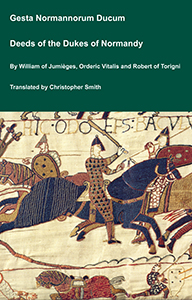
The Deeds of the Dukes of Normandy
The Gesta Normannorum Ducum [The Deeds of the Dukes of Normandy] is a landmark medieval chronicle tracing the rise and fall of the Norman dynasty from its early roots through the pivotal events surrounding the Norman Conquest of England. Originally penned in Latin by the monk William of Jumièges shortly before 1060 and later expanded at the behest of William the Conqueror, the work chronicles the deeds, politics, battles, and leadership of the Norman dukes, especially William’s own claim to the English throne. The narrative combines earlier historical sources with firsthand information and oral testimony to present an authoritative account of Normandy’s transformation from a Viking settlement into one of medieval Europe’s most powerful realms. William’s history emphasizes the legitimacy, military prowess, and governance of the Norman line, framing their expansion, including the conquest of England, as both divinely sanctioned and noble in purpose. Later chroniclers such as Orderic Vitalis and Robert of Torigni continued the history, extending the coverage into the 12th century, providing broader context on ducal rule and its impact. Today this classic work remains a foundational source for understanding Norman identity, medieval statesmanship, and the historical forces that reshaped England and Western Europe between 800AD and 1100AD.
Available at Amazon in eBook and Paperback format.
Proceedings of the Somerset Archaeological and Natural History Society Volume 16 Pages 14-28. Colonel Bennett, the proprietor, had arranged for inspection a collection of interesting objects found in the Camp, including horseshoes, bones, Boman coins, querns, and a stone in the form of a hatchet.
The Rev. H. W. Winwood described the bones as those of bos longifrons, deer and swine.
Mr. Stevens stated that the quern was of an early and very interesting form.
Mr. James Paeker thought the stone hatchet very doubtful. One very like it from Cambridge had been recently examined by himself, and Dr. Rollestone, and they had come to the conclusion that it had never been manufactured.
A gentleman present observed that two stone hatchets, very similar, had lately been found near Congresbury.
Mr. Jones remarked, that he believed there was no classical authority to prove that the Romans ever used horseshoes. There certainly was no Latin word for horse shoe, and he did not know that any illustration of their use occurred in any ancient sculpture. The only instance he had himself seen, was a faint trace on one hoof of one of the horses in a higa, basso relievo, in the Museum at Avignon, but this he was sure was accidental. Columella, the great Roman authority on rural affairs, in his teatise on the choosing and rearing of horses, makes no reference to horseshoes. It was, therefore, he thought by no means certain that the horseshoes were of the same date with the Roman coins.
Having enjoyed the magnificent view, embracing a dis trict, it is said, with a radius of 30 miles, the company assembled on the camp under the presidency of Sir W Medlycott.
The Lord Bishop pointed out how that the ancient oc cupants had, in this camp, according to their usual custom, taken advantage of the natural formation of the ground in constructing this strong-hold.
The Rev. Prebendary Scarth [aged 55], at the request of the president, described the camp and its fortifications. He remarked that the subject was one which was full of in terest, but which it was very difficult to say anything certain about. He thought that all he could say, after examining this camp, and looking round the fortifications of the encampment, and comparing it with the other camps of a similar kind in this country, but more especially in South Wales, and all that line of country which was occupied by the Britons previous to the Roman conquest, when Caractacus so nobly defended his country—having himself examined those defences, he was inclined to think that everything showed this to have been an ancient British earthwork; and he thought the remains found within it tended to confirm that opinion. The chief features of this were the very strong ramparts with which it was surrounded, and more especially the entrances. The entrances were particularly curious from the way in which they were fortified, showing that they were of particular importance. He knew of no camp which showed the entrances so well defined as this, except that wonderful work. Maiden Castle, near Dorchester, which was one of the noblest and most wonderful works that existed in this country. He thought the earthwork they were now ex amining was only second to that. It did not appear to have had any Roman camp within in, as was sometimes found. There was a Roman camp within the British for tification at Clifton, for example. Again, the construction of the ramparts here, so far as he had been able to examine them, was very different from what they found at Clifton, where there was an inner core composed oflime and stone, a mass which could not be cut through.
Proceedings of the Somerset Archaeological and Natural History Society Volume 16 Pages 14-28. Mr. Scarth [aged 55] pointed out how very strongly the entrance to the camp was protected. There were eight mounds or ridges, each with a ditch between them; and the road in was curved, so that the attacking force might be taken in flank. Of course had that camp been well garrisoned it would have been almost impossible for any force to have taken it. In order to get a full idea of the strength of the place, he advised them to keep along the ridge on which they were now standing for some distance.
Attention was called by Colonel Bennett to a cottage near the church (South Cadbury); which Mr, Scarth suggested to have formerly been the "priest's house."
In 1871 Harry Mengden Scarth [aged 56] was appointed Rector of All Saints Church, Wrington [Map].
In 1871 Harry Mengden Scarth [aged 56] was presented to the Rectory of All Saints Church, Wrington [Map] by Harry George Powlett 4th Duke Cleveland [aged 67] which office he held unti lhis death.
In 1876 [his wife] Elizabeth Sally Hamilton died.
In 1889 [his daughter] Alice Mary Elizabeth Scarth [aged 40] died.
On 5th April 1890 Harry Mengden Scarth [aged 75] died at Tangier [Map]. He was buried at All Saints Church, Wrington [Map].