

Chronicle of Walter of Guisborough
A canon regular of the Augustinian Guisborough Priory, Yorkshire, formerly known as The Chronicle of Walter of Hemingburgh, describes the period from 1066 to 1346. Before 1274 the Chronicle is based on other works. Thereafter, the Chronicle is original, and a remarkable source for the events of the time. This book provides a translation of the Chronicle from that date. The Latin source for our translation is the 1849 work edited by Hans Claude Hamilton. Hamilton, in his preface, says: 'In the present work we behold perhaps one of the finest samples of our early chronicles, both as regards the value of the events recorded, and the correctness with which they are detailed; Nor will the pleasing style of composition be lightly passed over by those capable of seeing reflected from it the tokens of a vigorous and cultivated mind, and a favourable specimen of the learning and taste of the age in which it was framed.'
Available at Amazon in eBook and Paperback format.
On 21st February 1830 Henry Wallis was born.
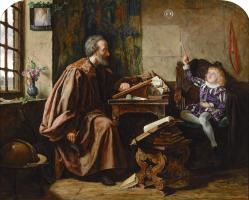
1853. Henry Wallis [aged 22]. "Sir Walter Raleigh in the Tower".
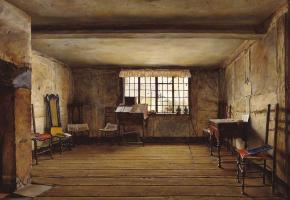
1853. Henry Wallis [aged 22]. "The Room in Which Shakespeare Was Born".

1856. Henry Wallis [aged 25]. "The Death of Chatterton" depicting the death of the 17-year-old English early Romantic poet Thomas Chatterton, 1752–1770, who is believed to have poisoned himself with arsenic. Wallis sold the painting to Augustus Egg in 1856. The model used for the painting was the young George Meredith [aged 27], a 19th-century English novelist and poet.
Thomas Chatterton: On 20th November 1752 he was born

1857. Henry Wallis [aged 26]. Portrait of Mary Ellen Peacock [aged 35].
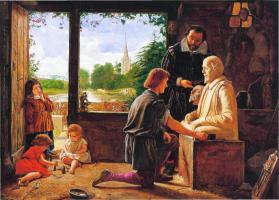
1857. Henry Wallis [aged 26]. "A Sculptor's Workshop, Stratford-on-Avon, A.D. 1619". The painting features sculptor Gerard Johnson carving Shakespeare's funerary monument, a half-length sculpture of the poet holding a quill pen in one hand, a piece of paper in the other, and with his arms resting on a cushion, while Ben Jonson shows him Shakespeare's death mask. Wallis attempted to make his picture as historically accurate as possible, but time has proven him incorrect. As Sanders has written: "The painting is a complete theatrical fiction. As far as we know, Shakespeare's monument was made in Southwark and not in Stratford, and the death mask, shown being held by Ben Jonson in the painting, was a pious fraud discovered in Germany in 1849. Moreover, the stone spire of Holy Trinity, Stratford, which appears through the open frontage of the workshop, was only added to the church in 1763."
In 1857 Mary Ellen Peacock [aged 35], wife of George Meredith [aged 28], eloped with Henry Wallis [aged 26].


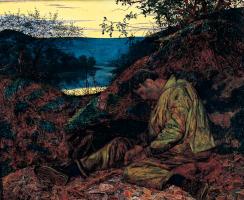
1857. Henry Wallis [aged 26]. "The Stone Breaker".
On 29th September 1857 Mary Ellen Peacock [aged 36] wrote to Henry Wallis [aged 27]:
"If we have to stay in England let us be at Clifton. I have no answer from George [aged 29]. I imagine he wants to see Darvall [Henry Darvall] before writing. If he gives no reply in a week I shall take his silence for freedom and go abroad without another word, if you will like it, and where you will… I am always dreading to lose you because I feel I have no right to you, and I love you so really, so far beyond anything I have known of love, that there are ways in which I believe I could bear to lose you. God knows how hard it would be; but I believe I could bear it. Not by Death or weariness or anger. By Death I could not lose you
The love where Death has set his seal
Nor age can chill, nor rival steal
Nor falsehood disavow, (Lord Byron, Elegy on Thyrza)
But I do not fear your Death, because I feel how much you owe to Life, how much Life has for you, and surely I shall in no shape lead you Delilah-like to Death, since it is my one aim to add to your strength, my one prayer 'God grant that I may do this man no harm'. And for weariness or anger, if we begin to thread either of those paths we will part before they possess us."
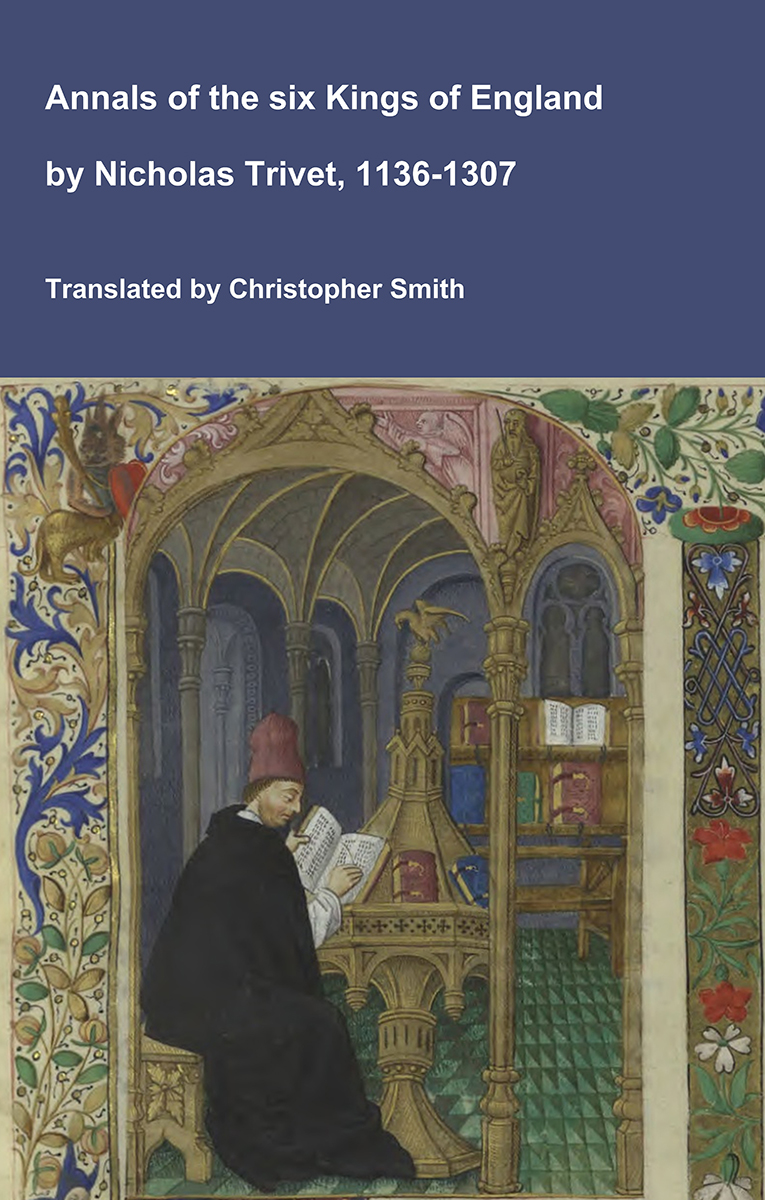
Annals of the six Kings of England by Nicholas Trivet
Translation of the Annals of the Six Kings of England by that traces the rise and rule of the Angevin aka Plantagenet dynasty from the mid-12th to early 14th century. Written by the Dominican scholar Nicholas Trivet, the work offers a vivid account of English history from the reign of King Stephen through to the death of King Edward I, blending political narrative with moral reflection. Covering the reigns of six monarchs—from Stephen to Edward I—the chronicle explores royal authority, rebellion, war, and the shifting balance between crown, church, and nobility. Trivet provides detailed insight into defining moments such as baronial conflicts, Anglo-French rivalry, and the consolidation of royal power under Edward I, whose reign he describes with particular immediacy. The Annals combines careful year-by-year reporting with thoughtful interpretation, presenting history not merely as a sequence of events but as a moral and political lesson. Ideal for readers interested in medieval history, kingship, and the origins of the English state, this chronicle remains a valuable and accessible window into the turbulent world of the Plantagenet kings.
Available at Amazon in eBook and Paperback format.
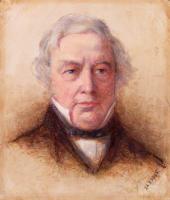
1858. Henry Wallis [aged 27]. Portrait of Thomas Love Peacock, father of his mistress Mary Ellen Peacock [aged 36].

1858. Henry Wallis [aged 27]. Portrait of Mary Ellen Peacock [aged 36], wife of George Meredith [aged 29], with whom Henry Wallis had eloped the previous year.
On 20th December 1916 Henry Wallis [aged 86] died at 1 Walpole Road, Croydon.