


Chronicle of a Bourgeois of Valenciennes
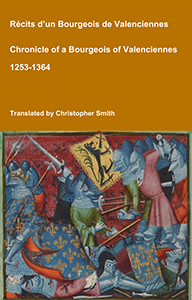
Récits d’un bourgeois de Valenciennes aka The Chronicle of a Bourgeois of Valenciennes is a vivid 14th-century vernacular chronicle written by an anonymous urban chronicler from Valenciennes in the County of Hainaut. It survives in a manuscript that describes local and regional history from about 1253 to 1366, blending chronology, narrative episodes, and eyewitness-style accounts of political, military, and social events in medieval France, Flanders, and the Low Countries. The work begins with a chronological framework of events affecting Valenciennes and its region under rulers such as King Philip VI of France and the shifting allegiances of local nobility. It includes accounts of conflicts, sieges, diplomatic manoeuvres, and the impact of broader struggles like the Hundred Years’ War on urban life in Hainaut. Written from the perspective of a burgher (bourgeois) rather than a monastery or royal court, the chronicle offers a rare lay viewpoint on high politics and warfare, reflecting how merchants, townspeople, and civic institutions experienced the turbulence of the 13th and 14th centuries. Its narrative style combines straightforward reporting of events with moral and civic observations, making it a valuable source for readers interested in medieval urban society, regional politics, and the lived experience of war and governance in pre-modern Europe.
Available at Amazon in eBook and Paperback format.
In 1296 Hugh de Cressingham was appointed Lord High Treasurer.
. [11 Sep 1297]. On that same day, among the Scots' pikemen fell the aforementioned treasurer of the lord king, Sir Hugh de Cressingham, rector of the church of Rudding and chief justice of the assizes at York. Although he was a prebendary in many churches and cared for many souls, he had never donned spiritual armour or a cassock, but rather a helmet and armour in which he perished. And the man who had once frightened many with the sword of his tongue in numerous judgments was finally slain by the sword of the wicked. The Scots, skinning him, divided his flesh among themselves in small pieces, not as relics but as insults, for he was exceedingly handsome and robust. They called him not the king's treasurer but the king's traitor, and it was more accurate than they believed; for he had deceived many that day, and he himself was deceived, being proud and devoted to greed.
Corruit eodem die inter Scotos lancearios prænominatus ille thesaurarius domini regis dominus Hugo de Cressyngham, rector ecclesiæ de Ruddeby et capitalis justitiarius in is assisis Eborum, qui cum esset præbendarius in multis ecclesiis, et multarum haberet curam animarum, nunquam tamen arma spiritualia vel casulam induit, sed galeam et loricam in quibus corruit. Et qui gladio linguæ suæ multos olim exterruerat in judiciis multis, gladio tandem perversorum occisus est; quem excoriantes Scoti diviserunt inter se pellem ipsius in modicas partes, non quidem ad reliquias sed in contumelias: erat enim pulcher et grassus nimis: vocaveruntque eum non thesaurarium sed trayturarium regis, et verius hoc quam credebant; multos enim seduxit in die hac, sed et ipse seductus est qui erat levis et lubricus, elatus superbia et avaritiæ deditus.
. [11 Sep 1297]. There were about a thousand cavalry and fifty thousand infantry in total, excluding the forces that Lord Henry de Percy had gathered from the counties of Carlisle and Lancashire, amounting to three hundred cavalry and eighty thousand selected infantry. While on the way to Stirling with these forces, he received a command from Lord Hugh de Cressingham, the king's treasurer, to dismiss those forces with thanks, saying that the army they already had would be sufficient and that it would be unwise to wear them out in vain or to consume the king's treasury more than necessary. He did so, and the people were very angry, nearly wanting to stone him. As various people expressed different opinions, some were calling for the army to cross the bridge, while others argued against it.
Erant tamen quasi mille equestres et quinquaginta millia peditum universorum, præter populum quem dominus Henricus de Percy de comitatibus Carlioli et Lancastriæ congregaverat, numeratum ad trecentos equites et octoginta millia peditum electorum; qui cum esset in veniendo cum eis versus Stryvelyn modicum ante recepit in mandatis a domino Hugone de Cressyngham, thesaurario regis, ut eundem populum cum gratiarum actione remitteret, dicens exercitum quem habebant sufficere posse, nec expedire ipsos vexare in vanum vel regis ærarium consumere plusquam necesse erat. Fecitque sic, et indignatus est populus valde, volens eum quasi lapidare. Variis itaque varia censentibus, conclamabant quidam. ut pontem transcenderent, alii e converso non.
Lanercost Chronicle. 11th September 1297. When this had been done and the greater part of the army had been dismissed, the Steward brought them to the bridge of Stirling, where on the other side of the water the army of Scotland was posted. They [the Scots] allowed as many of the English to cross the bridge as they could hope to overcome, and then, having blocked the bridge1, they slaughtered all who had crossed over, among whom perished the Treasurer of England, Hugh de Cressingham, of whose skin William Wallace caused a broad strip to be taken from the head to the heel, to make therewith a baldrick for his sword1. The Earl of Warenne escaped with difficulty and with a small following, so hotly did the enemy pursue them. After this the Scots entered Berwick and put to death the few English that they found therein; for the town was then without walls, and might be taken as easily by English or Scots coming in force. The castle of the town, however, was not surrendered on this occasion.
Note 1. Ponte obturato i.e. with the bridge blocked.
Note 2. Other writers say the skin was cut up into horse-girths.
John of Fordun's Chronicle. 11th September 1297. 99. Battle of Stirling Bridge
In the year 1297, the fame of William Wallace was spread all abroad, and, at length, reached the ears of the king of England; for the loss brought upon his people was crying out. As the king, however, was intent upon many troublesome matters elsewhere, he sent his treasurer, named Hugh of Clissingham, with a large force to repress this William's boldness, and to bring the kingdom of Scotland under his sway. When, therefore, he heard of this man's arrival, the aforesaid William, then busy besieging the English who were in Dundee Castle, straightway intrusted the care and charge of the siege of the castle to the burgesses of that town, on pain of loss of life and limb, and, with his army, marched on, with all haste, towards Strivelyn (Stirling), to meet this Hugh. A battle was then fought, on the 11th of September, near Strivelyn (Stirling), at the bridge over the Forth. Hugh of Clissingham was killed, and all his army put to flight: some of them were slain with the sword, others taken, others drowned in the waters. But, through God, they were all overcome; and the aforesaid William gained a happy victory, with no little praise. Of the nobles, on his side, the noble Andrew of Moray alone, the father of Andrew, fell wounded.
Scalacronica. 11th September 1297. And the following winter, the said William Wallace burnt all Northumberland. The Earl of Warenne (age 66), who was Keeper of Scotland for the King of England, being in the south1, turned towards Scotland; where at the bridge of Stirling he was defeated by William Wallace, who, being at hand in order of battle2, allowed so many of the English as he pleased to cross over the said bridge, and, at the right moment3, attacked them, caused the bridge to be broken, where many of the English perished, with Hugh de Cressingham, the King's Treasurer; and it was said that the Scots caused him to be flayed, and in token of hatred made girths of his skin. The Earl of Warenne took flight to Berwick. William Wallace, to whom the Scots adhered, immediately after this discomfiture, followed4 the said Earl of Warenne in great force, and skirting Berwick, arrived on Hutton Moor in order of battle; but perceiving the English arrayed to oppose him, he came no nearer to Berwick, but retired and bivouacked in Duns Park5.
Note 1. Warenne, or Surrey, which was his principal title, had been recalled on 18th August for service with King Edward on the Continent, and Sir Brian Fitz Alan was appointed Keeper of Scotland in his place. But Sir Brian having raised a difficulty about his salary (£1128 8s.), the Prince of Wales wrote on 7th Sept., 1298, requiring Surrey to remain at his post. (See Stevenson's Documents illustrative of the History of Scotland, ii. 230.)
Note 2. En batailA soun point. i.e., in force or in order of battle; used in both senses.
Note 3. A soun point. i.e.
Note 4. Suyst, misprinted fuyst in Maitland Club Ed.
Note 5. Not Duns Park on Whitadder, but in a place which then bore that name a little to the north of Berwick.
 Become a Member via our Buy Me a Coffee page to read more.