

Abbot John Whethamstede’s Chronicle of the Abbey of St Albans
Abbot John Whethamstede's Register aka Chronicle of his second term at the Abbey of St Albans, 1451-1461, is a remarkable text that describes his first-hand experience of the beginning of the Wars of the Roses including the First and Second Battles of St Albans, 1455 and 1461, respectively, their cause, and their consequences, not least on the Abbey itself. His text also includes Loveday, Blore Heath, Northampton, the Act of Accord, Wakefield, and Towton, and ends with the Coronation of King Edward IV. In addition to the events of the Wars of the Roses, Abbot John, or his scribes who wrote the Chronicle, include details in the life of the Abbey such as charters, letters, land exchanges, visits by legates, and disputes, which provide a rich insight into the day-to-day life of the Abbey, and the challenges faced by its Abbot.
Available at Amazon in eBook and Paperback format.
Paternal Family Tree: Cockayne
Maternal Family Tree: Elizabeth Harthill 1416
Around 1370 John Cockayne was born to [his father] Edmund Cockayne (age 14) and [his mother] Elizabeth Harthill.
Before February 1388 John Cockayne (age 18) was knighted.
On 26th February 1388 John Cockayne (age 18) was accused of divers enormous offences in the county of Derby, against the ministers, officers and servants of the king's uncle John, duke of Lancaster.
In March 1392 John Cockayne (age 22) received a commission of array.
In February 1393 John Cockayne (age 23) received a commission of arrest to pursue a fugitive in a case brought to attention by his uncle John.
In 1395 [his daughter] Alice Cockayne was born to John Cockayne (age 25) and [his future wife] Margaret Longford. She married Ralph Shirley.
On 16th May 1401 John Cockayne (age 31) was appointed Justice of the Peace Derbyshire.
On 11th May 1402 John Cockayne (age 32) commissioned to combat propaganda against Henry IV.

On 21st July 1403 King Henry IV of England (age 36), with his son the future King Henry V of England (age 16), defeated the rebel army of Henry "Hotspur" Percy (age 39) at the Battle of Shrewsbury at the site now known as Battlefield, Shrewsbury [Map]. King Henry V of England took an arrow to the side of his face. John Stanley (age 53) was wounded in the throat. Thomas Strickland (age 36) fought and was awarded £38 and two of the rebel Henry's horses. Richard Beauchamp 13th Earl Warwick (age 21) fought for the King. Walter Blount (age 55), the King's Standard Bearer, was killed by Archibald Douglas 1st Duke Touraine (age 31).
Thomas Wendesley (age 59), [his father] Edmund Cockayne (age 47) and Robert Goushill were killed.
Edmund Stafford 5th Earl Stafford (age 25) was killed. His son Humphrey Stafford succeeded 6th Earl Stafford, 7th Baron Stafford.
Hugh Shirley (age 52) was killed; he was one of four knights dressed as King Henry IV of England.
Of the rebels, Henry "Hotspur" Percy, Madog Kynaston (age 43) and John Clifton were killed.
Thomas Percy 1st Earl of Worcester (age 60) was beheaded after the battle. Earl Worcester extinct.
Richard Vernon 11th Baron Shipbrook (age 48) was hanged. Baron Shipbrook forfeit.
John Rossall was killed. His sister Eleanor Rossall (age 26) inherited a half-share in the Rossall Shrewsbury [Map] estates.
John Massey (age 65) was killed.
Before 1410 John Cockayne (age 39) and Margaret Longford were married.
Around 1410 [his son] William Cockayne was born to John Cockayne (age 40) and [his future wife] Isabel Shirley.
William of Worcester's Chronicle of England
William of Worcester, born around 1415, and died around 1482 was secretary to John Fastolf, the renowned soldier of the Hundred Years War, during which time he collected documents, letters, and wrote a record of events. Following their return to England in 1440 William was witness to major events. Twice in his chronicle he uses the first person: 1. when writing about the murder of Thomas, 7th Baron Scales, in 1460, he writes '… and I saw him lying naked in the cemetery near the porch of the church of St. Mary Overie in Southwark …' and 2. describing King Edward IV's entry into London in 1461 he writes '… proclaimed that all the people themselves were to recognize and acknowledge Edward as king. I was present and heard this, and immediately went down with them into the city'. William’s Chronicle is rich in detail. It is the source of much information about the Wars of the Roses, including the term 'Diabolical Marriage' to describe the marriage of Queen Elizabeth Woodville’s brother John’s marriage to Katherine, Dowager Duchess of Norfolk, he aged twenty, she sixty-five or more, and the story about a paper crown being placed in mockery on the severed head of Richard, 3rd Duke of York.
Available at Amazon in eBook and Paperback format.
Around 1410 [his son] John Cockayne was born to John Cockayne (age 40) and [his wife] Margaret Longford. He married Joan Abrichecourt.
In April 1410 John Cockayne (age 40) commissioned to arrest Henry Pierrepont, a turbulent landowner with interests at Chesterfield and in Nottinghamshire.
In 1411 [his son] John Cockayne was born to John Cockayne (age 41) and [his future wife] Isabel Shirley at Ashbourne, Derbyshire [Map]. He married his half third cousin Agnes Vernon and had issue.
After 24th October 1411 John Cockayne (age 41) was imprisoned at Tower of London [Map].
In 1416 [his mother] Elizabeth Harthill died. She was buried at the Abbey Church of St Edith, Polesworth [Map] where she has a fine alabaster effigy.
After 1417 John Cockayne (age 47) enlisted with Thomas Lancaster 1st Duke of Clarence (age 29) for military operations in the English Channel.
Before 1422 John Cockayne (age 51) and Isabel Shirley were married.
In 1438 [his son] William Cockayne (age 28) died. He was buried at St Oswald's Church, Ashbourne [Map].
Before 7th June 1438 [his son] John Cockayne (age 28) died.
On 7th June 1438 John Cockayne (age 68) died at Pooley, Warwickshire. He was buried at St Oswald's Church, Ashbourne [Map].
After 7th June 1438. Monument to John Cockayne (deceased) at St Oswald's Church, Ashbourne [Map]. Early Plate Bascinet and Gorget Period. Lancastrian Esses Collar. Cockerel Crest (most of which is missing). Horned Headdress. Chest with Angels with Rounded Wings holding Shields. Possibly Sutton and Prentys.


[his son] Reginald Cockayne was born to John Cockayne.
[his son] John Cockayne was born to John Cockayne.
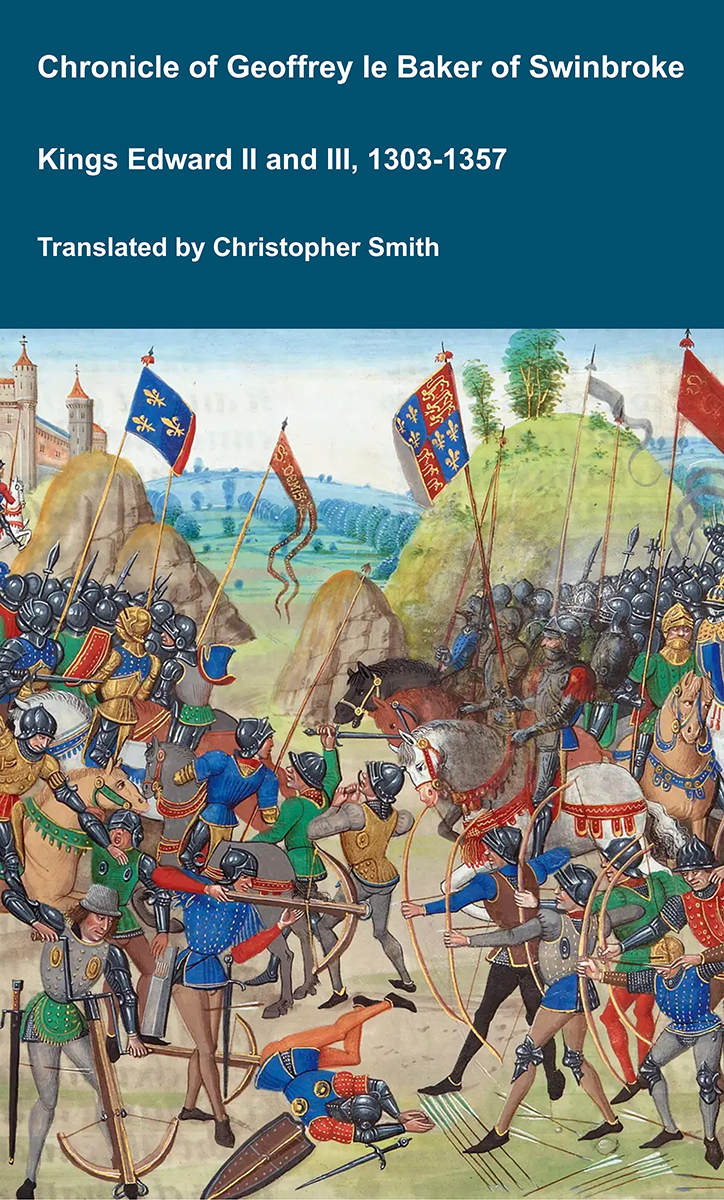
Chronicle of Geoffrey le Baker of Swinbroke
Baker was a secular clerk from Swinbroke, now Swinbrook, an Oxfordshire village two miles east of Burford. His Chronicle describes the events of the period 1303-1356: Gaveston, Bannockburn, Boroughbridge, the murder of King Edward II, the Scottish Wars, Sluys, Crécy, the Black Death, Winchelsea and Poitiers. To quote Herbert Bruce 'it possesses a vigorous and characteristic style, and its value for particular events between 1303 and 1356 has been recognised by its editor and by subsequent writers'. The book provides remarkable detail about the events it describes. Baker's text has been augmented with hundreds of notes, including extracts from other contemporary chronicles, such as the Annales Londonienses, Annales Paulini, Murimuth, Lanercost, Avesbury, Guisborough and Froissart to enrich the reader's understanding. The translation takes as its source the 'Chronicon Galfridi le Baker de Swynebroke' published in 1889, edited by Edward Maunde Thompson.
Available at Amazon in eBook and Paperback format.
[his father] Edmund Cockayne and [his mother] Elizabeth Harthill were married.
[his son] Roger Cockayne was born to John Cockayne.
Great x 3 Grandfather: William Cockayne 
Great x 2 Grandfather: John Cockayne
Great x 1 Grandfather: John Cockayne
GrandFather: John Cockayne
Father: Edmund Cockayne
Great x 4 Grandfather: Richard Vernon 
Great x 3 Grandfather: Richard Vernon
Great x 2 Grandfather: Richard Vernon
Great x 1 Grandfather: William Vernon
GrandMother: Cecilia Vernon
GrandFather: Richard Harthill
Mother: Elizabeth Harthill