


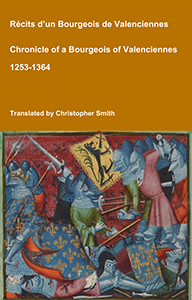
Chronicle of a Bourgeois of Valenciennes
Récits d’un bourgeois de Valenciennes aka The Chronicle of a Bourgeois of Valenciennes is a vivid 14th-century vernacular chronicle written by an anonymous urban chronicler from Valenciennes in the County of Hainaut. It survives in a manuscript that describes local and regional history from about 1253 to 1366, blending chronology, narrative episodes, and eyewitness-style accounts of political, military, and social events in medieval France, Flanders, and the Low Countries. The work begins with a chronological framework of events affecting Valenciennes and its region under rulers such as King Philip VI of France and the shifting allegiances of local nobility. It includes accounts of conflicts, sieges, diplomatic manoeuvres, and the impact of broader struggles like the Hundred Years’ War on urban life in Hainaut. Written from the perspective of a burgher (bourgeois) rather than a monastery or royal court, the chronicle offers a rare lay viewpoint on high politics and warfare, reflecting how merchants, townspeople, and civic institutions experienced the turbulence of the 13th and 14th centuries. Its narrative style combines straightforward reporting of events with moral and civic observations, making it a valuable source for readers interested in medieval urban society, regional politics, and the lived experience of war and governance in pre-modern Europe.
Available at Amazon in eBook and Paperback format.
In 1603 John Cutler 1st Baronet was born to [his father] Edward Cutler Salter of London.
In 1642 John Cutler 1st Baronet (age 39) and Elizabeth Foote (age 14) were married. The difference in their ages was 24 years.
On 28th May 1650 [his wife] Elizabeth Foote (age 23) died.
In November 1660 King Charles II of England Scotland and Ireland (age 30) rewarded of further tranche of those who supported his Restoration by awarding them Baronetcies...
On 8th November 1660 William Russell 1st Baronet was created 1st Baronet Russell of Laugherne in Carmarthenshire.
On 12th November 1660 John Cutler 1st Baronet (age 57) was created 1st Baronet Cutler of London.
On 21st November 1660 John Clotworthy 1st Viscount Massereene was created 1st Viscount Massereene, 1st Baron Lough Neagh, in the Irish peerage, with remainder in default of male heirs to his son-in-law. See Viscountcies of England Created with a Special Remainder.
On 21st November 1660 [his former father-in-law] Thomas Foote 1st Baronet (age 62) was created 1st Baronet Foote of London with a special remainder for title to revert on his death to his son-in-law, Arthur Onslow of West Clandon (age 36).
On 29th November 1660 John Wroth 1st Baronet (age 33) was created 1st Baronet Wroth of Blenden Hall in Kent.
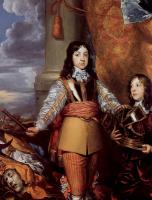


Samuel Pepys' Diary. 23rd January 1663. Thence to Mr. Grant (age 42), to bid him come for money for Mr. Barlow, and he and I to a coffee-house, where Sir J. Cutler (age 60)1 was; and in discourse, among other things, he did fully make it out that the trade of England is as great as ever it was, only in more hands; and that of all trades there is a greater number than ever there was, by reason of men taking more 'prentices, because of their having more money than heretofore. His discourse was well worth hearing.
Note 1. Citizen and grocer of London; most severely handled by Pope. Two statues were erected to his memory-one in the College of Physicians, and the other in the Grocers' Hall. They were erected and one removed (that in the College of Physicians) before Pope stigmatized "sage Cutler". Pope says that Sir John Cutler had an only daughter; in fact, he had two: one married to Lord Radnor; the other, mentioned afterwards by Pepys, the wife of Sir William Portman. B.
Samuel Pepys' Diary. 2nd March 1663. So to the yacht again, and carried us almost to London, so by our oars home to the office, and thence Mr. Pett (age 52) and I to Mr. Grant's coffee-house, whither he and Sir J. Cutler (age 60) came to us and had much discourse, mixed discourse, and so broke up, and so home where I found my poor wife all alone at work, and the house foul, it being washing day, which troubled me, because that tomorrow I must be forced to have friends at dinner. So to my office, and then home to supper and to bed.
Samuel Pepys' Diary. 10th April 1663. Up very betimes and to my office, where most hard at business alone all the morning. At noon to the Exchange [Map], where I hear that after great expectation from Ireland, and long stop of letters, there is good news come, that all is quiett after our great noise of troubles there, though some stir hath been as was reported. Off the Exchange [Map] with Sir J. Cutler (age 60) and Mr. Grant (age 42) to the Royall Oak Tavern, in Lumbard Street, where Alexander Broome the poet was, a merry and witty man, I believe, if he be not a little conceited, and here drank a sort of French wine, called Ho Bryan1, that hath a good and most particular taste that I never met with.
Note 1. Haut Brion, a claret; one of the first growths of the red wines of Medoc.
Samuel Pepys' Diary. 31st July 1663. Before I went to the office I went to the Coffee House, where Sir J. Cutler (age 60) and Mr. Grant (age 43) were, and there Mr. Grant showed me letters of Sir William Petty's (age 40), wherein he says, that his vessel which he hath built upon two keeles (a modell whereof, built for the King (age 33), he showed me) hath this month won a wager of £50 in sailing between Dublin and Holyhead with the pacquett-boat, the best ship or vessel the King hath there; and he offers to lay with any vessel in the world. It is about thirty ton in burden, and carries thirty men, with good accommodation, (as much more as any ship of her burden,) and so any vessel of this figure shall carry more men, with better accommodation by half, than any other ship. This carries also ten guns, of about five tons weight. In their coming back from Holyhead they started together, and this vessel came to Dublin by five at night, and the pacquett-boat not before eight the next morning; and when they came they did believe that, this vessel had been drowned, or at least behind, not thinking she could have lived in that sea. Strange things are told of this vessel, and he concludes his letter with this position, "I only affirm that the perfection of sayling lies in my principle, finde it out who can".
Samuel Pepys' Diary. 22nd December 1663. Up and there comes my she cozen Angier, of Cambridge, to me to speak about her son. But though I love them, and have reason so to do, yet, Lord! to consider how cold I am to speak to her, for fear of giving her too much hopes of expecting either money or anything else from me besides my care of her son. I let her go without drinking, though that was against my will, being forced to hasten to the office, where we sat all the morning, and at noon I to Sir R. Ford's (age 49), where Sir R. Browne (age 58) (a dull but it seems upon action a hot man), and he and I met upon setting a price upon the freight of a barge sent to France to the Duchess of Orléans (age 19). And here by discourse I find them greatly crying out against the choice of Sir J. Cutler (age 60) to be Treasurer for Paul's upon condition that he give £1500 towards it, and it seems he did give it upon condition that he might be Treasurer for the work, which they say will be worth three times as much money, and talk as if his being chosen to the office will make people backward to give, but I think him as likely a man as either of them, or better.


In 1669 John Cutler 1st Baronet (age 66) and Elicia Tipping were married. She by marriage Lady Cutler of London.
John Evelyn's Diary. 25th February 1672. To London, to speak with the Bishop, and Sir John Cutler (age 69), our patron, to present Mr. Frampton (age 49) (afterward Bishop of Gloucester).
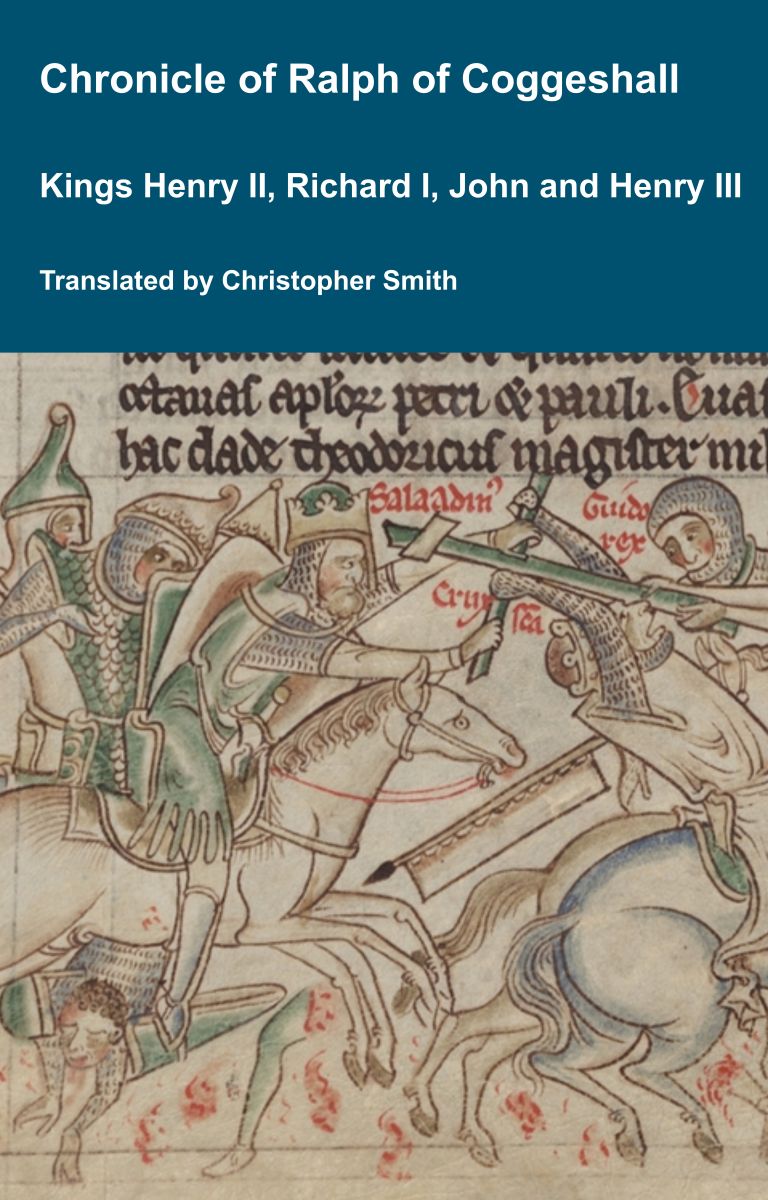
Chronicle of Abbot Ralph of Coggeshall
The Chronicle of Abbot Ralph of Coggeshall (Chronicon Anglicanum) is an indispensable medieval history that brings to life centuries of English and European affairs through the eyes of a learned Cistercian monk. Ralph of Coggeshall, abbot of the Abbey of Coggeshall in Essex in the early 13th century, continued and expanded his community’s chronicle, documenting events from the Norman Conquest of 1066 into the tumultuous reign of King Henry III. Blending eyewitness testimony, careful compilation, and the monastic commitment to record-keeping, this chronicle offers a rare narrative of political intrigue, royal power struggles, and social upheaval in England and beyond. Ralph’s work captures the reigns of pivotal figures such as Richard I and King John, providing invaluable insights into their characters, decisions, and the forces that shaped medieval rule. More than a simple annal, Chronicon Anglicanum conveys the texture of medieval life and governance, making it a rich source for scholars and readers fascinated by English history, monastic authorship, and the shaping of the medieval world.
Available at Amazon in eBook and Paperback format.
John Evelyn's Diary. 21st April 1672. To my Lord of Canterbury (age 73), to entreat him to engage Sir John Cutler (age 69), the patron, to provide us a grave and learned man, in opposition to a novice.
In 1676 John Cutler 1st Baronet (age 73) was appointed High Sheriff of Kent.
In 1679 John Cutler 1st Baronet (age 76) was elected MP Taunton which seat he held until 1680.
In 1689 [his son-in-law] Charles Robartes 2nd Earl Radnor (age 29) and [his daughter] Elizabeth Cutler Countess Radnor were married. She by marriage Countess Radnor.
In 1689 John Cutler 1st Baronet (age 86) was elected MP Bodmin which seat he held until 1693.
Before 1693 John Cutler 1st Baronet (age 89) was appointed Master of the Worshipful Company of Grocers four times.
In 1693 John Cutler 1st Baronet (age 90) died without male issue. He was buried at St Margaret's Church, Westminster [Map]. Baronet Cutler of London extinct. His estates were inherited by his daughter [his daughter] Elizabeth Cutler Countess Radnor.
[his daughter] Elizabeth Cutler Countess Radnor was born to John Cutler 1st Baronet and Elizabeth Foote. She married 1689 Charles Robartes 2nd Earl Radnor.