


William of Worcester's Chronicle of England
William of Worcester, born around 1415, and died around 1482 was secretary to John Fastolf, the renowned soldier of the Hundred Years War, during which time he collected documents, letters, and wrote a record of events. Following their return to England in 1440 William was witness to major events. Twice in his chronicle he uses the first person: 1. when writing about the murder of Thomas, 7th Baron Scales, in 1460, he writes '… and I saw him lying naked in the cemetery near the porch of the church of St. Mary Overie in Southwark …' and 2. describing King Edward IV's entry into London in 1461 he writes '… proclaimed that all the people themselves were to recognize and acknowledge Edward as king. I was present and heard this, and immediately went down with them into the city'. William’s Chronicle is rich in detail. It is the source of much information about the Wars of the Roses, including the term 'Diabolical Marriage' to describe the marriage of Queen Elizabeth Woodville’s brother John’s marriage to Katherine, Dowager Duchess of Norfolk, he aged twenty, she sixty-five or more, and the story about a paper crown being placed in mockery on the severed head of Richard, 3rd Duke of York.
Available at Amazon in eBook and Paperback format.
Paternal Family Tree: Hotham
In September 1540 John Hotham of Scorborough was born.
Before 1578 John Hotham of Scorborough (age 37) and Juliana Stanhope were married.
After 1578 John Hotham of Scorborough (age 37) and Mary Goring (age 23) were married.
On 10th January 1585 John Hotham of Scorborough (age 44) and Jane Legard (age 17) were married. The difference in their ages was 27 years.
Around July 1589 [his son] John Hotham 1st Baronet was born to John Hotham of Scorborough (age 48) and [his wife] Juliana Stanhope. He married (1) 16th February 1607 Katherine Rodes and had issue (2) 16th July 1614 Anne Rokeby (3) 27th October 1631 Katherine Bamburgh, daughter of William Bamburgh 1st Baronet and Mary Ford Viscountess Fairfax Lady Bamburgh.
On 16th February 1607 [his son] John Hotham 1st Baronet (age 17) and [his daughter-in-law] Katherine Rodes were married. She brought a dowry of 1,000 marks. They he had two sons and two daughters all of whom predeceased their father.
On 15th June 1609 John Hotham of Scorborough (age 68) died.
On 1st June 1623 [his former wife] Jane Legard (age 55) died.
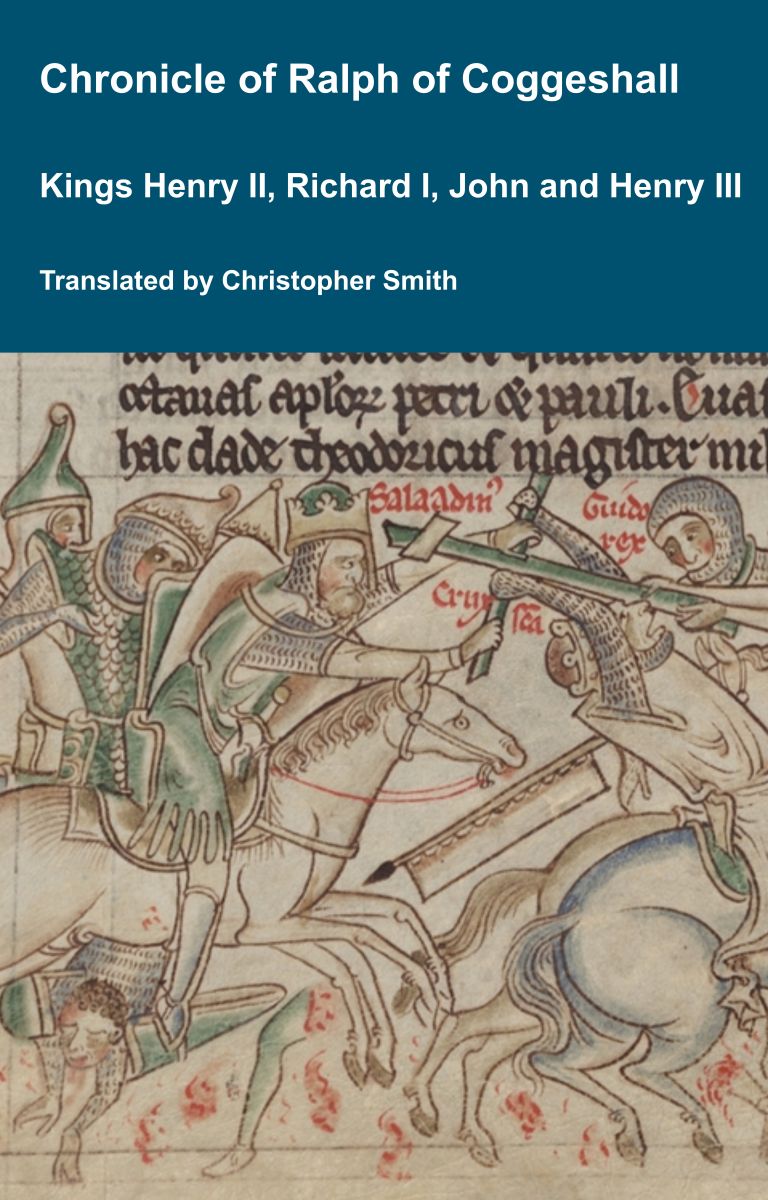
Chronicle of Abbot Ralph of Coggeshall
The Chronicle of Abbot Ralph of Coggeshall (Chronicon Anglicanum) is an indispensable medieval history that brings to life centuries of English and European affairs through the eyes of a learned Cistercian monk. Ralph of Coggeshall, abbot of the Abbey of Coggeshall in Essex in the early 13th century, continued and expanded his community’s chronicle, documenting events from the Norman Conquest of 1066 into the tumultuous reign of King Henry III. Blending eyewitness testimony, careful compilation, and the monastic commitment to record-keeping, this chronicle offers a rare narrative of political intrigue, royal power struggles, and social upheaval in England and beyond. Ralph’s work captures the reigns of pivotal figures such as Richard I and King John, providing invaluable insights into their characters, decisions, and the forces that shaped medieval rule. More than a simple annal, Chronicon Anglicanum conveys the texture of medieval life and governance, making it a rich source for scholars and readers fascinated by English history, monastic authorship, and the shaping of the medieval world.
Available at Amazon in eBook and Paperback format.
Archaeologia Volume 31 Section V. Melford, Suffolk, May 8th, 1844.
MY DEAR SIR,
In the valuable collection of Original Letters edited by Sir Henry Ellis (Vol. II. second Series), I observe two in 1569 and 1570 from [his mother-in-law] Lady Stanhope to Sir William Cecill, respecting the unhappy marriage of her [his wife] daughter with Mr. afterwards Sir John Hotham of Scorborough in Yorkshire, and also Sir John's letter to Cecill, as "Master of the Wards and Lyveries," defending himself, and in which he expatiates on the "Stanhopes eville delinge many wayes," but with less asperity than the lady, who not only reviles him, but, in fact, the whole county of York, and says "especially in Yorkshire, where he may suborne men and women to say what he listeth to serve his devilishe purpose." The lady had purchased the wardship of Hotham, and married him to her daughter, but it appears that after all it was a bad bargain, as she had not purchased his love. The Lord Treasurer Burghley found time for everything, and this lady even troubled him after her death. I shall be glad if you think the letter which I inclose worthy of notice by the Society of Antiquaries; the foolscap sheet is very neatly folded up, and endorsed in Lord Burghley's business-like manner, "6. Ap. 1588, Sr [his brother-in-law] Thomas Stanhoppe, Towchinge his Mothers funeralls." Anne Lady Stanhope was the widow of Sir Michael Stanhope, who was beheaded in 1551 on a charge of conspiring with the Protector Somerset, who had married his half-sister, to assassinate the Duke of Northumberland, the Marquess of Northampton, and the Earl of Pembroke, at a banquet at the Lord Paget's, but his chief offence appears to have been that he was brother-in-law to Somerset. His widow is described by Collins as having "kept continually a worshipful house, relieved the poor daily, gave good countenance and comfort to the preachers of God's word, spent the most of her latter days in prayer, and using the church where God's word was preached." Her son, Sir Thomas, dates his letter from Shelford1 in Nottinghamshire, a dissolved monastery, which with the manor had been granted by Henry VIII. to his father. Sir Thomas was ancestor of several noble families, and his letter shows the magnificence of his ideas, but the dole to the poor at his gate was probably only a continuance or revival of the old custom in the time of his predecessors the monks.
Believe me to be
Very faithfully yours,
RICHD. ALMACK.
ALBERT WAY, Esq., M.A., Director S.A.
Note 1. Shelford House was a garrison for King Charles the First, under the care of Philip Stanhope, son of the first Earl of Chesterfield, the grandson of this Sir Thomas Stanhope. In Mrs. Hutchinson's Memoirs of Col. John Hutchinson is a very interesting and minute account of the storming of this house, the miserable death of Philip Stanhope, and the destruction of the house by fire.
 Become a Member via our Buy Me a Coffee page to read more.