

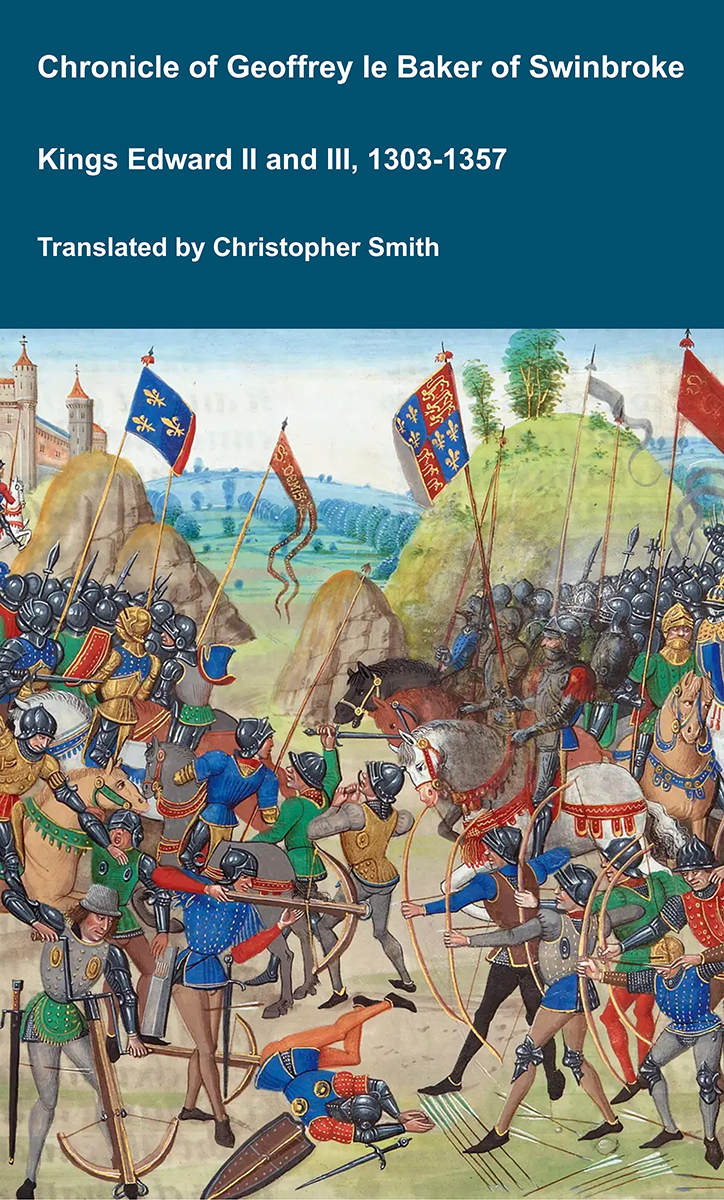
Chronicle of Geoffrey le Baker of Swinbroke
Baker was a secular clerk from Swinbroke, now Swinbrook, an Oxfordshire village two miles east of Burford. His Chronicle describes the events of the period 1303-1356: Gaveston, Bannockburn, Boroughbridge, the murder of King Edward II, the Scottish Wars, Sluys, Crécy, the Black Death, Winchelsea and Poitiers. To quote Herbert Bruce 'it possesses a vigorous and characteristic style, and its value for particular events between 1303 and 1356 has been recognised by its editor and by subsequent writers'. The book provides remarkable detail about the events it describes. Baker's text has been augmented with hundreds of notes, including extracts from other contemporary chronicles, such as the Annales Londonienses, Annales Paulini, Murimuth, Lanercost, Avesbury, Guisborough and Froissart to enrich the reader's understanding. The translation takes as its source the 'Chronicon Galfridi le Baker de Swynebroke' published in 1889, edited by Edward Maunde Thompson.
Available at Amazon in eBook and Paperback format.
In 1362 John Philpot was given the wardship of Robert Ogle of Ogle and Bothal (age 10) by King Edward III.
In 1371 John Philpot was elected MP London.
Archaeologia Volume 22 Section XVI. Of the discord raised in St Paule hys churche in London, betwene the Cleargie & the Duke, & Syr Henry Percye & the Londoners, by John Wiclyffe (age 49).
Thys sonne, therfor, of perdition, John Wiclyffe, was to appeare before the bishopps the Thursday before the feast of St. Peter his chaire [23rd February 1377],x there to be convented for marvellous wordes that he had spoken, Sathan, the adversarye of the whoole churche, as ys beleaved, teachynge hym; whoe after the nynth houre, the duke & Syr Henry Percye, & divyers other assystynge hym, whoe by there powre were able to trouble the weake people, & also beynge as a meane betwene them, that yf any thynge sholde fall from the table of the ritche bishopps, that ys to say plate, although it were soyled in the fall, they wolde gather yt upp & wolde chew yt by there backbytynge, beholde the abominable hoste, John aforenamed, was brought furthe with greate pompe, nether yet was sufficient yt for hym to have onely the common sergeants, unlesse Syr Henrye Percye the chiefe Marshall of Englande did goe before hym; in the waye he was animated by his companions not to feare the congregation of the bishopps, whoe in respect of hym were unlearned; nether yet the concourse of the people, seynge that he was walled in on every syde with so many knightes. His body was now broughte into St. Paule's churche with an incredible pryde, where such a multitude of people was gathered togeather to heare hym, that yt was harde for the noble men & knyghtes (the people lettynge them) to passe through, and even by & by with this occasion they were persuaded craftely to pull backe with there handes there scholer, that he myght escape deathe entended hym by manye bishopps. The devill founde a way, that fyrste a dissension beynge mayde betwene the noble men & bishopp, hys answeare myght be differed. Truly when the people beynge gathered togeather, stayed to geave place unto the noble men, Syr Henry Percye, abusynge hys authorytye, miserably pricked forwardes the people in the churche, whiche the Bishopp of London seyng, prohibited hym to exercyse suche authoritye in the churche, saynge that yf he had knowne he wolde have used hym selffe so there, he sholde not have come into the churche yf he coulde have letted hym, whiche the duke hearynge was offended, & protested that he wolde exercyse suche authorytye whether he wolde or not. When they were come into our Ladyes chappell, the duke & barons, with the archbishopp & bishopps, syttynge downe, the foresayed John also was sent in by Syr Henrye Percye to sytt downe, for because, sayed he, he haythe much to answeare he haith neade of a better seate. On the other syde, the byshopp of London denyed the sayme, affyrmynge yt to be agaynst reason that he sholde sytt there, & also contrary to the law for hym to sytt, whoe there was cited to answere before hys ordinarye; & therfor the tyme of hys answearynge, or so longe as any thynge sholde be deposed agynste hym, or hys cause sholde be handled, he ought to stande. Here upon very contumelyous wordes did ryse betwene Syr Henrye Percye & the bishopp, & the whoole multitude began to be troubled. And then the duke began to reprehende the bishopp, & the bishopp to turne then on the duke agayne. The duke was ashamed that he colde not in this stryfe prevaile,y & then began with frowarde threatenynges to deale with the bishopp, swearyng that he wolde pull downe both the pryde of hym & of all the bishopps in Englande, & added, thou trustest (sayed he) in thy parents, whoe can profytt the nothynge, for they shall have enough to doo to defend themselves, for hys parents, that ys to say hys father & hys mother, were of nobylitye, the Earle & the Countes of Devonshire. The bishopp on the other syde sayed, in defendynge the trueth I truste not in my parents, nor in the lyfe of any man, but in God in whom I ought to trust. Then the duke whysperynge in his eare sayed he had rather draw hym furth of the churche by the heare then suffer such thynges. The Londoners hearynge these words, angerlye with a lowd voyce cried out, swearynge they wolde not suffer there Bishopp to be injured, & that they wold soner loose there lyfe then there bishopp sholde be dishonered in the churche, or pulled out with such vyolence. There fury was the more encreased, for that the same day before none in the parlyament at Westminster, the duke being president, &c. it was requested in the kyngs name, that from that day forward there should be no more Mayre of London accordynge to the auncyent custome, but a captayne, and that the Marshall of England, as well in the cytye as in other places myght arrest such as offended, with many other thynges, which were manyfestly agaynst the lybertyes of the cytye, and portended daungers and hurt to the same, which being once hard, John Philpott, a cytezyn of specyall name, arose, and affyrmed that such thyngs were never sene, and that the mayor & comons wold suffer no such arrest, and so before none the counsell brake up. The duke and the byshops revylyng one another, the people wonderfully enraged and trobled, the enemy of mankynde, as I sayd before, procuryng this counsell, and by these occasyons that false varlet & mynyster of the devill persuaded, lest he should be confounded in his inventions, for he saw that in all thyngs he wold be profytable unto hym, & therefore was careful lest such a defender of his part should perysh ether secretly or so lightly.
Note x. The date here assigned to this remarkable transaction is doubted by Lowth, because the Pope's Bull, which he supposes to have been the cause of Wicliffe's citation to St. Paul's, bears as late a date as the 22d of May 1377. He therefore concludes, that the tumult could not have happened many days before the death of Edward the Third, which occurred on the 21st of June. Lewis, in his Life of Wicliffe (p. 50), supposes the meeting at St. Paul's not to have taken place till the February of the succeeding year, after the accession of Richard the Second, in which he is followed by Mr. Baber, in the memoirs prefixed to his edition of Wicliffe's New Testament, p. xvii. This, however, is completely at variance not only with the relation in the text, but also with that of Walsingham, the Continuator of Murimuth, and the other contemporary or early authorities. Mr. Godwin (Life of Chaucer, ii. p. 251) defends the earlier date, suggesting that the citation to St. Paul's was the immediate and personal act of the English prelacy, and that it was the citation of Wicliffe to Lambeth in the following year, which was the result of the Pope's interference, the English Bishops having found themselves too weak in the contest, and having, on that account, invited the interposition of the sovereign Pontiff. This appears to be the true solution, agreeing with the statement in the text, that it was upon the suggestion of the bishops, that Archbishop Sudbury had been unwillingly moved to issue the citation. It is true, indeed, that the mandate (preserved in Wilkin's Concilia, iii. p. 123), which the Archbishop and the Bishop of London, in consequence of the authority vested in them by the Pope's Bull, issued to the Chancellor of Oxford on the 5th of January following, required Wicliffe's presence at St. Paul's on the thirtieth juridical day from that date. But as we have no account from the contemporary writers that any second meeting in St. Paul's actually took place, it may be reasonably concluded that Lambeth was afterwards substituted, as a less likely scene for the renewal of popular commotion, though the result proved otherwise. The opinion here expressed may be strengthened by remarking that not only Fox, but his able antagonist Harpsfeld, who, though a zealous papist, was furnished with materials for his Ecclesiastical History by Archbishop Parker (in whose mild custody he was a prisoner) understood the tumult at St. Paul's to have preceded and been the cause of the Pope's interference, and that the proceeding at Lambeth was the consequence of it. Hist. Wicleffiana, p. 683.
Note y. y Fox, in quoting the Chronicle of St. Alban's, then belonging to Archbishop Parker, from which (as is stated in the introductory Letter) the Chronicle above printed is conceived to have been a translation, says, "to use the words of mine author, 'Erubuit Dux quod non potuit prevalere litigio,' i. e. that the Duke blushed because he could not overpasse the Bishop in brawling and railing." Acts & Mon. i. p. 558, edit. 1641. It clearly appears from this and other passages, that Fox had the use of the Latin original, translating it into language which suited his purpose, though not departing from the facts. Fuller, in his Church History, has dramatized this dialogue between the duke and the bishop, in his usual quaint style.
Archaeologia Volume 22 Section XVI. The Londoners go to the Kyng about the enjoyning their Liberties.
[Around 21st March 1377] The Londoners having held a comon councill about this present matter, sent of the chefe of there citie, ether to justifie that which had happened, or to excuse them unto the kyng, who suing long tyme to come unto the kynges speache, were kept from the kynges presence thorough the procurement of the duke as ytt is thought, yett att length after one dayes stayeng, the duke seing that they resolutely persisted in theyre determination to speak wyth the king, came unto them, willing them to declare unto him the cause of the coming, affirming that his Lord the King was very ill at ease, & that his sickness myght lightly be encreased yf that he were moved to anger, or should heare ought that dyd encounter or crosse his will & that which he would have. But the citizens, whose speaker & chefest man was John Philpott,g answered the duke wyth due reverence that they were not come by any meanes to augment the kinges sicknes ether by their coming or speache, but rather to mitigate his greif, that he myght be strong to defend them & others if that they myght obteyne access unto his highnes, moreover they sayd that they were charged that they should not communicate those matters which they had in commission from the citie, unto any other than unto theyre liegelord the king himselffe, specially seing that their liege the king had oftentymes willed them that in any matter that touched the citie & citizens, they should not make any other men mediators unto him, but declare theire owne matters them selves unto hym, face to face. But yf they should otherwyse doo then he him self had commanded & the citie had enjoyned them, that then they should gett them evill thankes att both their handes, when they had by such allegations obteyned accesse, they shewed unto the king, how ytt had been published in the parliament that ytt was his will that contrarye unto theyre liberties, the maior should be deposed, & a capteyne created, & other matters in parliament which sowned against there libertyes, also they excused themselves of dyvers things which had been done during the tyme of the comotion of the comonaltie of the citie, which myght redounde unto the dyshonor of the duke, sayeng that they were not pryvie unto any such doinges, but that among so greate a multitude, some lewd felowes had done such matters, they being unwittinge & unwilling, nether can so great a multitude be moved by the exhortations of the maire, when they be once upp, but they goo like a whirlwynd, hither & thither according unto the indiscrete direction of sundry heddes, untill they have done some great thing to the hurt of other or themselves; yet, blessed be God, our duke hath felt no harme, nether hath any of his ben hurt. But the king being a little cheared upp with theire comyng, answered that he would not the diminishing of theire liberties; no, he was rather ready yf neede were to augment them, nether dyd any such resolution ever come out of his mouth, & therefore he encouraged them not to feare, commanding them to depart home, & to appease the citizens, & to keape them in peace. After they had taken theire leave of the king, as they were comyng back agayne, they mett wyth the duke in the haule, who chardging them wyth those matters that we have told how they dyd, they answered as we have told you, they reported unto the king, adding there unto that yff they would fynd out or learne what he was that had devised such a dyshonor unto the reproach of the duke, that they would punish him as the duke him self would, or yff he would rather so, delyver him unto him for to be punished according to his owne pleasure. They sayed moreover that the citie dyd desyre him to stand theyre good Lord as he was wont, & yfi that ought had ben done otherwyse than became them, he should find the citie ready to satisfye him in all thinges. When the duke heard this he was glad, hoping that he should gayne some greate somme of money of the citizens, for he thought that they had used such speache for feare, but ytt was far otherwise then he trusted, for when he sayd that he would presently entreat wyth them about the instant matter, because he thought that, seing the chief of the citie were there, they were sufficient for to deale for all the comons, they answered, that they being citizens had ben sent by the citie unto there leige the king for dyvers causes, which being dispatched, there ambassade was expired, wherefore they could not entreat wyth him unless they had receaved new commission from the citie, & so the joyfulnes of the duke was deluded. But the citizens returning unto the citie, & declarynge in order what had happened, brought no small joye to all the citizens.
Note g. John Philpot was Mayor of London in 1378, and was knighted in Smithfield by Richard the Second in 1381, upon the overthrow of Wat Tyler. "A man," says Stow, "of jolly wit, and very rich in substance." Of the wealth and spirit of this citizen, some estimate will be formed, when we are told by Stow that, in 1378, "he hired with his own money 1000 soldiers, and defended the realm against the incursions of the enemy; so that in small time his hired men took John Mercer, a sea rover, with all his ships which he had before taken from Scarborough, and fifteen Spanish ships laden with great riches." Survey of London, b. i. p. 261, edit. 1720. For undertaking this adventure without the sanction of the Council, his conduct was censured, but he made a stout and triumphant defence, and it appears in Rymer that he was afterwards employed in affairs of trust by Richard the Second, to whom he had furnished loans.
In 1378 John Philpot was appointed Lord Mayor of London.
In 1381 John Philpot was elected MP London.
On 15th June 1381 King Richard II of England (age 14) met with Wat Tyler at Smithfield [Map]. During the course of the meeting Wat Tyler was wounded by William Walworth. Wat Tyler was then captured and beheaded at Smithfield [Map]. His head was placed on top a pole and carried through the city, then displayed on London Bridge.
William Walworth and John Philpot were knighted by King Richard II of England.


In 1384 John Philpot died.