

Chronicle of Walter of Guisborough
A canon regular of the Augustinian Guisborough Priory, Yorkshire, formerly known as The Chronicle of Walter of Hemingburgh, describes the period from 1066 to 1346. Before 1274 the Chronicle is based on other works. Thereafter, the Chronicle is original, and a remarkable source for the events of the time. This book provides a translation of the Chronicle from that date. The Latin source for our translation is the 1849 work edited by Hans Claude Hamilton. Hamilton, in his preface, says: 'In the present work we behold perhaps one of the finest samples of our early chronicles, both as regards the value of the events recorded, and the correctness with which they are detailed; Nor will the pleasing style of composition be lightly passed over by those capable of seeing reflected from it the tokens of a vigorous and cultivated mind, and a favourable specimen of the learning and taste of the age in which it was framed.'
Available at Amazon in eBook and Paperback format.
On 27th April 1759 Mary Wollstonecraft was born.
Around 1789 Henry Fuseli (age 47) and Mary Wollstonecraft (age 29) planned a trip with him to Paris. His wife Sophia Rawlins stopped any communication between the two.


Around 1790. John Opie (age 28). Portrait of Mary Wollstonecraft (age 30).

On 7th January 1792 Mary Wollstonecroft's (age 32) Vindication of the Rights of Women was published.

Around 1797. John Opie (age 35). Portrait of Mary Wollstonecraft (age 37).
On 29th March 1797 William Godwin (age 41) and Mary Wollstonecraft (age 37) were married probably because Mary Wollstonecraft was pregnant with Mary Godwin aka Shelley who was born five months later and who Mary Wollstonecraft wanted to be legitimate.


30th August 1797 [her daughter] Mary Godwin aka Shelley was born to [her husband] William Godwin (age 41) and Mary Wollstonecraft (age 38). She married 30th December 1816 Percy Bysshe Shelley, son of Timothy Shelley 2nd Baronet and Elizabeth Pilfold, and had issue.
On 10th September 1797 Mary Wollstonecraft (age 38) died from childbirth eleven days after the birth of [her daughter] Mary Godwin aka Shelley.
On 21st December 1801 [her former husband] William Godwin (age 45) and Mary Jane de Vial (age 33) were married. She was pregnant at the time; the second marriage of his precipitated by pregnancy. The child died young.
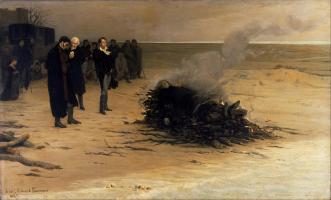
1911 Encyclopædia Britannica. The upshot came on the 28th of July, when [her future son-in-law] Shelley (age 21) aided [her daughter] Mary (age 16) [Mary Godwin aka Shelley] to elope from her father's house, Claire Clairmont (age 16) deciding to accompany them. They crossed to Calais, and proceeded across France into Switzerland. [her former husband] Godwin (age 58) and his wife were greatly incensed. Though he and Mary Wollstonecraft had entertained and avowed bold opinions regarding the marriage-bond, similar to Shelley's own, and had in their time acted upon these opinions, it is not clearly made out that Mary Godwin had ever been encouraged by paternal influence to think or do the like. Shelley and she chose to act upon their own likings and responsibility - he disregarding any claim which Harriet had upon him, and Mary setting at nought her father's authority. Both were prepared to ignore the law of the land and the rules of society. The three young people returned to London in September.


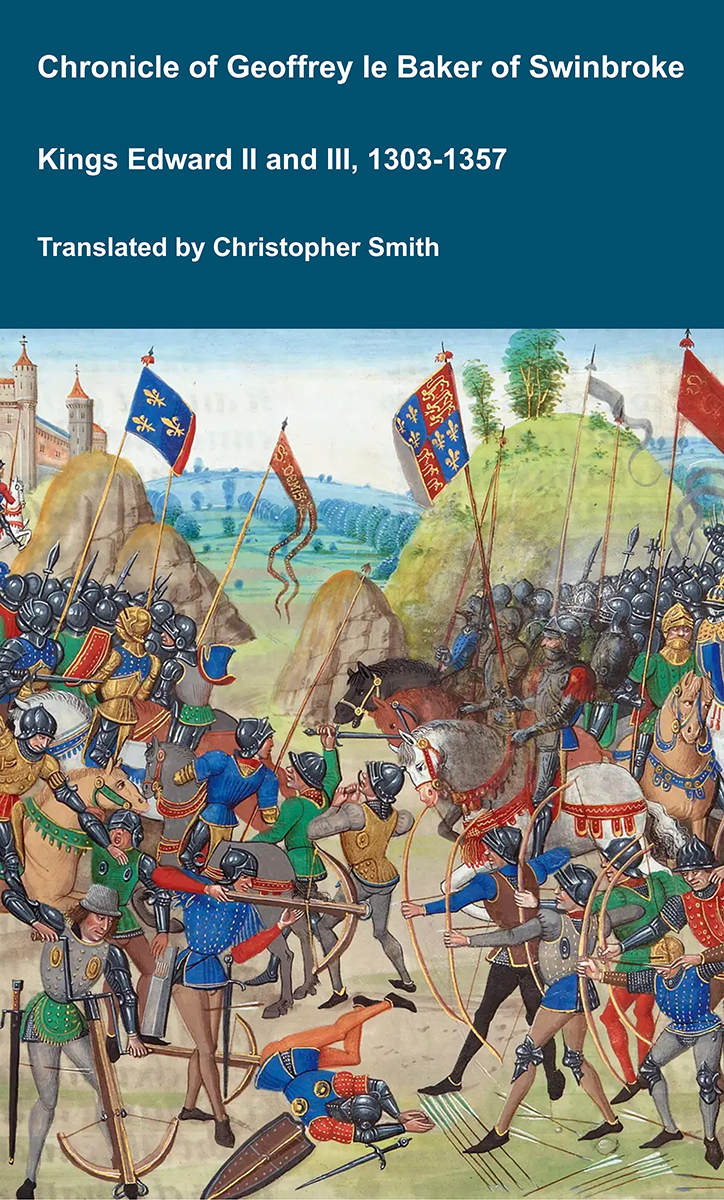
Chronicle of Geoffrey le Baker of Swinbroke
Baker was a secular clerk from Swinbroke, now Swinbrook, an Oxfordshire village two miles east of Burford. His Chronicle describes the events of the period 1303-1356: Gaveston, Bannockburn, Boroughbridge, the murder of King Edward II, the Scottish Wars, Sluys, Crécy, the Black Death, Winchelsea and Poitiers. To quote Herbert Bruce 'it possesses a vigorous and characteristic style, and its value for particular events between 1303 and 1356 has been recognised by its editor and by subsequent writers'. The book provides remarkable detail about the events it describes. Baker's text has been augmented with hundreds of notes, including extracts from other contemporary chronicles, such as the Annales Londonienses, Annales Paulini, Murimuth, Lanercost, Avesbury, Guisborough and Froissart to enrich the reader's understanding. The translation takes as its source the 'Chronicon Galfridi le Baker de Swynebroke' published in 1889, edited by Edward Maunde Thompson.
Available at Amazon in eBook and Paperback format.
On 7th April 1836 [her former husband] William Godwin (age 80) died.
Cansisk's Monumental Inscriptions Volume 1 Old St Pancras Churchyard. Churchyard St Pancras Old Church [Map]. Mary Wollstonecraft Godwin, Author of A Vindication of the Rights of Woman; Born 27th April 1759: Died 10th September, 1797.1
[her former husband] William Godwin, Author of Political Justice. Born March 3rd 1756: Died April 7th 1836, Aged 80 years.
Mary Jane (deceased), Second Wife of William Godwin, Died June I7th 1841, Aged 75 years.
Note 1. This well-known writer was bom in 1759. The place of her birth is uncertain, but is supposed to have been at a farm in Epping Forest. At an early age she engaged herself in the occupation of tuition, for which she was eminently qualified. Unhappily, her sentiments on religious subjects were most exceptional, and she had imbibed principles hostile to that system which has been long established for the regulation of civil society. It was well, therefore, that after a few years she declined the employment of tuition, and confined herself to her pen. Having a contempt for the institution of marriage, she entered into a connection with Mr. Imlay, an American merchant, whom she met at Paris in 1792, and made with him a tour in the north of Europe, of which she gave an account in an interesting volume of letters in 1796. In consequence of the desertion of this gentleman, she resolved upon destroying herself (having failed in the attempt a few months before); she went by water from London Bridge to Putney, and deliberately jumped off Putney Bridge in the month of October, 1795. She was baffled in her attempt this time; her clothes having buoyed her up, she was rescued 'by some watermen. In July, 1796, Mrs. Wollstonecraft took a house at Somers Town, in the parish of St. Pancras, not long after which she formed a connection with the well-known author of "Political Justice," &c. Their sentiments were perfectly in unison, and they both had so thorough a contempt for the rite of marriage, that it was only in consequence of her pregnancy, and the apprehension that she might incur that exclusion from the society of many valuable and esteemed friends which custom awards ip cases of this kind, that they were induced to comply with that ceremony. In April, 1797, Mr. and Mrs. Godwin took a house in the Polygon, Somers Town, where on the 10th of September following Mrs. Godwin died, eleven days after having given birth to a daughter. She was the mother of the future wife of Percy Bysshe Shelley, the poet.