

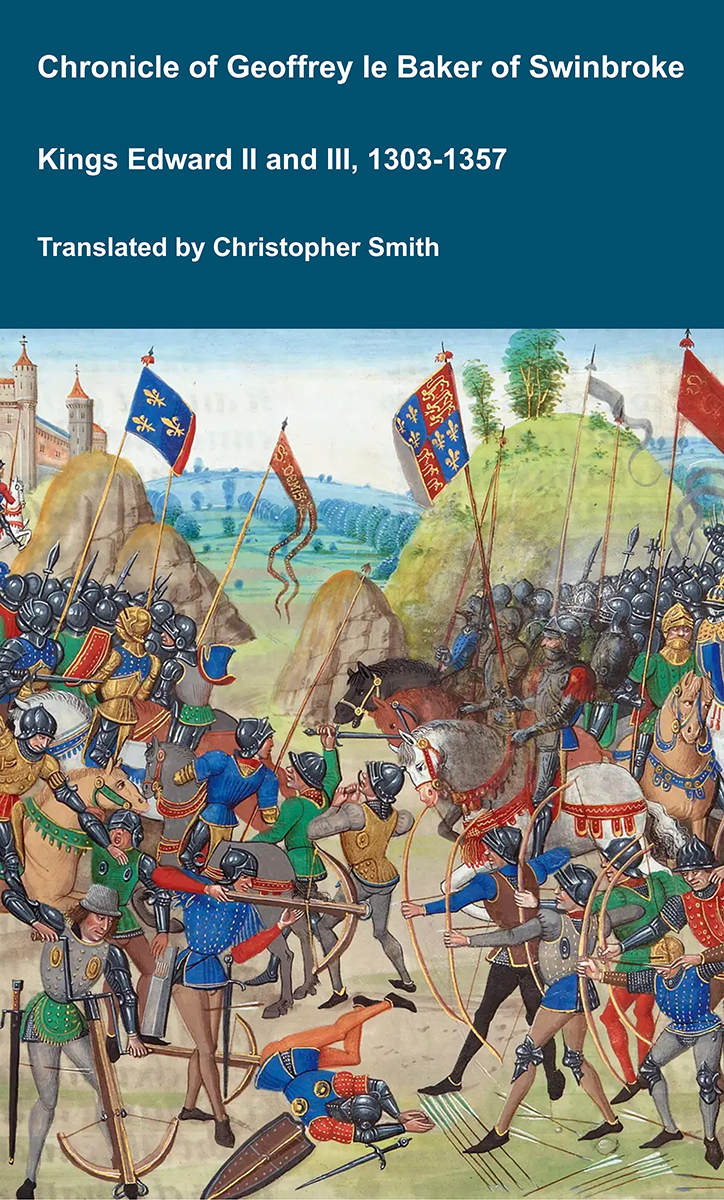
Chronicle of Geoffrey le Baker of Swinbroke
Baker was a secular clerk from Swinbroke, now Swinbrook, an Oxfordshire village two miles east of Burford. His Chronicle describes the events of the period 1303-1356: Gaveston, Bannockburn, Boroughbridge, the murder of King Edward II, the Scottish Wars, Sluys, Crécy, the Black Death, Winchelsea and Poitiers. To quote Herbert Bruce 'it possesses a vigorous and characteristic style, and its value for particular events between 1303 and 1356 has been recognised by its editor and by subsequent writers'. The book provides remarkable detail about the events it describes. Baker's text has been augmented with hundreds of notes, including extracts from other contemporary chronicles, such as the Annales Londonienses, Annales Paulini, Murimuth, Lanercost, Avesbury, Guisborough and Froissart to enrich the reader's understanding. The translation takes as its source the 'Chronicon Galfridi le Baker de Swynebroke' published in 1889, edited by Edward Maunde Thompson.
Available at Amazon in eBook and Paperback format.
On 1st November 1609 Matthew Hale was born.
On 7th November 1650 Matthew Hale (age 41) was appointed Chief Baron of the Exchequer.
Samuel Pepys' Diary. 20th November 1662. After dinner to the Temple [Map], to Mr. Thurland; and thence to my Lord Chief Baron, Sir Edward Hale's (age 53) [Pepy's appear to name Matthew Hales as Edward Hales?], and back with Mr. Thurland to his chamber, where he told us that Field will have the better of us; and that we must study to make up the business as well as we can, which do much vex and trouble us: but I am glad the Duke (age 29) is concerned in it.

Samuel Pepys' Diary. 21st February 1663. Up and to the office, where Sir J. Minnes (age 63) (most of the rest being at the Parliament-house), all the morning answering petitions and other business. Towards noon there comes a man in as if upon ordinary business, and shows me a writ from the Exchequer, called a Commission of Rebellion, and tells me that I am his prisoner in Field's business; which methought did strike me to the heart, to think that we could not sit in the middle of the King's business. I told him how and where we were employed, and bid him have a care; and perceiving that we were busy, he said he would, and did withdraw for an hour: in which time Sir J. Minnes took coach and to Court, to see what he could do from thence; and our solicitor against Field came by chance and told me that he would go and satisfy the fees of the Court, and would end the business. So he went away about that, and I staid in my closett, till by and by the man and four more of his fellows came to know what I would do; I told them stay till I heard from the King (age 32) or my Lord Chief Baron (age 53), to both whom I had now sent. With that they consulted, and told me that if I would promise to stay in the house they would go and refresh themselves, and come again, and know what answer I had: so they away, and I home to dinner, whither by chance comes Mr. Hawley and dined with me. Before I had dined, the bayleys come back again with the constable, and at the office knock for me, but found me not there; and I hearing in what manner they were come, did forbear letting them know where I was; so they stood knocking and enquiring for me.
On 18th May 1671 Matthew Hale (age 61) was appointed Chief Justice of the King's Bench.
John Evelyn's Diary. 26th May 1671. Having brought an action against one Cocke, for money which he had received for me, it had been referred to an arbitration by the recommendation of that excellent good man, the Chief-Justice Hale (age 61), but, this not succeeding, I went to advise with that famous lawyer, Mr. Jones, of Gray's Inn, and, 27th of May, had a trial before Chief Justice of the King's Bench Hale; and, after the lawyers had wrangled sufficiently, it was referred to a new arbitration. This was the very first suit at law that ever I had with any creature, and oh, that it might be the last!
On 25th December 1676 Matthew Hale (age 67) died.