


Chronicle of Abbot Ralph of Coggeshall
The Chronicle of Abbot Ralph of Coggeshall (Chronicon Anglicanum) is an indispensable medieval history that brings to life centuries of English and European affairs through the eyes of a learned Cistercian monk. Ralph of Coggeshall, abbot of the Abbey of Coggeshall in Essex in the early 13th century, continued and expanded his community’s chronicle, documenting events from the Norman Conquest of 1066 into the tumultuous reign of King Henry III. Blending eyewitness testimony, careful compilation, and the monastic commitment to record-keeping, this chronicle offers a rare narrative of political intrigue, royal power struggles, and social upheaval in England and beyond. Ralph’s work captures the reigns of pivotal figures such as Richard I and King John, providing invaluable insights into their characters, decisions, and the forces that shaped medieval rule. More than a simple annal, Chronicon Anglicanum conveys the texture of medieval life and governance, making it a rich source for scholars and readers fascinated by English history, monastic authorship, and the shaping of the medieval world.
Available at Amazon in eBook and Paperback format.
 Church of St John the Baptist, Ashley
 All Saints' Church, Nocton
 De Grey Mausoleum, St John the Baptist Church, Flitton
 St Mungo's Church, Simonburn
 St Mary The Virgin Church, Rufford
 St Andrew's Church, Brigstock
 Hawarden Castle
Matthew Noble is in Sculptors.
In 1851 the Census shows [his future wife] Frances Mary Claxton (age 23) living with John Francis (age 70) and described as a grand-daughter which suggest her mother Ann was the deceased daughter of John Francis. Her future husband Matthew Noble (age 33) is listed as a lodger.
On 29th December 1855 Matthew Noble (age 38) and Frances Mary Claxton (age 28) were married.
Around 1857 [his son] Herbert Noble was born to Matthew Noble (age 39).
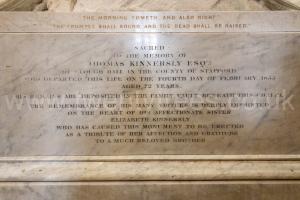
1859. Church of St John the Baptist, Ashley [Map]. Monument to Thomas Kinnersley of Clough Hall in Staffordshire. Monument commissioned by his sister Elizabeth. Sculpted by Matthew Noble (age 41).
Thomas Kinnersley of Clough Hall in Staffordshire: Around 1782 he was born. On 4th February 1855 he died.
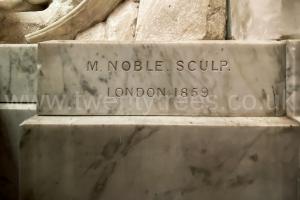
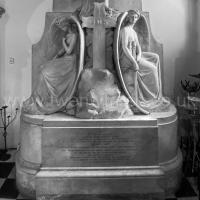
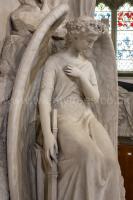
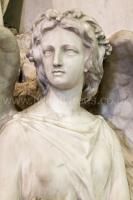
On 28th January 1859 Frederick John Robinson 1st Earl Ripon (age 76) died. He has a monument at All Saints' Church, Nocton [Map] sculpted by Matthew Noble (age 41). His son George (age 31) succeeded 2nd Earl Ripon, 2nd Viscount Gooderich of Nocton in Lincolnshire. Henrietta Anne Theodosia Vyner Marchioness Ripon (age 25) by marriage Countess Ripon.
Henrietta Anne Theodosia Vyner Marchioness Ripon: On 17th April 1833 she was born to Henry Vyner and Mary Gertude Robinson. On 8th April 1851 George Frederick Samuel Robinson 1st Marquess Ripon and she were married. He the son of Frederick John Robinson 1st Earl Ripon and Sarah Albinia Louisa Hobart. They were first cousin once removed. In 1871 George Frederick Samuel Robinson 1st Marquess Ripon was created 1st Marquess Ripon. She by marriage Marchioness Ripon. On 28th February 1907 Henrietta Anne Theodosia Vyner Marchioness Ripon died.


On 14th November 1859 Thomas de Grey 2nd Earl de Grey (age 77) died. His nephew George (age 32) succeeded 3rd Earl de Grey, 4th Baron Grantham, 7th Baronet Robinson of Newby in Yorkshire. His daughter Ann (age 53) succeeded 7th Baroness Lucas of Crudwell.
Monument at the De Grey Mausoleum, St John the Baptist Church, Flitton [Map] sculpted by Matthew Noble (age 42) in 1864.
Ann Florence Robinson Countess Cowper: In 1806 she was born to Thomas de Grey 2nd Earl de Grey and Henrietta Cole Countess de Grey. In 1833 George Augustus Frederick Cowper 6th Earl Cowper and she were married. She by marriage Countess Cowper. She the daughter of Thomas de Grey 2nd Earl de Grey and Henrietta Cole Countess de Grey. He the son of Peter Nassau Clavering-Cowper 5th Earl Cowper and Emily Lamb Countess Cowper. In 1880 Ann Florence Robinson Countess Cowper died. Her son Francis succeeded 8th Baron Lucas of Crudwell.


Abbot John Whethamstede’s Chronicle of the Abbey of St Albans
Abbot John Whethamstede's Register aka Chronicle of his second term at the Abbey of St Albans, 1451-1461, is a remarkable text that describes his first-hand experience of the beginning of the Wars of the Roses including the First and Second Battles of St Albans, 1455 and 1461, respectively, their cause, and their consequences, not least on the Abbey itself. His text also includes Loveday, Blore Heath, Northampton, the Act of Accord, Wakefield, and Towton, and ends with the Coronation of King Edward IV. In addition to the events of the Wars of the Roses, Abbot John, or his scribes who wrote the Chronicle, include details in the life of the Abbey such as charters, letters, land exchanges, visits by legates, and disputes, which provide a rich insight into the day-to-day life of the Abbey, and the challenges faced by its Abbot.
Available at Amazon in eBook and Paperback format.
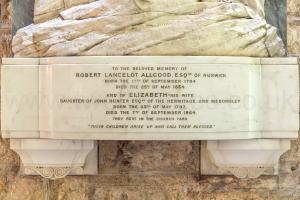
1868. St Mungo's Church, Simonburn [Map]. Memorial to Robert Lancelot Allgood and his wife Elizabeth Hunter. Sculpted by Matthew Noble (age 50).
Robert Lancelot Allgood: On 17th September 1794 he was born to James Allgood. Before 22nd February 1822 Robert Lancelot Allgood and Elizabeth Hunter were married. On 25th May 1854 Robert Lancelot Allgood died.
Elizabeth Hunter: On 30th May 1792 she was born to John Hunter of The Hermitage and Medomsley. On 7th September 1864 she died.
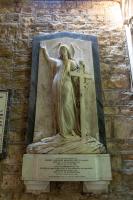
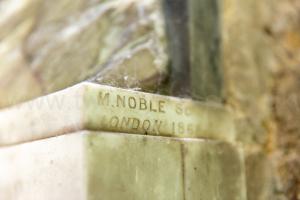
On 20th August 1872 Thomas Fermor-Hesketh 5th Baronet (age 47) died. His son Thomas (age 25) succeeded 6th Baronet Fermor-Hesketh of Rufford in Lancashire. Monument at St Mary The Virgin Church, Rufford [Map] by Matthew Noble (age 55).
Thomas Henry Fermor-Hesketh 6th Baronet: In 1847 he was born to Thomas Fermor-Hesketh 5th Baronet and Arabella Fermor Lady Hesketh. In 1876 Thomas Henry Fermor-Hesketh 6th Baronet died unmarried. His brother Thomas succeeded 7th Baronet Fermor-Hesketh of Rufford in Lancashire.
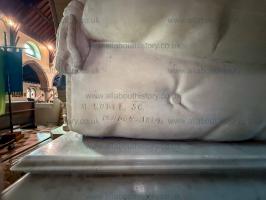
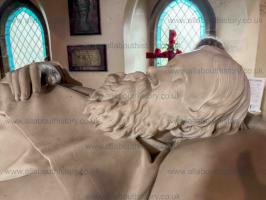
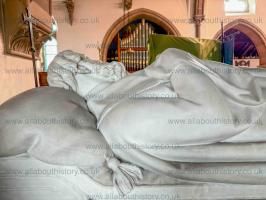
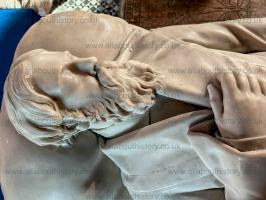
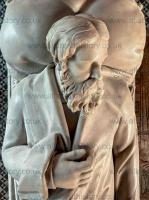
After 10th November 1873. St Andrew's Church, Brigstock [Map]. Monument to Robert Smith aka Vernon 1st Baron Lyveden (deceased) sculpted by Matthew Noble (age 56).

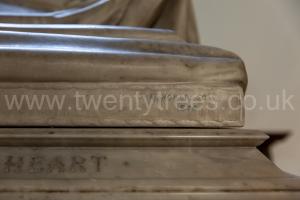


On 17th June 1874 Stephen Glynne 9th Baronet (age 66) collapsed and died outside Bishopsgate railway station. He was buried at the Church of St Deiniol, Hawarden, Flintshire. He was unmarried. Baronet Glynne of Bicester aka Bisseter in Oxfordshire extinct. His estates, including Hawarden Castle [Map], were inherited by William Henry Gladstone (age 34), eldest son of his sister Catherine Glynne (age 62).
Church of St Deiniol, Hawarden, Flintshire. Recumbent effigy by Matthew Noble (age 57) in a tomb recess designed by John Douglas.
Stephen Glynne 9th Baronet: On 22nd September 1807 he was born to Stephen Richard Glynne 8th Baronet and Mary Griffin. On 5th March 1815 Stephen Richard Glynne 8th Baronet died in Nice, France. His son Stephen succeeded 9th Baronet Glynne of Bicester aka Bisseter in Oxfordshire.
William Henry Gladstone: On 3rd June 1840 he was born to William Ewart Gladstone and Catherine Glynne. On 30th September 1875 William Henry Gladstone and Gertrude Stuart were married. On 4th July 1891 William Henry Gladstone died.
Catherine Glynne: In 1812 she was born to Stephen Richard Glynne 8th Baronet and Mary Griffin. On 25th July 1839 William Ewart Gladstone and she were married. In 1900 Catherine Glynne died.


On 21st January 1876 [his son] Herbert Noble (age 19) died in a railway accident at Abbots Ripton. The Special Scotch Express train from Edinburgh to London was involved in a collision, during a blizzard, with a coal train. An express travelling in the other direction then ran into the wreckage.
On 23rd June 1876 Matthew Noble (age 59) died at his home 43 Abingdon Villas, Kensington. He was buried at Brompton Cemetery, Kensington.
In 1909 [his former wife] Frances Mary Claxton (age 81) died.