

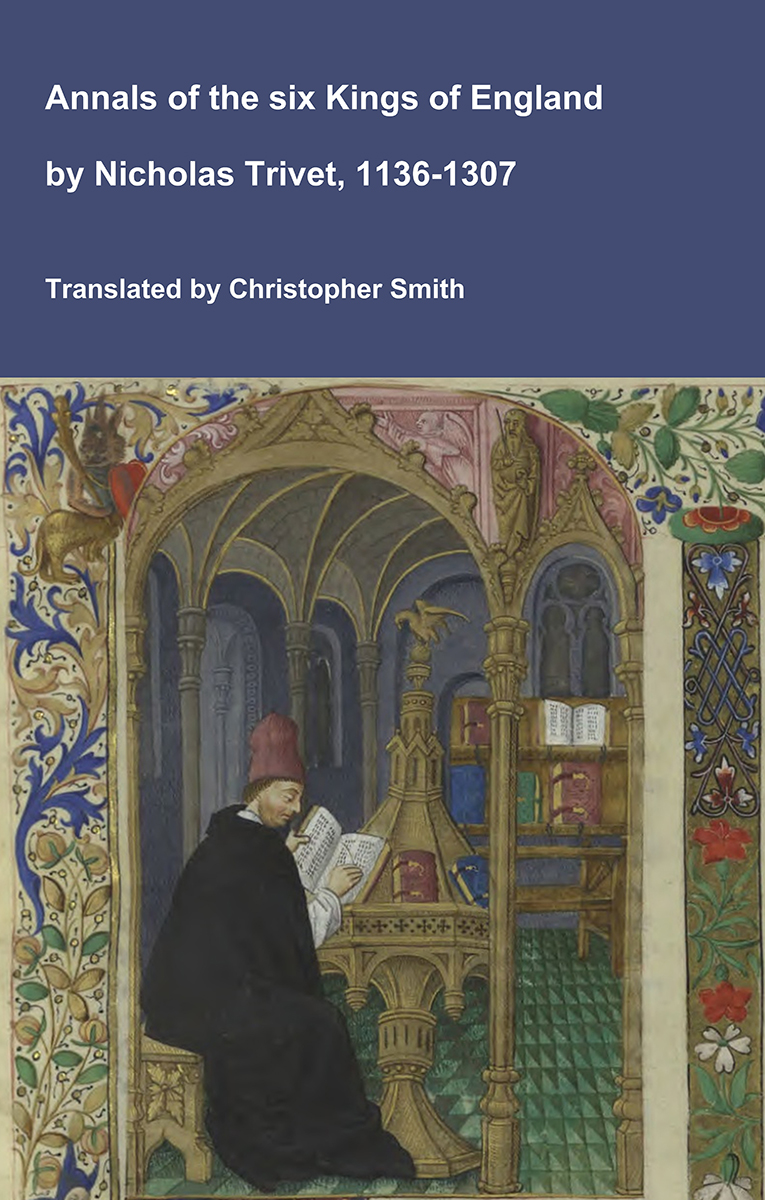
Annals of the six Kings of England by Nicholas Trivet
Translation of the Annals of the Six Kings of England by that traces the rise and rule of the Angevin aka Plantagenet dynasty from the mid-12th to early 14th century. Written by the Dominican scholar Nicholas Trivet, the work offers a vivid account of English history from the reign of King Stephen through to the death of King Edward I, blending political narrative with moral reflection. Covering the reigns of six monarchs—from Stephen to Edward I—the chronicle explores royal authority, rebellion, war, and the shifting balance between crown, church, and nobility. Trivet provides detailed insight into defining moments such as baronial conflicts, Anglo-French rivalry, and the consolidation of royal power under Edward I, whose reign he describes with particular immediacy. The Annals combines careful year-by-year reporting with thoughtful interpretation, presenting history not merely as a sequence of events but as a moral and political lesson. Ideal for readers interested in medieval history, kingship, and the origins of the English state, this chronicle remains a valuable and accessible window into the turbulent world of the Plantagenet kings.
Available at Amazon in eBook and Paperback format.
Paternal Family Tree: Bugge
Around 1290 Richard Willoughby was born to [his father] Richard Bugge aka Willoughby [aged 57] at Willoughby-on-the-Wolds, Nottinghamshire [Map].
In 1310 Richard Willoughby [aged 20] and Isabel Morteyn were married.
In 1323 Richard Willoughby [aged 33] was appointed Chief Justice of the Bench in Ireland.
In February 1324 Richard Willoughby [aged 34] was elected MP Northamptonshire.
In 1325 [his father] Richard Bugge aka Willoughby [aged 92] died at Willoughby-on-the-Wolds, Nottinghamshire [Map].
In 1328 Richard Willoughby [aged 38] was appointed Justice of the Common Pleas.
In 1330 Richard Willoughby [aged 40] was appointed Justice of the King's Bench.
In 1332 [his wife] Isabel Morteyn died.
In 1333 Richard Willoughby [aged 43] and Joan Grey were married.
Henrici Quinti, Angliæ Regis, Gesta, is a first-hand account of the Agincourt Campaign, and subsequent events to his death in 1422. The author of the first part was a Chaplain in King Henry's retinue who was present from King Henry's departure at Southampton in 1415, at the siege of Harfleur, the battle of Agincourt, and the celebrations on King Henry's return to London. The second part, by another writer, relates the events that took place including the negotiations at Troye, Henry's marriage and his death in 1422.
Available at Amazon in eBook and Paperback format.
In 1338 Richard Willoughby [aged 48] was appointed Chief Justice of the King's Bench.
In 1340 Richard Willoughby [aged 50] pleaded guilty on payment of 1200 marks.
In 1340 Richard Willoughby [aged 50] was imprisoned at Corfe Castle, Dorset [Map].
In 1340 Richard Willoughby [aged 50] was charged with corruption.
Around 1340 [his son] Edmund Willoughby was born to Richard Willoughby [aged 50] and [his wife] Joan Grey at Wollaton, Nottinghamshire. He married Alice Somerville and had issue.
In 1342 [his wife] Joan Grey died at Rotherfield Greys, Oxfordshire.
After 1342 Richard Willoughby [aged 52] and Elizabeth Valletort were married.
In 1343 Richard Willoughby [aged 53] was appointed Justice of the King's Bench.
On 14th March 1362 Richard Willoughby [aged 72] died. He was buried at St Mary & All Saints Church, Willoughby-on-the-Wolds [Map].


After 1363 [his former wife] Elizabeth Valletort died.
Chronicle of Walter of Guisborough
A canon regular of the Augustinian Guisborough Priory, Yorkshire, formerly known as The Chronicle of Walter of Hemingburgh, describes the period from 1066 to 1346. Before 1274 the Chronicle is based on other works. Thereafter, the Chronicle is original, and a remarkable source for the events of the time. This book provides a translation of the Chronicle from that date. The Latin source for our translation is the 1849 work edited by Hans Claude Hamilton. Hamilton, in his preface, says: 'In the present work we behold perhaps one of the finest samples of our early chronicles, both as regards the value of the events recorded, and the correctness with which they are detailed; Nor will the pleasing style of composition be lightly passed over by those capable of seeing reflected from it the tokens of a vigorous and cultivated mind, and a favourable specimen of the learning and taste of the age in which it was framed.'
Available at Amazon in eBook and Paperback format.

Effigy in Willoughby Church. Willoughby Church [Map]
THIS is supposed to be one of the Lords of Willoughby, in Nottinghamshire. Perhaps Sir Richard de Willoughby, who was Chief Justice of the King's Bench 11th Edward IIIa Chaucer says of his Serjeant-at-law,
"Justice he was full oftin in Assise,
By patent, and by pleine commissione;"
and that he was
"Girt with a ceint of silk with barris smale."
The tunic of the figure is confined by a richly-embossed girdle.
Details. Ornament of the girdle.
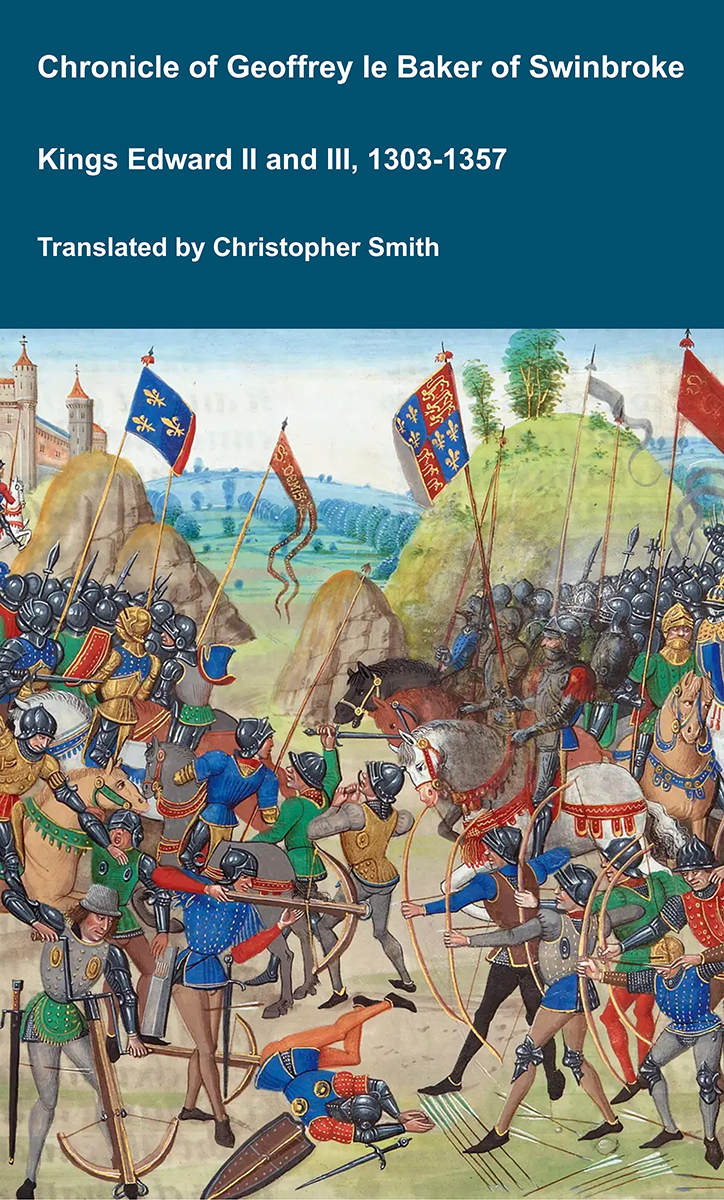 Chronicle of Geoffrey le Baker of Swinbroke. At dawn, the king immediately summoned1 the chancellor, the treasurer, and the justices then present in London. He at once intended to send the Bishop of Chichester [the chancellor] and the Bishop of Coventry [the treasurer], stripped of their offices, to Flanders as pledges for money. But the Bishop of Chichester explained to the king and his council the danger of the canon law that threatened those who imprisoned bishops. So the king allowed them to leave the Tower. However, the senior justices: Sir John de Stonore, Sir Richard de Willoughby, Sir William de Shareshull, and especially Sir Nicholas de la Beche, who had previously been the constable of the Tower of London, and Sir John Molyns, knight; likewise, the merchants Sir John de Pulteney, William de la Pole, and his brother Richard; and the senior clerks of the chancery: Sir John de St. Paul, Michael de Wath, Henry de Stratford; and of the Exchequer, Sir John de Thorp, and many others, he ordered to be thrown into various prisons. He did not release them until his anger, which he had conceived over the withholding of money that ought to have been sent for the siege of Tournai, had subsided.
Statim in aurora misit rex pro cancellario, tesaurario, et iusticiariis tunc Londoniis existentibus, et statim episcopum Cicestrensem cancellarii dignitate et episcopum Coventrensem ab officio tesaurarie absolutos voluit misisse in Flandriam impignorandos pro pecunia; set Cicestrensis exposuit sibi et suis periculum canonis qui imminet episcopos incarcerantibus, et sic ipsos turrim exire permisit. Iusticiarios vero maiores, scilicet dominum Iohannem de Stonore, dominum Ricardum de Wyleby, dominhum Willelmum de Scharesheolle, et precipue dominum Nicholaum de la Beche, qui prius fuit custos turris Londoniarum, et dominum Iohannem Molyns militem; item, mercatores dominos J de Pulteney, Willelmum de la Pole, et Ricardum fratrem eius; et clericos cancellarie maiores, videlicet dominos Iohannem de Sancto Paulo, Michaelem de Wath, Henricum de Stratford, et de skakkario dominum Iohannem de Thorp et alios quam plures, iussit diversis carceribus mancipari. Nec eos absolvit quousque sua melancolia concepta de pecunie detencione, quam ad obsidionem Torneacensem debuerant misisse, fuerat sedata.
Note 1. Robert Stratford, bishop of Chichester and brother of the archbishop, was chancellor; Roger de Northburgh, bishop of Coventry, treasurer. John Stonore was chief justice of the Common Pleas; he was restored 9th May 1342. Richard Willoughby and William de Shareshull were justices of the Common Pleas. Nicholas de la Beche, constable of the Tower, became, in 1343, seneschal of Gascony. Michael Wath was Master of the Rolls, 13341337; and was succeeded by John of St. Paul, 1337-1340. Foss, Judges of England, 3.
[his son] Hugh Willoughby was born to Richard Willoughby.
[his daughter] Majory Willoughby was born to Richard Willoughby.
[his son] Roger Willoughby was born to Richard Willoughby.
[his son] Thomas Willoughby was born to Richard Willoughby.
[his son] Richard Willoughby was born to Richard Willoughby.
GrandFather: Robert Bugge de Bingham 
Father: Richard Bugge aka Willoughby