

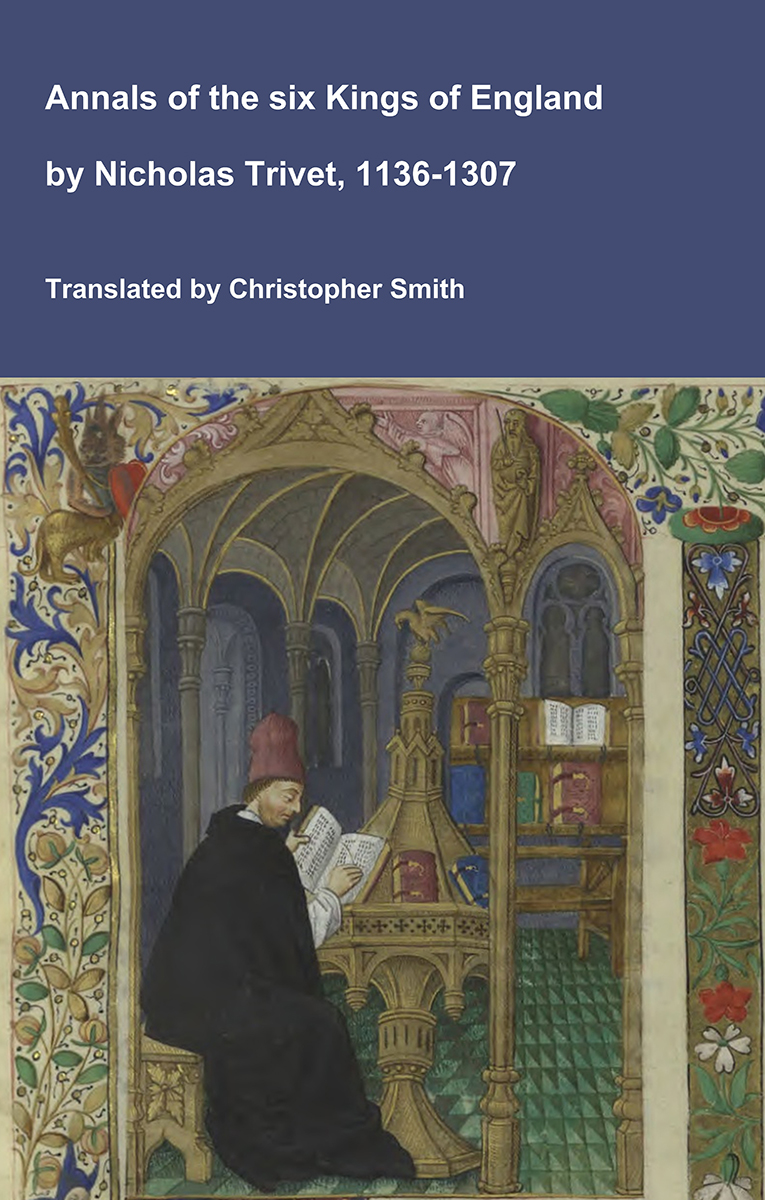
Annals of the six Kings of England by Nicholas Trivet
Translation of the Annals of the Six Kings of England by that traces the rise and rule of the Angevin aka Plantagenet dynasty from the mid-12th to early 14th century. Written by the Dominican scholar Nicholas Trivet, the work offers a vivid account of English history from the reign of King Stephen through to the death of King Edward I, blending political narrative with moral reflection. Covering the reigns of six monarchs—from Stephen to Edward I—the chronicle explores royal authority, rebellion, war, and the shifting balance between crown, church, and nobility. Trivet provides detailed insight into defining moments such as baronial conflicts, Anglo-French rivalry, and the consolidation of royal power under Edward I, whose reign he describes with particular immediacy. The Annals combines careful year-by-year reporting with thoughtful interpretation, presenting history not merely as a sequence of events but as a moral and political lesson. Ideal for readers interested in medieval history, kingship, and the origins of the English state, this chronicle remains a valuable and accessible window into the turbulent world of the Plantagenet kings.
Available at Amazon in eBook and Paperback format.
Around 1535 Robert Cooke was born.
On 29th January 1561 Robert Cooke [aged 26] was appointed Chester Herald of Arms in Ordinary.
Henry Machyn's Diary. 25th January 1562. The 25 day of January was appointed Master Robert Cooke [aged 27], Blanch-Rosse pursewant at armes, my lord Robart Dudley's [aged 29] servant, the wyche he never servyd in no plase a-for.
Note. P. 272. Robert Cooke, afterwards Clarenceux king of arms, was created Rose-Blanch pursuivant Jan. 25, and Chester herald Jan. 29, 1561; his patent for the latter office is printed in Rymer's Fœdera, &c. vol. xv. p. 620; followed by that advancing his predecessor, William Flower, to the office of Norroy (see the ceremony of creation mentioned in p. 276).
Henry Machyn's Diary. 8th February 1562. The viij day of February William Flower [aged 64], Chester herald, was appointed Norroy king of arms from the Trent north-ward; and pursewant [Blanch-Rose,] [aged 27] the servand unto my lord Robart Dudley [aged 29], was appointed Chester herald.
Henry Machyn's Diary. 20th December 1562. The xx day of Desember was bered my lord Gr[ey of Wilton] [deceased] knyght of the Garter, sum-tyme capten of Gynes, and bered [at] (blank) with a herse garnyssed with velvett and blake and armes, [with four] haroldes of armes, master Garter [aged 52] prensepalle, and master Norrey kyng at armes [aged 64], [Chest] ur harold [aged 27] and Ruge-dragon, and ther was a xx clark [es syng]yng all the way, furst ij porters in blake with blake sta[ffs and] in gownes, and then the standard borne, and then mo .... the grett baner of ys armes, and then the harold [bearing the] helmett and crest, and a-nodur the targett and the sword, and a-nodur [the coat armour;] then master Garter, and then the corse, with a ryche palle; and .... of ys men bayryng ytt; and iiij grett banar-rolles of m[arriages;] after the cheyffe mornars and after mony mornars, and th[ere did prea]che master (blank); and ther was iij dosen of bokeram skochyons of armes, and viij dosen of penselles to garnys the herse, and ... grett skochyons of pastyd paper, and the chyrche hangyd with blake and armes, and a viij dosen of skochyons of armes; and after a[ll done at] the berehyng all they when(t) bake agayne unto master de[an's] plase to dener, for ther was a nobull dener as [has] bene sene for venesun and wyld fulle.
Note. P. 297. Funeral of William lord Grey of Wilton, K.G. The circumstancial account of this ceremonial, drawn up by one of the attendant heralds, is appended to the "Commentarie of the Services" of this nobleman, in the volume edited for the Camden Society by Sir Philip Grey Egerton, Bart. The church (left blank in p. 298,) was Cheshunt, co. Hertford; the preacher was Michael Reniger; and in line 17, for "master de[an's] plase," read "master De[nny's] plase."
On 21st May 1567 Robert Cooke [aged 32] was appointed Clarenceux King of Arms.
On 3rd October 1584 Gilbert Dethick [aged 74] died. Robert Cooke [aged 49] served as Acting Garter King of Arms until the appointment of Gilbert's son William Dethick [aged 42] on 21st April 1586.
Archaeologia Volume 1 Section 55. [31st July 1587] .... whither being come (about two of the clock on the Monday morning) the body was receved most reverently at the minster door of Peterborough, by the bishop, dean and chapter, and Clarenceux king of armes [aged 52]; and, in the prescnce of the Scots which came with the same, it was laid in a vault prepared for the same, in the quire of the said church, on the South side, opposite to the tomb of Queen Katharine dowager of Spain, the first wife of King Henry the Eighth; the occasion why the body was forthwith laid into the vault, and not borne in the solemnity, was, because it was so extreame heavy by reason of the lead, that the Gentlemen could not endure to have carryed it with leisure in the solenin preceding; and besides, was feared, that the sowder might ripp, and being very hot weather, might be found some annoyance.

Tudor Tracts Chapter 20. Whither being come, about two of the clock on the Monday morning [31st July 1587]; the body was received most reverently at the Minster Door of Peterborough, by the Bishop [aged 46], Dean [aged 42] and Chapter, and [Robert Cooke [aged 52]] Clarenceux King at Arms.
And, in the presence of the Scots which came with the same, it was laid in a Vault prepared for the same, in the Quire of the said Church, on the south side; opposite to the tomb of Queen Katharine [of Arragon], Dowager of Spain, the first wife of King Henry the Eighth.
The occasion why the body was forthwith laid into the Vault, and not borne in the Solemnity; was because it was so extreme[ly] heavy, by reason of the lead, that the Gentlemen could not have endured to have carried it, with leisure, in the solemn proceeding: and besides, [it] was feared that the solder might rip; and, [it] being very hot weather, might be found some annoyance.
In 1593 Robert Cooke [aged 58] died.