

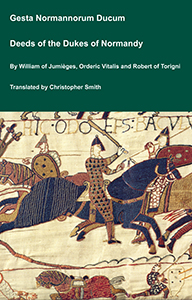
The Deeds of the Dukes of Normandy
The Gesta Normannorum Ducum [The Deeds of the Dukes of Normandy] is a landmark medieval chronicle tracing the rise and fall of the Norman dynasty from its early roots through the pivotal events surrounding the Norman Conquest of England. Originally penned in Latin by the monk William of Jumièges shortly before 1060 and later expanded at the behest of William the Conqueror, the work chronicles the deeds, politics, battles, and leadership of the Norman dukes, especially William’s own claim to the English throne. The narrative combines earlier historical sources with firsthand information and oral testimony to present an authoritative account of Normandy’s transformation from a Viking settlement into one of medieval Europe’s most powerful realms. William’s history emphasizes the legitimacy, military prowess, and governance of the Norman line, framing their expansion, including the conquest of England, as both divinely sanctioned and noble in purpose. Later chroniclers such as Orderic Vitalis and Robert of Torigni continued the history, extending the coverage into the 12th century, providing broader context on ducal rule and its impact. Today this classic work remains a foundational source for understanding Norman identity, medieval statesmanship, and the historical forces that reshaped England and Western Europe between 800AD and 1100AD.
Available at Amazon in eBook and Paperback format.
In 1456 Roger Lupton was born to [his father] Thomas Lupton of Sedbergh. He was educated at King's College, Cambridge University [Map].
In 1500 Roger Lupton [aged 44] was appointed Canon of the seventh stall at St George's Chapel, Windsor Castle [Map] which position he held for life.
In February 1504 Roger Lupton [aged 48] was appointed Provost of Eton College by King Henry VIII [aged 12] which position he held until 1535.
Before 1510 Roger Lupton [aged 53] was appointed Master of St Anthony's Hospital in St Benet Fink [Map].
1st January 1513. The following pieces of plate received from William Holland of London, goldsmith, 1 Jan. 4 Henry VIII.
[Given in three columns (1) name of a person (to whom the article has been presented); (2), description of the article; and (3), its weight.]
Bishop of Canterbury [aged 63], a cup with a gilt cover, 34 oz.
Lady Hastings [aged 30], the same, 30¾ oz.
Sir H. Marney [aged 66], the same, 23 oz.
Mr. Lupton [aged 57], the same, 23 oz.
Sir E. Ponyngs [aged 54], the same, 22¼ oz.
The Abbot of Abingdon, the same, 23¾ oz.
Sir Edward Haward, the same, 24 oz.
The old Lady Guylford [aged 50], a little pot gilt, 17 7/8 oz.
Lady Lucy, the same, 16 7/8 oz. [Possibly Catherine Hastings [aged 35] who married John Melton of Aston Yorkshire 10th Baron Lucy [aged 37] before 1506]
Lady Mountjoy, the same, 16 7/8 oz.
Lady Bulleyn [aged 33], the same, 16½ oz.
Lord Audeley [aged 30], a salt with a gilt cover, 15¾ oz.
The Queen's grace [aged 27], a pair of great pots gilt, 575 oz.
Mrs. Catesby, a proper bottle for rose water, 4 oz.
Mrs. Briget, the same, 3 7/8 oz.
Mrs. Lacy, the same, 4 oz. Which, at 5s. the oz., is £212 11s 10½d.
James Worsley, a proper pot, parcel gilt, 10 oz. Copynger, 8 spoons, part gilt, 9¾ oz., Amadas. Which is, at 4s. the oz., 76s. 6d.
In part payment, old plate to the value of £194 16s. 8d. has been delivered to him. The remainder paid by J. Heron [aged 43].
On the dorse [reverse]:-Holland beseeches the King to reward him for the workmanship of the Queen's great pots, "for he cannot live to make such curious work at the price within written"; and £6 13s. 4d. is added in another hand, making a total due of £28 5s. Signed by the King.


Lupton's Tower [Map]. A bell tower at Eton College [Map] commissioned by Roger Lupton [aged 58] and constructed between 1514 and 1520. The facade looking at the school yard is decorated with three reliefs. Henry VIII Coat of Arms held by red dragon (symbol of Tudor dynasty) and a white greyhound is on the top of the tower; below is Assumption of Mary with a childand angels; and at the low part Henry's heraldic shield held by two angels.
In 1527 Roger Lupton [aged 71] established six scholarships to St John's College, Cambridge University [Map], to be awarded exclusively to boys from Sedbergh School with a preference for founder's kin
On 27th February 1540 Roger Lupton [aged 84] died. He was buried in the chapel that bears his name Lupton's Chapel Eton College [Map]. His tomb has a monumental brass with him wearing the mantle of a Canon of Windsor with the inscription in Latin "Miserere mei Deus secundum magnam misericordiam tuam" being the first part of the first verse of Psalm 51.
Lupton's Chapel Eton College [Map] is a side chapel of Eton College Chapel [Map] commissioned by Roger Lupton and in which he was subsequently buried. His monumental brass survives at Eton, showing him dressed as a Canon of Windsor wearing a long robe with a cross.
 Roger Lupton Arms. Argent, on a chevron between three wolf's heads and necks erased sable three lilies of the field on a chief gules between two escallops a Tau cross or. Arms granted to Roger Lupton by King Henry VII. The Tau cross was a symbol of Saint Anthony of Egypt and thus probably referred to his mastership of St Anthony's Hospital. The escallops were possibly bells, another symbol of Saint Anthony, of which two were often shown suspended from the cross member of a Tau cross. The wolves were canting references to his surname from the Latin Lupus, "a wolf", and Sable, three lilies argent, is the base part of the arms of Eton College [Map].