

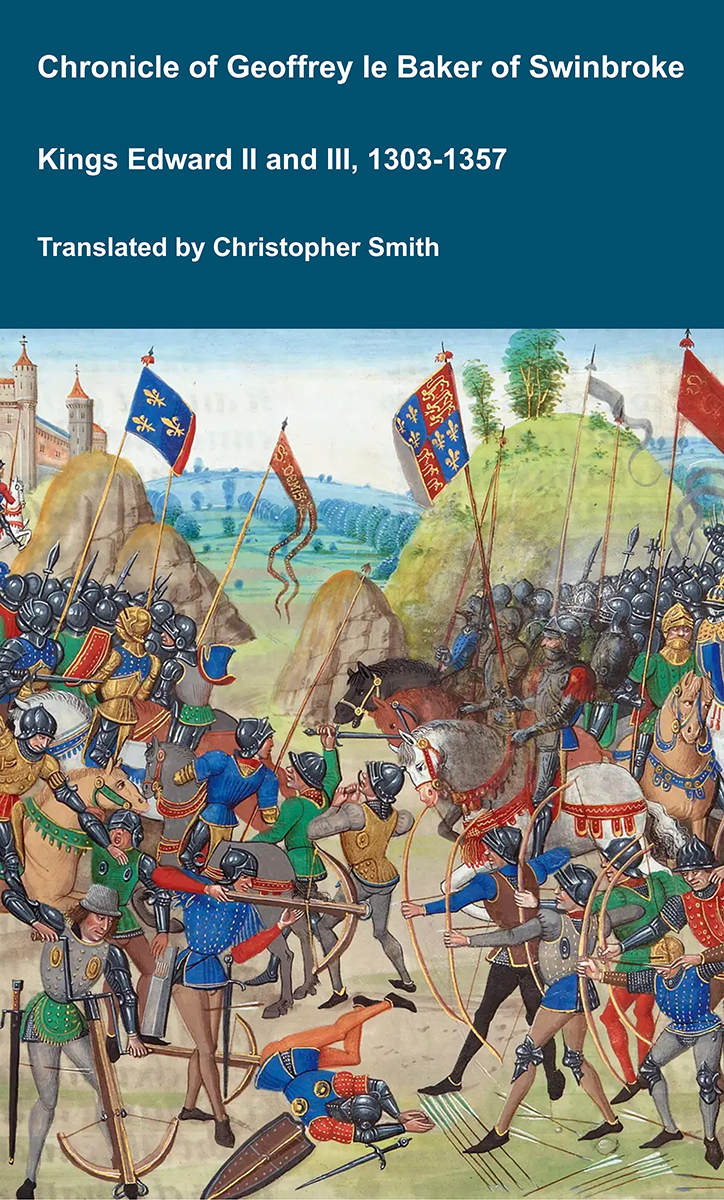
Chronicle of Geoffrey le Baker of Swinbroke
Baker was a secular clerk from Swinbroke, now Swinbrook, an Oxfordshire village two miles east of Burford. His Chronicle describes the events of the period 1303-1356: Gaveston, Bannockburn, Boroughbridge, the murder of King Edward II, the Scottish Wars, Sluys, Crécy, the Black Death, Winchelsea and Poitiers. To quote Herbert Bruce 'it possesses a vigorous and characteristic style, and its value for particular events between 1303 and 1356 has been recognised by its editor and by subsequent writers'. The book provides remarkable detail about the events it describes. Baker's text has been augmented with hundreds of notes, including extracts from other contemporary chronicles, such as the Annales Londonienses, Annales Paulini, Murimuth, Lanercost, Avesbury, Guisborough and Froissart to enrich the reader's understanding. The translation takes as its source the 'Chronicon Galfridi le Baker de Swynebroke' published in 1889, edited by Edward Maunde Thompson.
Available at Amazon in eBook and Paperback format.
Before 3rd January 1835 [her father] William Cox [aged 21] and [her mother] Jane Woolgar [aged 21] were married.
On 3rd January 1835 Sarah Cox aka Fanny Cornforth was born to [her father] William Cox [aged 21] and [her mother] Jane Woolgar [aged 21] at Steyning, Sussex. She was baptised on 1st February 1835.
In 1847 [her mother] Jane Woolgar [aged 33] died.

1854. Dante Gabriel Rossetti [aged 25]. "Found". Model Sarah Cox aka Fanny Cornforth [aged 18].

Around 1858. Dante Gabriel Rossetti [aged 29]. Drawing of Sarah Cox aka Fanny Cornforth [aged 22].

1858. Dante Gabriel Rossetti [aged 29]. Fair Rosamund. Model Sarah Cox aka Fanny Cornforth [aged 22].

1858. Dante Gabriel Rossetti [aged 29]. Drawing of Sarah Cox aka Fanny Cornforth [aged 22].
The Diary of George Price Boyce 1858. 15th December 1858. To Rossetti [aged 30]. The new things I noticed were an intensely impressive water colour of the Virgin in the house of John, the latter seated at the window and striking a light and looking out upon Jerusalem at twilight. The Virgin is spinning. A Knight girded for combat embracing his Lady Love [The Chapel before the Lists]. Several studies of Miss Herbert [aged 27] (Mrs. Crabbe). A most beautiful pen and ink study of Topsy's (Morris's) "Stunner" at Oxford. He showed me some fine medieval drapery and some gorgeous Eastern pieces lent him from the India House. We went off at dusk and dined at the Cock, and afterwards adjourned to 24 Dean St., Soho, to see "Fanny [aged 23]." Interesting face and jolly hair and engaging disposition.
In 1859 [her father] William Cox [aged 45] died.
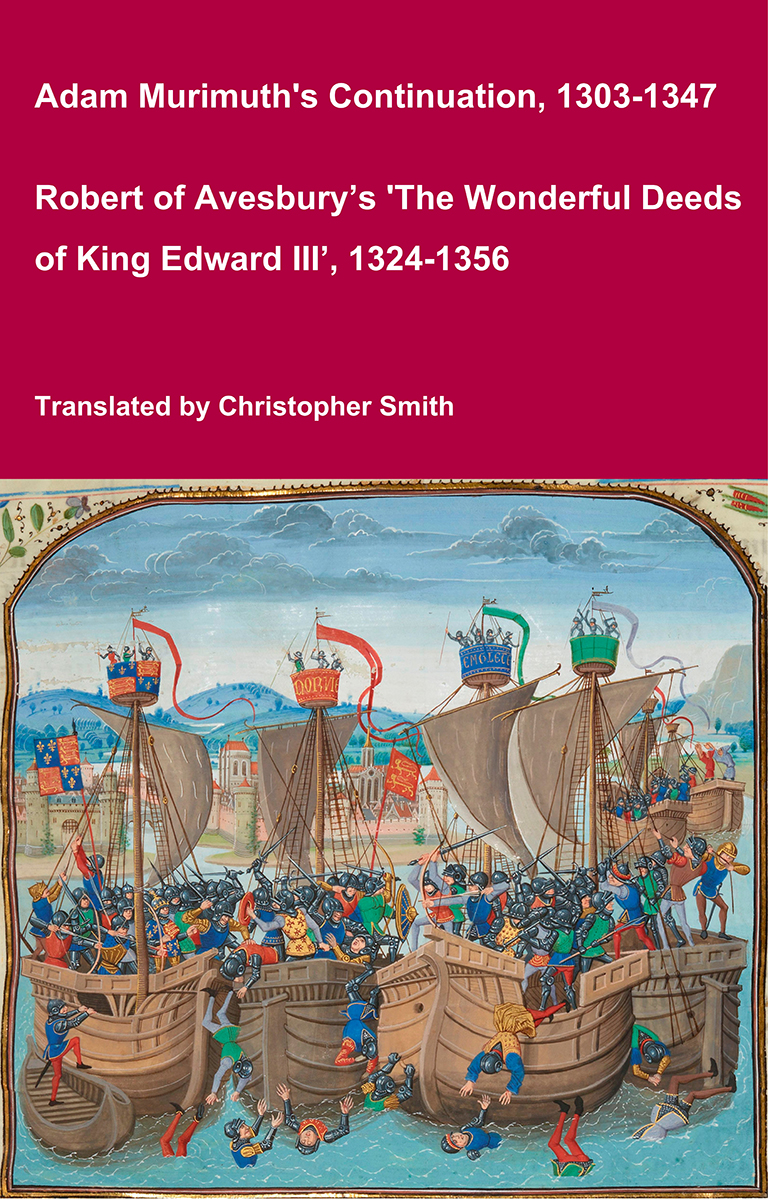
Adam Murimuth's Continuation and Robert of Avesbury’s 'The Wonderful Deeds of King Edward III'
This volume brings together two of the most important contemporary chronicles for the reign of Edward III and the opening phases of the Hundred Years’ War. Written in Latin by English clerical observers, these texts provide a vivid and authoritative window into the political, diplomatic, and military history of fourteenth-century England and its continental ambitions. Adam Murimuth Continuatio's Chronicarum continues an earlier chronicle into the mid-fourteenth century, offering concise but valuable notices on royal policy, foreign relations, and ecclesiastical affairs. Its annalistic structure makes it especially useful for establishing chronology and tracing the development of events year by year. Complementing it, Robert of Avesbury’s De gestis mirabilibus regis Edwardi tertii is a rich documentary chronicle preserving letters, treaties, and official records alongside narrative passages. It is an indispensable source for understanding Edward III’s claim to the French crown, the conduct of war, and the mechanisms of medieval diplomacy. Together, these works offer scholars, students, and enthusiasts a reliable and unembellished account of a transformative period in English and European history. Essential for anyone interested in medieval chronicles, the Hundred Years’ War, or the reign of Edward III.
Available at Amazon in eBook and Paperback format.

1859. Dante Gabriel Rossetti [aged 30]. Bocca Baciata aka "mouth that has been kissed". Model Sarah Cox aka Fanny Cornforth [aged 23] The first of Rossetti's single female figures which thereafter became his signature style. The flowers in the background are marigolds, a white rose in her hair. An apple on the balustrade. The title from the Italian proverb from the last line of the Seventh story of the Second Book of Boccacio's Decameron "Bocca baciata non perde ventura, anzi rinnova come fa la luna" aka "The mouth that has been kissed does not lose its good fortune; rather, it renews itself just as the moon does."
Around August 1860 Timothy Hughes and Sarah Cox aka Fanny Cornforth [aged 25] were married. At some time thereafter she adopted the surname Cornforth, the surname of her husband's stepfather.
On 11th February 1862 at twenty past seven in the morning Elizabeth Siddal [aged 32] overdosed on laudanum at 14 Chatham Place. Possibly suicide - there may have been a note that said "look after Harry (her invalid brother)" which Ford Madox Brown [aged 40] persuaded Dante Gabriel Rossetti [aged 33] to burn. Shortly after her death Sarah Cox aka Fanny Cornforth [aged 27] moved into the family home to become housekeeper to Dante Gabriel Rossetti.

1865. Dante Gabriel Rossetti [aged 36]. "The Blue Bower". Model Sarah Cox aka Fanny Cornforth [aged 29].

1865. Dante Gabriel Rossetti [aged 36]. Sarah Cox aka Fanny Cornforth [aged 29].
The Diary of George Price Boyce 1865. 19th May 1865. Dined with Rossetti [aged 37] and Fanny [aged 30] and Howell at Chelsea. Settled to take för 50 eleven selected pencil studies of heads, R. in addition giving me one of a new model he has got to sit.


The Diary of George Price Boyce 1865. 22nd May 1865. Rossetti [aged 37] sent down by Pope 13 pencil studies of heads, of which 2 (one of Ellen Smith and another ¾ of a new model) are gifts.
The other 11, viz, 3 of Fanny Cornforth [aged 30], 2 of Ellen Smith, 1 of Ada, 1 of Mrs. Morris of Upton, £10, 1 of the negro boy, 1 of a negro girl, 1 of Mrs. Eaton, and 1 of Marie Ford I pay £60 for.

1867. Dante Gabriel Rossetti [aged 38]. "Lady Lilith". Watercolor. Model Sarah Cox aka Fanny Cornforth [aged 31]. Painted after the original Lady Lilith. On a label attached to its frame is a verse from Goethe's Faust translated by Shelley:
"Beware of her fair hair, for she excells
All women in the magic of her locks,
And when she twines them round a young man's neck
she will not ever set him free again."
In October 1872 [her husband] Timothy Hughes died.

Between 1873 and 1878. Edward Coley Burne-Jones 1st Baronet [aged 39]. Study for "Laus Veneris". Model Sarah Cox aka Fanny Cornforth [aged 37].
In Nov 1879 John Schott and Sarah Cox aka Fanny Cornforth [aged 43] were married after which they ran the Rose Tavern.
Adam Murimuth's Continuation and Robert of Avesbury’s 'The Wonderful Deeds of King Edward III'
This volume brings together two of the most important contemporary chronicles for the reign of Edward III and the opening phases of the Hundred Years’ War. Written in Latin by English clerical observers, these texts provide a vivid and authoritative window into the political, diplomatic, and military history of fourteenth-century England and its continental ambitions. Adam Murimuth Continuatio's Chronicarum continues an earlier chronicle into the mid-fourteenth century, offering concise but valuable notices on royal policy, foreign relations, and ecclesiastical affairs. Its annalistic structure makes it especially useful for establishing chronology and tracing the development of events year by year. Complementing it, Robert of Avesbury’s De gestis mirabilibus regis Edwardi tertii is a rich documentary chronicle preserving letters, treaties, and official records alongside narrative passages. It is an indispensable source for understanding Edward III’s claim to the French crown, the conduct of war, and the mechanisms of medieval diplomacy. Together, these works offer scholars, students, and enthusiasts a reliable and unembellished account of a transformative period in English and European history. Essential for anyone interested in medieval chronicles, the Hundred Years’ War, or the reign of Edward III.
Available at Amazon in eBook and Paperback format.
In 1891 [her husband] John Schott died.
On 30th March 1907 Sarah Cox aka Fanny Cornforth [aged 72] was admitted to the West Sussex County Lunatic Asylum, the records of which state that she was suffering from "senile mania, confusion, weak-mindedness and an inability to sustain a rational conversation, a poor memory and sleeplessness."
On 24th February 1909 Sarah Cox aka Fanny Cornforth [aged 74] died.