

Abbot John Whethamstede’s Chronicle of the Abbey of St Albans
Abbot John Whethamstede's Register aka Chronicle of his second term at the Abbey of St Albans, 1451-1461, is a remarkable text that describes his first-hand experience of the beginning of the Wars of the Roses including the First and Second Battles of St Albans, 1455 and 1461, respectively, their cause, and their consequences, not least on the Abbey itself. His text also includes Loveday, Blore Heath, Northampton, the Act of Accord, Wakefield, and Towton, and ends with the Coronation of King Edward IV. In addition to the events of the Wars of the Roses, Abbot John, or his scribes who wrote the Chronicle, include details in the life of the Abbey such as charters, letters, land exchanges, visits by legates, and disputes, which provide a rich insight into the day-to-day life of the Abbey, and the challenges faced by its Abbot.
Available at Amazon in eBook and Paperback format.
Paternal Family Tree: Tresham
1461 Second Battle of St Albans
29th March 1461 Battle of Towton
1470 October 1470 King Henry VI Restored
Before 1420 [his father] William Tresham and [his mother] Isabel Vaux [aged 17] were married.
Around 1420 Thomas Tresham was born to [his father] William Tresham and [his mother] Isabel Vaux [aged 18].
In 1446 Thomas Tresham [aged 26] was appointed Justice of the Peace Huntingdonshire.
In 1446 Thomas Tresham [aged 26] served as an esquire for Henry VI.
In 1447 Thomas Tresham [aged 27] was appointed MP Buckinghamshire.
In 1449 Thomas Tresham [aged 29] was appointed MP Huntingdonshire.
On 23rd September 1450 [his father] William Tresham was killed while travelling to meet Richard Plantagenet 3rd Duke of York [aged 39] by a group of men as a result of a propery dispute before he was tried for treason. His son Thomas Tresham [aged 30] escaped albeit severly injured.
Chronicle of Gregory. 23rd September 1450. Ande that same year was slayne [his father] Tresham, the man of lawe, that was Speker of the Parlymentt, and his son [Thomas Tresham [aged 30]] was soore woundyde in Northehampton schyre. And by the King and his counselle a Parlyment was ordaynyde to be-gyn on Syn Leonarde is day nexte folowynge. In the mene tyme many strange and woundyrfulle bylle were sete in dyvers placys, some at the kyngys owne chambyr doore at Westemyster, in his palysse, and some at the halle dore at Westemyster, ande some at Poulys chyrche dore, and in many othyr dyvers placys of London.
In 1451 Thomas Tresham [aged 31] was appointed High Sheriff of Huntingdonshire.
In 1451 Thomas Tresham [aged 31] was appointed High Sheriff of Cambridgeshire.
The History of William Marshal was commissioned by his son shortly after William’s death in 1219 to celebrate the Marshal’s remarkable life; it is an authentic, contemporary voice. The manuscript was discovered in 1861 by French historian Paul Meyer. Meyer published the manuscript in its original Anglo-French in 1891 in two books. This book is a line by line translation of the first of Meyer’s books; lines 1-10152. Book 1 of the History begins in 1139 and ends in 1194. It describes the events of the Anarchy, the role of William’s father John, John’s marriages, William’s childhood, his role as a hostage at the siege of Newbury, his injury and imprisonment in Poitou where he met Eleanor of Aquitaine and his life as a knight errant. It continues with the accusation against him of an improper relationship with Margaret, wife of Henry the Young King, his exile, and return, the death of Henry the Young King, the rebellion of Richard, the future King Richard I, war with France, the death of King Henry II, and the capture of King Richard, and the rebellion of John, the future King John. It ends with the release of King Richard and the death of John Marshal.
Available at Amazon in eBook and Paperback format.
In 1453 Thomas Tresham [aged 33] was appointed MP Northamptonshire.
Paston Letters Volume 2 235. 19th January 1454. 2.235. Newsletter Of John Stodeley1.
As touchyng tythynges, please it you to wite that at the Princes2 comyng to Wyndesore, the Duc of Buk' [aged 51] toke hym in his armes and presented hym to the Kyng in godely wise, besechyng the Kyng to blisse hym; and the Kyng yave no maner answere. Natheless the Duk abode stille with the Prince by the Kyng; and whan he coude no maner answere have, the Queene come in, and toke the Prince in hir armes and presented hym in like forme as the Duke had done, desiryng that he shuld blisse it; but alle their labour was in veyne, for they departed thens without any answere or countenaunce savyng only that ones he loked on the Prince and caste doune his eyene ayen, without any more.
Item, the Cardinalle [aged 74]3 hathe charged and commaunded alle his servauntz to be redy with bowe and arwes, swerd and bokeler, crossebowes, and alle other habillementes of werre, suche as thei kun medle with to awaite upon the saufgarde of his persone.
Item, th'erle of Wiltshire [aged 33]4 and the Lord Bonvile [aged 61] have done to be cryed at Taunton in Somerset shire, that every man that is likly and wole go with theym and serve theym, shalle have vjd. every day as long as he abidethe with theym.
Item, the Duk of Excestre [aged 23]5 in his owne persone hathe ben at Tuxforthe beside Dancastre, in the north contree, and there the Lord Egremond [aged 31]6 mette hym, and thei ij. ben sworne togider, and the Duke is come home agein.
Item, th'erle of Wiltshire, the Lord Beaumont, Ponynges, Clyfford, Egremond, and Bonvyle, maken all the puissance they kan and may to come hider with theym.
Item, Thorpe7 of th'escheker articuleth fast ayenst the Duke of York, but what his articles ben it is yit unknowen.
Item, Tresham [aged 34]8, Josep9, Danyelle10, and Trevilian11 have made a bille to the Lordes, desiryng to have a garisone kept at Wyndesore for the saufgarde of the Kyng and of the Prince, and that they may have money for wages of theym and other that shulle kepe the garyson.
Item, the Duc of Buk' hathe do to be made Ml. Ml. [2000] bendes with knottes, to what entent men may construe as their wittes wole yeve theym.
Item, the Duke of Somersetes herbergeour hath taken up all the loggyng that may be goten nere the Toure, in Thamystrete, Martlane, Seint Katerines, Tourehille, and there aboute.
Item, the Queene hathe made a bille of five articles, desiryng those articles to be graunted; wherof the first is that she desireth to have the hole reule of this land; the second is that she may make the Chaunceller, the Tresorere, the Prive Seelle, and alle other officers of this land, with shireves and alle other officers that the Kyng shuld make; the third is, that she may yeve alle the bisshopriches of this land, and alle other benefices longyng to the Kynges yift; the iiijth is that she may have suffisant lyvelode assigned hir for the Kyng and the Prince and hir self. But as for the vth article, I kan nat yit knowe what it is.
Note 1. [Egerton MS. 914, B.M.] There is no evidence that this letter had anything to do with the Paston correspondence, but as a very interesting political letter of the period we have thought it right to give it a place in the collection. The date is quite certain, being after the birth of Prince Edward in October 1453, and before the death of Cardinal Kemp in March 1454.
Note 2. Edward, only son of Henry VI. [aged 32], born 13th October 1453.
Note 3. John Kemp, Cardinal Archbishop of Canterbury.
Note 4. James Butler, Earl of Wiltshire and Ormond.
Note 5. Henry Holland.
Note 6. Thomas Percy, third son of Henry, Earl of Northumberland [aged 60].
Note 7. Thomas Thorpe, one of the Barons of the Exchequer, who was also Speaker of the House of Commons, but was at this time imprisoned in the Fleet in consequence of an action brought against him by the Duke of York.—(See Rolls of Parl. v. 239.)
Note 8. Thomas Tresham, who as 'Sir Thomas Tresham, Knight,' was attainted under Edward IV. for fighting on the Lancastrian side at Towton, but his attainder was afterwards reversed in Parliament 7 and 8 Edw. IV., on the ground that he was a household servant of Henry VI. and had been brought up in his service from a child.—Rolls of Parl. v. 616–617.
Note 9. William Joseph, who, with Thorpe, was frequently accused by the Yorkists of misleading the King.—Rolls of Parl. v. 280, 282, 332, 342.
Note 10. Thomas Daniel, Esq.—See p. 255, Note 2.
 Become a Member via our Buy Me a Coffee page to read more.
In 1455 Thomas Tresham [aged 35] was appointed Usher of the King's Chamber.
In 1459 Thomas Tresham [aged 39] was appointed MP Northamptonshire.
On 9th October 1459 Thomas Tresham [aged 39] was elected Speaker of the House of Commons at Coventry, Warwickshire [Map]. The primary purpose of the Parliament was to attaint the Yorkist leaders:
Richard Plantagenet 3rd Duke of York [aged 48], his sons Edward Earl of March [aged 17], Edmund Earl of Rutland [aged 16] were attainted, as were Richard Neville Earl Salisbury [aged 59] and his sons Richard "Kingmaker" Neville Earl Warwick, 6th Earl Salisbury [aged 30] and John Neville 1431-1471 [aged 28].
Before 1460 Thomas Tresham [aged 39] and Margaret Zouche [aged 23] were married.
In 1460 [his daughter] Isabella Tresham was born to Thomas Tresham [aged 40] and [his wife] Margaret Zouche [aged 24].
On 10th July 1460 the Yorkist army led by the future King Edward IV of England [aged 18] and including Richard "Kingmaker" Neville Earl Warwick, 6th Earl Salisbury [aged 31], Archbishop George Neville [aged 28], William Neville 1st Earl Kent [aged 55], Edward Brooke 6th Baron Cobham [aged 45] and John Scrope 5th Baron Scrope of Bolton [aged 22] defeated the Lancastrian army at the 1460 Battle of Northampton.
Edmund Grey 1st Earl Kent [aged 43] had started the day as part of the Lancastrian army but did nothing to prevent the Yorkist army attacking.
King Henry VI of England and II of France [aged 38] was captured.
Humphrey Stafford 1st Duke of Buckingham [aged 57] was killed. His grandson Henry [aged 5] succeeded 2nd Duke of Buckingham, 7th Earl Stafford, 8th Baron Stafford.
John Talbot 2nd Earl of Shrewsbury [aged 42] was killed. His son John [aged 11] succeeded 3rd Earl of Shrewsbury, 3rd Earl Waterford, 8th Baron Furnivall, 12th Baron Strange Blackmere, 9th Baron Talbot.
Thomas Percy 1st Baron Egremont [aged 37] was killed. [Baron Egremont of Egremont Castle in Cumberland extinct. Some authoirities state, however, that he left a son, Sir John Percy, who never assumed the title.]
John Beaumont 1st Viscount Beaumont [aged 50] was killed. His son William [aged 22] succeeded 2nd Viscount Beaumont, 7th Baron Beaumont.
William Lucy [aged 56] was killed apparently by servants of a member of the Stafford family who wanted his wife Margaret Fitzlewis [aged 21].
Thomas Tresham [aged 40] fought.
William Beaumont 2nd Viscount Beaumont and William Norreys [aged 19] were knighted.
Thomas "Bastard of Exeter" Holland was executed following the battle.
The battle was fought south of the River Nene [Map] in the grounds of Delapré Abbey.
Become a Member via our Buy Me a Coffee page to read more.
On 17th February 1461 the Lancastrian army defeated the Yorkist army at Second Battle of St Albans and rescued King Henry VI of England and II of France [aged 39]. The Lancastrian army was commanded by Henry Holland 3rd Duke Exeter [aged 30] and included Henry Percy 3rd Earl of Northumberland [aged 39], John Mowbray 3rd Duke of Norfolk [aged 45], Henry Grey 4th or 7th Baron Grey of Codnor [aged 26], Henry Roos and Richard Welles 7th Baron Welles, Baron Willoughby [aged 33].
Thomas Ros 9th Baron Ros Helmsley [aged 33], William Tailboys 7th Baron Kyme [aged 46], John Talbot 3rd Earl of Shrewsbury [aged 12] and Thomas Tresham [aged 41] were knighted.
The Yorkist army included Richard "Kingmaker" Neville Earl Warwick, 6th Earl Salisbury [aged 32], William Fitzalan 9th or 16th Earl of Arundel [aged 43], John Wenlock 1st Baron Wenlock [aged 61] and Henry Bourchier 2nd Count of Eu 1st Earl Essex [aged 57]. John Neville 1st Marquess Montagu [aged 30] was captured. Robert Poynings [aged 42] and James Luttrell [aged 34] were killed.
John Grey [aged 29] was killed fighting for Lancaster. A death that was to have far reaching consequences; his widow Elizabeth Woodville Queen Consort England [aged 24] subsequently married King Edward IV of England [aged 18].
During the battle William Bonville 1st Baron Bonville [aged 68] and Thomas Kyriell [aged 65] were assigned to the protection of the King Henry VI. After the battle both were beheaded against all decent laws of battle.
William Bonville 1st Baron Bonville was beheaded. His great granddaughter Cecily succeeded 2nd Baroness Bonville.
Thomas Kyriell was beheaded.
William Cotton [aged 21] was killed.
Become a Member via our Buy Me a Coffee page to read more.
Chronicle of Gregory. 17th February 1461. Ande at the nyght aftyr the batayle the King [aged 39] blessyd his son the Prynce [aged 7], and Doctor Morton [aged 41] brought forthe a boke that was full of orysons, and there the boke was oppenyd, and blessyd that yong chylde cum pinguedine terre et cum rore celi1, and made him knyght. And the yong knyght weryd a payre of bregant yerys i-coveryd with purpylle velvyt i-bete with golde-smythe is worke. And the Prynce made many knyghtys. The fryste that he made was Androwe Trolloppe, for he was hurte and might not goo for a calletrappe in his fote; and he said, "My lorde, I have not deservyd hit for I slowe but xv men, for I stode stylle in oo place and they come unto me, but they bode stylle with me." And then come Whytyngam [aged 32], Tresham [aged 41], and many moo othyr, and were made knyghtys that same tyme.
Note 1. "with the richness of the earth and with the dew of heaven".
On 29th March 1461 the Battle of Towton was a decisive victory for King Edward IV of England [aged 18] bringing to an end the first war of the Wars of the Roses. Said to be the bloodiest battle on English soil 28000 were killed mainly during the rout that followed the battle.
The Yorkist army was commanded by King Edward IV of England with John Mowbray 3rd Duke of Norfolk [aged 45], William Neville 1st Earl Kent [aged 56], William Hastings 1st Baron Hastings [aged 30] (knighted), Walter Blount 1st Baron Mountjoy [aged 45], Henry Bourchier 2nd Count of Eu 1st Earl Essex [aged 57], John Scrope 5th Baron Scrope of Bolton [aged 23] and John Wenlock 1st Baron Wenlock [aged 61].
The Lancastrian army suffered significant casualties including Richard Percy [aged 35], Ralph Bigod Lord Morley [aged 50], John Bigod [aged 28], Robert Cromwell [aged 71], Ralph Eure [aged 49], John Neville 1st Baron Neville of Raby [aged 51], John Beaumont [aged 33], Thomas Dethick [aged 61], Everard Simon Digby, William Plumpton [aged 25] and William Welles [aged 51] who were killed.
Henry Percy 3rd Earl of Northumberland [aged 39] was killed. Earl of Northumberland, Baron Percy of Alnwick, Baron Percy of Topcliffe forfeit.
Ralph Dacre 1st Baron Dacre Gilsland [aged 49] was killed. He was buried at the nearby Saxton church where his chest tomb is extant. Baron Dacre Gilsland extinct.
Lionel Welles 6th Baron Welles [aged 55] was killed. His son Richard [aged 33] succeeded 7th Baron Welles.
The Lancastrian army was commanded by Henry Beaufort 2nd or 3rd Duke of Somerset [aged 25], Henry Holland 3rd Duke Exeter [aged 30], Henry Percy 3rd Earl of Northumberland and Andrew Trollope.
Henry Holland 3rd Duke Exeter was attainted after the battle; Duke Exeter, Earl Huntingdon forfeit.
Those who fought for the Lancaster included William Tailboys 7th Baron Kyme [aged 46], William Plumpton, John Sutton 1st Baron Dudley [aged 60], William Norreys [aged 20], Thomas Grey 1st Baron Grey of Richemont [aged 43], Robert Hungerford 3rd Baron Hungerford 1st Baron Moleyns [aged 30], John Talbot 3rd Earl of Shrewsbury [aged 12], Richard Welles 7th Baron Welles, Baron Willoughby, Richard Woodville 1st Earl Rivers [aged 56], James Butler 1st Earl Wiltshire 5th Earl Ormonde [aged 40], John Butler 6th Earl Ormonde [aged 39], William Beaumont 2nd Viscount Beaumont [aged 22], Henry Roos and Thomas Tresham [aged 41]. Cardinal John Morton [aged 41] were captured.
John Heron of Ford Castle Northumberland [aged 45], Robert Dethick [aged 86], Andrew Trollope and his son David Trollope were killed.
Become a Member via our Buy Me a Coffee page to read more.
Chronicle of Gregory. 29th March 1461. Ande the xxix [29] day of the same monythe of Marche, that was þe Palme Sunday, the kyng [aged 18] mette with the lordys of the Northe at Schyrborne. And there was on Harrys party that was King-
Prynce Edwarde [aged 7], Kyng Harrys son.
The Duke of Exceter [aged 30].
The Duke of Somersett [aged 25].
The Erle of Northehumberlond [aged 39].
The Erle of Devynschyre [aged 29].
The lord Bemound [aged 33].
The lord Clyfforde [deceased].
The lord Nevyle.
The lord Wellys [aged 51].
The lord Wylby [aged 40].
The lord Harry of Bokyngham.
The lord Rivers [aged 56].
The lord Schalys.
The lord Maule [aged 50].
The lord Ferys of Groby [aged 23].
The lord Foschewe. [Possibly John Fortescue [aged 67]]
The lord Lovelle [aged 28].
Syr Thomas Hammys, captayne of alle the fote men.
Syr Thomas Tressam [aged 41].
Syr Robert Whytyngham [aged 32].
Syr John Dawne.
And the yonge Lord of Schrouysbury [aged 12], and many moo othyr, bothe lordys, knyghtys, and squyers.
Here ben the namys of the lordys that were slayne in the felde in King Harrys [aged 39] party.
The lord Nevyle [aged 51],
And many moo then I can reherse; but whythe [t]es and othyr that were slayne in the fylde is a grete nombyr, by syde xlij [42] knyghtys that were slayne aftyr; the hoole nombyr is XXXV M1 [35000] of comeners. Jhesu be þou marcyfulle unto her soulys. Amen.
And the lordys before wretyn fledde, the substance in to Schotlond with the King Harry and Quene Margarete [aged 31], and son the Prynce with hym, full of sorowe and hevynys, no wondyr. God knowythe, but every man deme the beste tylle the trought be tryde owte. For many a lady lost her beste be lovyd in that batayle.
Become a Member via our Buy Me a Coffee page to read more.
In 1462 [his son] John Tresham was born to Thomas Tresham [aged 42] and [his wife] Margaret Zouche [aged 26]. He married in or before 1500 Isabel Harrington and had issue.
Patent Rolls. 1st August 1462. Westminster Palace [Map]. Grant to the king's uncle William Neville [aged 57], Earl of Kent and lord of Fauconberg, and the heirs male of his body of the manors and lordships of Crukerne, Misterton, Glopton, Kyngeston by Yevulchestre, Somerton Erleghy Batheneston and Shekerwike, co. Somerset, Northam, Londay, Slapton, Torrybrian, Clyfton Dertmouth Hardenesse, Norton Daunde by Dertmouth, Aylesbeare and Whympell, co. Devon, and Shevyok, Antony, Portloo, Landulp, Trelowia, Northill, Landrian, Legh Durant, Oldlawitta, Penpol, Elerky and Lanyhorn, co. Cornwall, the boroughs of Crofthull and Portpigham, co. Cornwall, the lordships and manors of Ebryngton, Yeverne Courteney, Maperton, Ramsam, Wroxhale, Childefrome, Tolre Porcorum, Pountknoll, Valet, Clevecombo, Swere, Netherkentcombe and Hasilbeare, co. Dorset, the castle and lordship of Warder, co. Wilts, the lordships and manors of Chellesfelde, Esthall, Faukehnm, Ayssh and Wylmyngtou, co. Kent, and Maunsfelde, Lyndeby and Clypston in Shirwode, co. Nottingham, tho castle and lordships of Horeston and Balsover, co. Derby, the lordships and manor's of Whitle and Warpesden alias Warpelesden, co. Surrey, the manors of Bondeby, co. Lincoln, and Westle, co. Suffolk, all manors, messuages, lands, rents and services late of Antony Nuthill of Holdernesse in the county of York, all burgages, messuages, lands, rents and services late of Thomas Tresham [aged 42], knight, in the town, suburb and fields of Norhampton, the manor of Wavenden, co. Buckingham, and all other lands, rents and services in those places, with all timber and lead, late of the said Thomas Tresham in the town of Norhampton, with advowsons, knights' fees, frandchises, liberties, hundreds, courts leet, views of frank-pledge, fairs, markets, warrens, fisheries, wreck of sea, chattels of felons and fugitives and all other profits, in the king's hands by reason of an act of Parliament at Westminster, 4 November, and all the issues of the same from the first day of the reign. And if he die without male heir of his body the king grants the said lordships and manors of Crukeme, Aylesbcare, Whympell, Torribrian, Ebryngton, Yeverne Courtenay, Shevyok, Antony, Portloo, Landulp, Trelowia, Northll, Landryan, Legh Durant, Oldlawitta, Penpoll, Elerky, Norton, Croftholl, Porpighan and Lavyhome with advowsons and knight's fees to George Neville, Bishop of Exeter [aged 30], John Markham, knight, chief Justice of the Bench, Robert Danby, knight, chief justice of the Common Bench, Thomas Witham [aged 42], chancellor of the Exchequer, Thomas Cooke, citizen and alderman of London, Robert Ingleton, John Payntour and Thomas Graveson for twelve years from his death.
Become a Member via our Buy Me a Coffee page to read more.
In 1464 Thomas Tresham [aged 44] was pardoned.
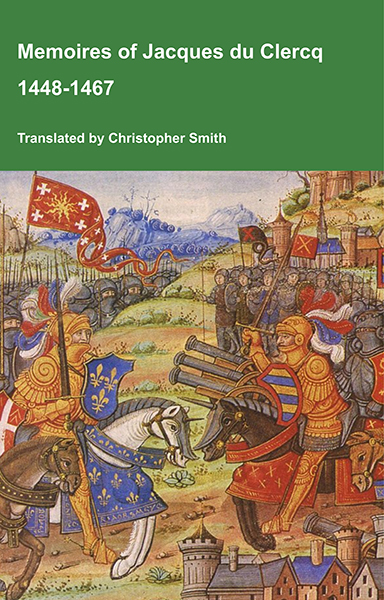
This is a translation of the 'Memoires of Jacques du Clercq', published in 1823 in two volumes, edited by Frederic, Baron de Reissenberg. In his introduction Reissenberg writes: 'Jacques du Clercq tells us that he was born in 1424, and that he was a licentiate in law and a counsellor to Philip the Good, Duke of Burgundy, in the castellany of Douai, Lille, and Orchies. It appears that he established his residence at Arras. In 1446, he married the daughter of Baldwin de la Lacherie, a gentleman who lived in Lille. We read in the fifth book of his Memoirs that his father, also named Jacques du Clercq, had married a lady of the Le Camelin family, from Compiègne. His ancestors, always attached to the counts of Flanders, had constantly served them, whether in their councils or in their armies.' The Memoires cover a period of nineteen years beginning in in 1448, ending in in 1467. It appears that the author had intended to extend the Memoirs beyond that date; no doubt illness or death prevented him from carrying out this plan. As Reissenberg writes the 'merit of this work lies in the simplicity of its narrative, in its tone of good faith, and in a certain air of frankness which naturally wins the reader’s confidence.' Du Clercq ranges from events of national and international importance, including events of the Wars of the Roses in England, to simple, everyday local events such as marriages, robberies, murders, trials and deaths, including that of his own father in Book 5; one of his last entries.
Available at Amazon in eBook and Paperback format.
In 1467 Thomas Tresham [aged 47] was appointed MP Northamptonshire.
In 1468 Thomas Tresham [aged 48] was imprisoned for having taken part in the plots of John de Vere 13th Earl of Oxford [aged 25] at Tower of London [Map].
On 6th October 1470 Henry VI [aged 48] was re-adepted, ie restored, King of England.
Thomas Tresham [aged 50] was released.
On 14th April 1471 Edward IV [aged 28] commanded at the Battle of Barnet supported by his brothers George [aged 21] and Richard [aged 18], John Babington [aged 48], Wiliam Hastings [aged 40] (commanded), Ralph Hastings, William Norreys [aged 30], William Parr [aged 37], John Savage [aged 49], William Bourchier Viscount Bourchier [aged 41], Thomas St Leger [aged 31], John Tuchet 6th Baron Audley, 3rd Baron Tuchet [aged 45], Thomas Burgh 1st Baron Burgh of Gainsborough [aged 40], John Scott [aged 48] and Thomas Strickland.
The Yorkists William Blount [aged 29], Humphrey Bourchier [aged 36], Henry Stafford [aged 46] and Thomas Parr were killed.
Humphrey Bourchier 1st Baron Cromwell [aged 40], was killed. Baron Cromwell extinct.
The Lancastrians...
Warwick the Kingmaker [aged 42] was killed. Earl Salisbury, Baron Montagu, Baron Montagu and Baron Monthermer forfeit on the assumption he was attainted either before or after his death; the date of his attainder is unknown. If not attainted the titles may have been abeyant between his two daughters Isabel Neville Duchess Clarence [aged 19] and Anne Neville Queen Consort England [aged 14].
John Neville 1st Marquess Montagu [aged 40] was killed. Marquess Montagu, Baron Montagu forfeit; unclear as to when he was attainted. He was buried at Bisham Abbey [Map].
William Tyrrell was killed.
William Fiennes 2nd Baron Saye and Sele [aged 43] was killed. His son Henry [aged 25] succeeded 3rd Baron Saye and Sele. Anne Harcourt Baroness Saye and Sele by marriage Baroness Saye and Sele.
Henry Holland 3rd Duke Exeter [aged 40] commanded the left flank, was badly wounded and left for dead, Henry Stafford and John Paston [aged 27] were wounded, John de Vere 13th Earl of Oxford [aged 28] commanded, and John Paston [aged 29] and William Beaumont 2nd Viscount Beaumont [aged 33] fought.
Robert Harleston [aged 36] was killed.
Thomas Hen Salusbury [aged 62] was killed.
Thomas Tresham [aged 51] escaped but was subsequently captured and executed on the 6th of May 1471.
Become a Member via our Buy Me a Coffee page to read more.
On 5th May 1471 those captured at the 4th May 1471 Battle of Tewkesbury were tried in the Market Square Tewkesbury, Gloucestershire [Map] by John Howard 1st Duke of Norfolk [aged 46] and the Duke of Gloucester [aged 18]: Edmund Beaufort [aged 32], Hugh Courtenay [aged 44], Gervase Clifton [aged 66], Thomas Tresham [aged 51] and Humphrey Tuchet [aged 37].
On 6th May 1471 those captured at the 4th May 1471 Battle of Tewkesbury: Edmund Beaufort [aged 32], Hugh Courtenay [aged 44], Gervase Clifton [aged 66] and Humphrey Tuchet [aged 37] were executed.
Thomas Tresham [aged 51] was executed. His estates including manor of Westhall, in Rushton St Peter, were forfeit.
John Lelands Itinerary Volume 6. Names of those killed at the battle of Gaston near Tewskebury.
Prince Edward was buried in the monastery of Tewkesbury.
Lord Edmund, Duke of Somerset, was captured and beheaded, and was buried there.
Lord John of Somerset, brother of Duke Edmund, was also buried there.
Thomas Courtenay, Earl of Devon, was buried there.
Lord Wenlock, whose body was later transferred elsewhere for burial.
Humphrey Handleley was beheaded with Thomas Courtenay and buried with him.
Edmund Howard, knight.
William Wichingham, knight.
Sir Delves the elder was killed in the field, and John Delves his son was beheaded there; they were buried together, later transferred elsewhere.
Sir John Leukenor, knight, was killed in the field and buried near the Delves.
Sir William Vaux, knight, was killed in the field and buried there.
Gervase Clifton was captured and beheaded, and buried there.
Sir William Carr and Sir Henry Roos, knights, were captured and beheaded. They were buried in the cemetery of Tewkesbury.
Sir Thomas Tresham was captured and beheaded, and buried there.
Sir William Lirmouthe, Sir John Urman, Sir Thomas Semar, and Sir William Rowys, knights, were killed in the field and buried there in the cemetery.
Sir William Newborough, knight, was captured and beheaded, and buried there.
Henry Wateley, esquire, was killed and buried there.
Henry Barow, esquire, was killed and buried there.
Fielding, esquire, was killed and buried there.
John Gower, standard-bearer of Prince Edward; John Flore, banner-bearer of the Duke of Somerset; Henry Tresham, Walter Courtenay, and Robert Acton were captured and beheaded.
The Prior of St. John's, London, was captured and beheaded; his body was brought back to London to his own people.
History of the Arrival of Edward IV Part 5. [6th May 1471] This battayle thus done and atchived, and the Kyngs grace thus largly shewed, it was so that, in the abbey, and othar places of the towne, were founden Edmond, callyd Duke of Somerset, the prior of Seynt Johns, called Ser John Longesthrother, Ser Thomas Tressham [aged 51], Ser Gervaux of Clyfton [aged 66]45, knyghts, squiers, and othar notable parsonnes dyvers, whiche all, divers tymes, were browght afore the Kyng's brothar, the Duke of Gloucestar and Constable of England, and the Duke of Norfolke, Marshall of England, theyr iudges; and so were iudged to deathe, in the mydst of the towne, Edmond Duke of Somarset, and the sayd Prior of Seint Johns, with many othar gentils that there were taken, and that of longe tyme had provoked and continuyed the great rebellyon that so long had endured in the land agaynst the Kynge, and contrye to the wele of the Realme. The sayd Duke, and othar thus iudged, were executyd in the mydste of the towne, upon a scaffolde therefore made, behedyd evereche one, and without any othar dismembringe, or settynge up, licensyd to be buryed.
Note 45. Clyfton, Clyston, in MS.
Around 1484 [his former wife] Margaret Zouche [aged 48] died.
A Chronicle of Tewkesbury Abbey. These are the names of the noblemen that were slayne at Tewkesbury felde.
Lord Edwarde, prince of Kynge Henry, in the felde of Gastum besyde Tewkesbery, slayne and buryed in ye mydste of ye covent quiere in ye monastery ther: for whom god worketh.
Lord Edmunde Duke late of Somarset taken and behedyd and buryed before an ymage of S. James at an autar in ye sayd monastery churche on ye northe parte.
Lord John Somarset, brother of ye sayd duke of Somarset, slayne in the fylde ther, and buryed with his sayd brother before ye sayd ymage toward mary mawdlyns auter.
Lord Thomas1 Courtney Erle of Devonshire slayne in the filde and buried about ye mydst of ye sayd auter of saynt James.
Syr Vmfray Haudeley ther take and behedyd and buryed with ye sayd Thomas Courtney, Erle of Devenshire, in one sepulcre before ye sayd altar.
Lord Wenloke slayne in the filde & his body take fro hens to be buryed.
Sir Edmund Barnarde knight slayne in ye filde and syr William Whytingham knyght, slayn also in ye filde and bothe bodyes buryed in ye body of ye sayd monastarye churche callyd ye parishe churche besyde saint Jorges chapell.
Syr John Delves, elder, slayne in ye filde: mastar John Delves, his sonne, take and beheadyd; and both buryed by syds seynt Johns chapell in ye sayde parishe churche and theyr bodies afterward take fro hens to theyr contrey.
Syr John Locnor [Lewknor] slayne and buryed in ye sayd parishe churche besyds ye bodies of ser Edmond and ser William before sayde.
Syr William Vauce, knyght, slayn in ye fild, and buryed in ye parishe churche before an image of our lady pety in ye northe syd.
Syr Geruase of Clifton, knyght, take and behedyd.
Syr William Car, knyght,
ser Henry Rose, knyght, taken and behedyd and buryed in ye churche yarde there.
Syr William Lyrmouthe, knyght, Ser John Vring, knyght, ser Thomas Seiner, knyght, ser William Rowes, knyght, all slayne in ye filde and buryed in ye churche yarde.
Syr Thomas Tryssam, knyght, take and behedyd, whos body was buryed in ye sayd monastary churche byfore a pilar betwyxt ye awtar of s. james and seint nicholas.
Syr Willyam Newborow, knyght, take and behedyd, buryed in ye parishe churche, besyds ye fante of baptisme yer in ye southe syde.
Mastar Henry Wrattesley, squier, slayne in ye filde and buryed in s. John baptist chaple in ye monastary churche on ye southe syde.
Mastar Henry Baron, squire, slayn and buryed in ye parishe churche before an Image of seint clement pope and martyr, and his body aftarwarde was fet from hens to his contrey.
Mastar Fildynge, squire, Mastar Hervy, recordar of Bristow, bothe slayne in ye filde and theyr bodyes buryed in ye churche with many othar.
John Gower, swerde berer of ye prince, John Flore2, bannarberer of ye duke of Somarset, Henry Tressam, Watar Courtney, Robait Acson3, Lewis Milis, Birchfeld of Westminstar, Mastar Gogh, squire, ser Thomas Tressam his clerke, Turnebull, all take and behedyd, and theyr bodyes buryed in ye churche in dyvars placis.
Also prior and lord of saynt Jones besyds London, taken in ye fild and with othar behedyd, whos body closyd in leade was take from hens to his owne place.
Note 1. Should be John.
Note 2. Stow has 'Flory'.
Note 3. Stow has 'Jackson'.
Become a Member via our Buy Me a Coffee page to read more.
GrandFather: Thomas Tresham of Sywell
Father: William Tresham
Great x 4 Grandfather: Robert Vaux 
Great x 3 Grandfather: Elias Vaux
Great x 2 Grandfather: William Vaux
Great x 1 Grandfather: William Vaux
GrandFather: William Vaux
Mother: Isabel Vaux