

The Deeds of the Dukes of Normandy
The Gesta Normannorum Ducum [The Deeds of the Dukes of Normandy] is a landmark medieval chronicle tracing the rise and fall of the Norman dynasty from its early roots through the pivotal events surrounding the Norman Conquest of England. Originally penned in Latin by the monk William of Jumièges shortly before 1060 and later expanded at the behest of William the Conqueror, the work chronicles the deeds, politics, battles, and leadership of the Norman dukes, especially William’s own claim to the English throne. The narrative combines earlier historical sources with firsthand information and oral testimony to present an authoritative account of Normandy’s transformation from a Viking settlement into one of medieval Europe’s most powerful realms. William’s history emphasizes the legitimacy, military prowess, and governance of the Norman line, framing their expansion, including the conquest of England, as both divinely sanctioned and noble in purpose. Later chroniclers such as Orderic Vitalis and Robert of Torigni continued the history, extending the coverage into the 12th century, providing broader context on ducal rule and its impact. Today this classic work remains a foundational source for understanding Norman identity, medieval statesmanship, and the historical forces that reshaped England and Western Europe between 800AD and 1100AD.
Available at Amazon in eBook and Paperback format.
Paternal Family Tree: Prinsep
Valentine Cameron Prinsep is in Painters.
On 14th May 1835 [his father] Henry Thoby Prinsep [aged 42] and [his mother] Sarah Monckton Pattle [aged 18] were married at Calcutta, India. The difference in their ages was 24 years.


On 14th February 1838 Valentine Cameron Prinsep was born to [his father] Henry Thoby Prinsep [aged 45] and [his mother] Sarah Monckton Pattle [aged 21] in Calcutta, India.
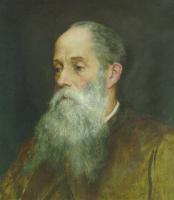
In 1856 John Roddam Spencer-Stanhope [aged 26] accompanied George Frederick Watts [aged 38] and Valentine Cameron Prinsep [aged 17] on an expedition to Asia Minor to observe the excavations of the ruins of the Mausoleum of Halicarnassus at Budrum led by Charles Newton, the Keeper of Greek Antiquities at the British Museum. Newton was a friend of Stanhope's father.
Life of William Morris. In the early part of the Long Vacation of 1857, Rossetti [aged 28] went down to Oxford to see his friend Benjamin Woodward, the architect. Morris, always delighted to take a day at Oxford, went with him. The long battle between the Palladian and Gothic styles for the new University Museum had been at last decided by the Oxford authorities in favour of the latter. Woodward's plans, in a style of mixed Rhenish and Venetian Gothic, had been accepted, and the museum was now in progress. Besides his principal work at the museum, he was engaged in building a debating hall for the Union Society. That hall, now the principal library, was just roofed in. In formi, the hall was a long building with apsidal ends. A narrow gallery fitted with bookshelves ran completely round it, and above the shelves was a broad belt of wall divided into ten bays, pierced by twenty six-foil circular windows, and surmounted by an open timber roof. Rossetti was at once fired with the idea of painting the space thus given. In his notions of the application of painting to architedural surfaces, Woodward, an ardent admirer and a skilled imitator of the Venetian builders, cordially concurred ; and it was at once settled that the ten bays and the whole of the ceiling should be covered with painting in tempera. The Building Committee of the Union, who had a general discretion as regards the work to be done during the Long Vacation, were induced to authorize the work without waiting to refer the matter to a general meeting of the Society. It was arranged that the paintings should forthwith be designed and carried out under Rossetti's superintendence. He himself, and other artists whom he should invite to join him, were to be the executants. The Union was to defray the expense of scaffolding and materials, and the travelling and lodging expenses of the artists, who, beyond this, were to give their services for nothing. No sooner was this settled, than Rossetti went straight back to London and issued his orders: Burne-Jones [aged 23] and Morris [aged 22] were to lay aside all other work and start on the new scheme at once. He had it all planned in his mind. The ten paintings on the walls were to be a series of scenes from the "Morte d' Arthur," and the roof above them was to be covered with a floriated design. For the pidures, ten men had to be found, each of whom should execute one bay, and the work, in the first enthusiasm, was estimated as a matter of six weeks or so. Arthur Hughes [aged 24], Spencer Stanhope [aged 27], Val Prinsep [aged 18], and Hungerford Pollen [aged 36], were drawn into the scheme and agreed to take a picture each; Madox Brown [aged 35] was also asked to execute one, but declined. Rossetti undertook to do two, or if possible three, himself, and Morris and Burne-Jones were each to do one under his eye and with his guidance : eight or nine of the ten bays were thus accounted for, and the remainder of the space was for the moment left to chance.
 Become a Member via our Buy Me a Coffee page to read more.
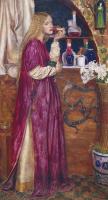
1860. Valentine Cameron Prinsep [aged 21]. "The Queen was in the Parlour, Eating Bread and Honey".
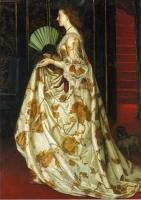
1864. Valentine Cameron Prinsep [aged 25]. "My Lady Betty". See The Athenæum 1864.
The Athenaeum 1864. 14th May 1864. Mr. V. Prinsep's [aged 26] contributions mark a great advance in his powers of design, and, what his former pictures mostly lacked, increased care in drawing, greater clearness and cleanness of bandling and colour, and progress in perception of what properly makes a picture. The last is one of the rarest gifts to a young painter, and often the latest he obtains by practice and thought. To all who give attention to this subject in a broad or philosophical manner, it is wonderful to find how few are the painters who perccive that it is not everything that is fit for the exercise of Art. At least half the pictures in every Exhibition evince no thought on the part of their producers for this matter, and—such is. the painful conclusion we cannot avoid—afford direct proof that their painters have not the primary qualification of an artist. All true artists are born with perception of this kind—some have it as their chief source of power, none have it thrust upon them—although scores get reputations on the strength of mere tricks, which the critic knows to be disdained by legions of unknown but self-respecting wen. Some achieve power of perception, as Mr. V. Prinsep soems to be doing; his Berenice — a mighty woman — is eminently pictorial in subject, and not less so in treatment. It might bave been less unrefined in form of drawing without being less strong than it is My Lady Betty (455), a courtly woman wearing a dress of white, gold-embroidered brocade, and! holding a fan before her as she walks, is inferior in subject to the last, but surpasses it in pictorial power displayed. It is very solid and good in execution. Benedick and Beatrice. (560) has perhaps. more subject, in the ordinary sense of the word, which implies something the ordinary spectator finds tangible, but it is Iess valuable as a picture than 'My Lady Betty,' and has parts that are very badly drawn,
On 11th February 1878 [his father] Henry Thoby Prinsep [aged 85] died.
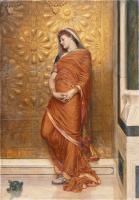
1882. Valentine Cameron Prinsep [aged 43]. "At the Golden Gate".
Anne Boleyn. Her Life as told by Lancelot de Carle's 1536 Letter.
In 1536, two weeks after the execution of Anne Boleyn, her brother George and four others, Lancelot du Carle, wrote an extraordinary letter that described Anne's life, and her trial and execution, to which he was a witness. This book presents a new translation of that letter, with additional material from other contemporary sources such as Letters, Hall's and Wriothesley's Chronicles, the pamphlets of Wynkyn the Worde, the Memorial of George Constantyne, the Portuguese Letter and the Baga de Secrets, all of which are provided in Appendices.
Available at Amazon in eBook and Paperback format.

Around 1883. Joseph Parkin Mayall [aged 44]. Portrait of Valentine Cameron Prinsep [aged 44].
On 28th July 1884 Valentine Cameron Prinsep [aged 46] and Florence Leyland [aged 24] were married at St George's Church, Hanover Square. The difference in their ages was 21 years.
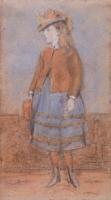

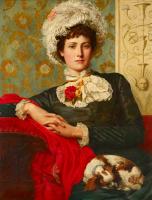
1885. Valentine Cameron Prinsep [aged 46]. "Unprofessional Beauty"
On 15th December 1887 [his mother] Sarah Monckton Pattle [aged 71] died.

1892. Valentine Cameron Prinsep [aged 53]. Portrait of Ann Fitzgerald Mackay Lady Simpson [aged 35] wife of Walter Grindlay Simpson 2nd Baronet [aged 48]. The painting was donated to Glasgow Museums in 1953 by her daughter Ethel Lucy Florence McKay Simpson [aged 16].
Ann Fitzgerald Mackay Lady Simpson: In 1857 she was born to Alexander Mackay and Isabella Catherine Thomson at Ness Caithness. On 13th January 1881 Walter Grindlay Simpson 2nd Baronet and she were married at Banchory-Devenick. On 22nd October 1941 she died at Oxford, Oxfordshire [Map].
Walter Grindlay Simpson 2nd Baronet: On 1st September 1843 he was born to James Young Simpson 1st Baronet. He was baptised on 14th October 1843. On 6th May 1870 James Young Simpson 1st Baronet died at 52 Queen Street Edinburgh. His son Walter succeeded 2nd Baronet Simpson of Strathavon and the City of Edinburgh. On 29th May 1898 he died at Balabraes Ayton. His son James succeeded 2nd Baronet Simpson of Strathavon and the City of Edinburgh.
Ethel Lucy Florence McKay Simpson: On 2nd November 1875 she was born to Walter Grindlay Simpson 2nd Baronet and Ann Fitzgerald Mackay Lady Simpson. On 25th January 1908 Arthur Willert and she were married. On 3rd April 1955 she died.
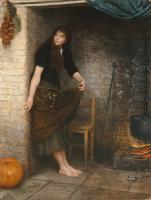
1899. Valentine Cameron Prinsep [aged 60]. "Cinderella".
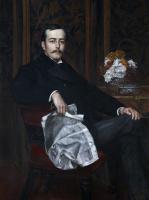
Around 1900. Valentine Cameron Prinsep [aged 61]. Portrait of Francis Layland-Barratt 1st Baronet [aged 40].
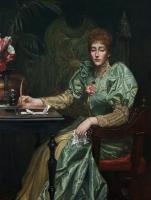
Around 1900. Valentine Cameron Prinsep [aged 61]. Portrait of Frances Layland Lady Layland-Barratt [aged 35].
Frances Layland Lady Layland-Barratt: In 1865 she was born. In 1884 Francis Layland-Barratt 1st Baronet and she were married. On 23rd July 1908 Francis Layland-Barratt 1st Baronet was created 1st Baronet Layland Barratt of the Manor House and of Trefgarne Lodge. She by marriage Lady Layland Barratt of the Manor House and of Trefgarne Lodge. In 1953 she died.

Before 11th November 1904. Valentine Cameron Prinsep [aged 66]. Portrait of Theresa Susey Helen Chetwynd-Talbot Marchioness Londonderry [aged 48].
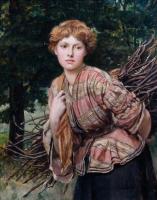
Before 11th November 1904. Valentine Cameron Prinsep [aged 66]. "Gamekeeper's Daughter".
On 11th November 1904 Valentine Cameron Prinsep [aged 66] died. He was buried at Brompton Cemetery, Kensington.
New York Times 13 Nov 1904. 13th November 1904. VAL PRINSEP [deceased], R. A., DEAD. Well-Known English Artist Was Born in India in 1838.
LONDON, Nov. 12.—Valantine Cameron Prinsep, R. A., better known as Val Prinsep, Professor of Painting to the Royal Academy, died yesterday from the effects of an operation.
It was thought in 1896 that Val Prinsep would be elected President of the Royal Academy, but Sir Edward Poynter was [aged 68] the successful candidate.
Mr. Prinsep was born in India in 1838. but was educated in England, returning to the land of his birth in 1876 to paint what is perhaps his best-known work, the "Declaration of the Queen as Empress" at the famous Delhi Durbar. A pupil of Watts and Gleyre, Prinsep exhibited his first picture at the Academy in 1862, when he was twenty-four years old. He achieved rapid success and became an A. R. A. in and an R. A. in 1894. He was an author and playwright as well as a painter.
Mr. Prinsep married a daughter [[his former wife] Florence Leyland [aged 45]] of the late [his former father-in-law] F. R. Leyland, the patron of Whistler and Rossetti. When Mr. Leyland died there was a good deal of criticism of the Prinseps because the "Peacock Room" in his London house was not preserved where the public could see it. This work of Whistler, who was a fellow-pupil of Prinsep under Gleyre, has recently been bought by an American.


On 22nd July 1921 [his former wife] Florence Leyland [aged 61] died. She was buried with her husband Valentine Cameron Prinsep, who had died seventeen years before, at Brompton Cemetery, Kensington.
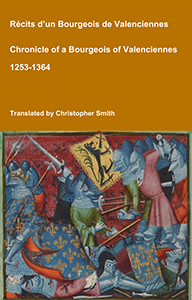
Chronicle of a Bourgeois of Valenciennes
Récits d’un bourgeois de Valenciennes aka The Chronicle of a Bourgeois of Valenciennes is a vivid 14th-century vernacular chronicle written by an anonymous urban chronicler from Valenciennes in the County of Hainaut. It survives in a manuscript that describes local and regional history from about 1253 to 1366, blending chronology, narrative episodes, and eyewitness-style accounts of political, military, and social events in medieval France, Flanders, and the Low Countries. The work begins with a chronological framework of events affecting Valenciennes and its region under rulers such as King Philip VI of France and the shifting allegiances of local nobility. It includes accounts of conflicts, sieges, diplomatic manoeuvres, and the impact of broader struggles like the Hundred Years’ War on urban life in Hainaut. Written from the perspective of a burgher (bourgeois) rather than a monastery or royal court, the chronicle offers a rare lay viewpoint on high politics and warfare, reflecting how merchants, townspeople, and civic institutions experienced the turbulence of the 13th and 14th centuries. Its narrative style combines straightforward reporting of events with moral and civic observations, making it a valuable source for readers interested in medieval urban society, regional politics, and the lived experience of war and governance in pre-modern Europe.
Available at Amazon in eBook and Paperback format.
Frederick Luke Val Fildes was born to Luke Fildes. His godfather was Valentine Cameron Prinsep. He married 1915 Muriel John, daughter of William Goscombe John and Marthe Weiss.
Great x 1 Grandfather: Reverend John Prinsep
GrandFather: John Prinsep
Father: Henry Thoby Prinsep
Great x 1 Grandfather: James Auriol
GrandMother: Sophie Elizabeth Auriol
GrandFather: James Peter Pattle
Mother: Sarah Monckton Pattle
Great x 1 Grandfather: Ambroise Pierre de l'Etang
GrandMother: Adeline Marie de l'Etang