

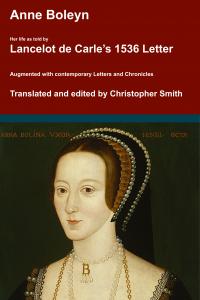
Anne Boleyn. Her Life as told by Lancelot de Carle's 1536 Letter.
In 1536, two weeks after the execution of Anne Boleyn, her brother George and four others, Lancelot du Carle, wrote an extraordinary letter that described Anne's life, and her trial and execution, to which he was a witness. This book presents a new translation of that letter, with additional material from other contemporary sources such as Letters, Hall's and Wriothesley's Chronicles, the pamphlets of Wynkyn the Worde, the Memorial of George Constantyne, the Portuguese Letter and the Baga de Secrets, all of which are provided in Appendices.
Available at Amazon in eBook and Paperback format.
Paternal Family Tree: Borlase
Around 1564 William Borlase of Little Marlow was born to [his father] John Borlase of Buckinghamshire (age 37).
On 17th November 1581 William Borlase of Little Marlow (age 17) matriculated Magdalen College, Oxford University.
In 1584 William Borlase of Little Marlow (age 20) was a student at Gray's Inn.
In 1589 [his son] William Borlase was born to William Borlase of Little Marlow (age 25). He married before 21st August 1619 Jane Popham and had issue.
Around 1590 [his son] Henry Borlase was born to William Borlase of Little Marlow (age 26).
On 6th May 1593 [his father] John Borlase of Buckinghamshire (age 66) died.
In 1601 William Borlase of Little Marlow (age 37) was appointed High Sheriff of Buckinghamshire.
On 28th June 1603 William Borlase of Little Marlow (age 39) was knighted at Beddington, Surrey.
In 1604 William Borlase of Little Marlow (age 40) was elected MP Aylesbury.
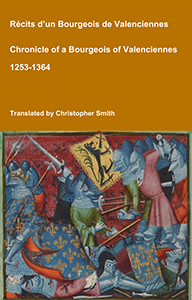
Chronicle of a Bourgeois of Valenciennes
Récits d’un bourgeois de Valenciennes aka The Chronicle of a Bourgeois of Valenciennes is a vivid 14th-century vernacular chronicle written by an anonymous urban chronicler from Valenciennes in the County of Hainaut. It survives in a manuscript that describes local and regional history from about 1253 to 1366, blending chronology, narrative episodes, and eyewitness-style accounts of political, military, and social events in medieval France, Flanders, and the Low Countries. The work begins with a chronological framework of events affecting Valenciennes and its region under rulers such as King Philip VI of France and the shifting allegiances of local nobility. It includes accounts of conflicts, sieges, diplomatic manoeuvres, and the impact of broader struggles like the Hundred Years’ War on urban life in Hainaut. Written from the perspective of a burgher (bourgeois) rather than a monastery or royal court, the chronicle offers a rare lay viewpoint on high politics and warfare, reflecting how merchants, townspeople, and civic institutions experienced the turbulence of the 13th and 14th centuries. Its narrative style combines straightforward reporting of events with moral and civic observations, making it a valuable source for readers interested in medieval urban society, regional politics, and the lived experience of war and governance in pre-modern Europe.
Available at Amazon in eBook and Paperback format.
In 1614 William Borlase of Little Marlow (age 50) was elected MP Buckinghamshire.
Before 21st August 1619 [his son] William Borlase (age 30) and [his daughter-in-law] Jane Popham were married.
In 1624 [his son] Henry Borlase (age 34) died.
In 1624 William Borlase of Little Marlow (age 60) founded Sir William Borlase's Grammar School in memory of his son [his son] Henry Borlase (age 34) who had died that year.
On 4th September 1629 William Borlase of Little Marlow (age 65) died. He was buried on 10th September 1629.