

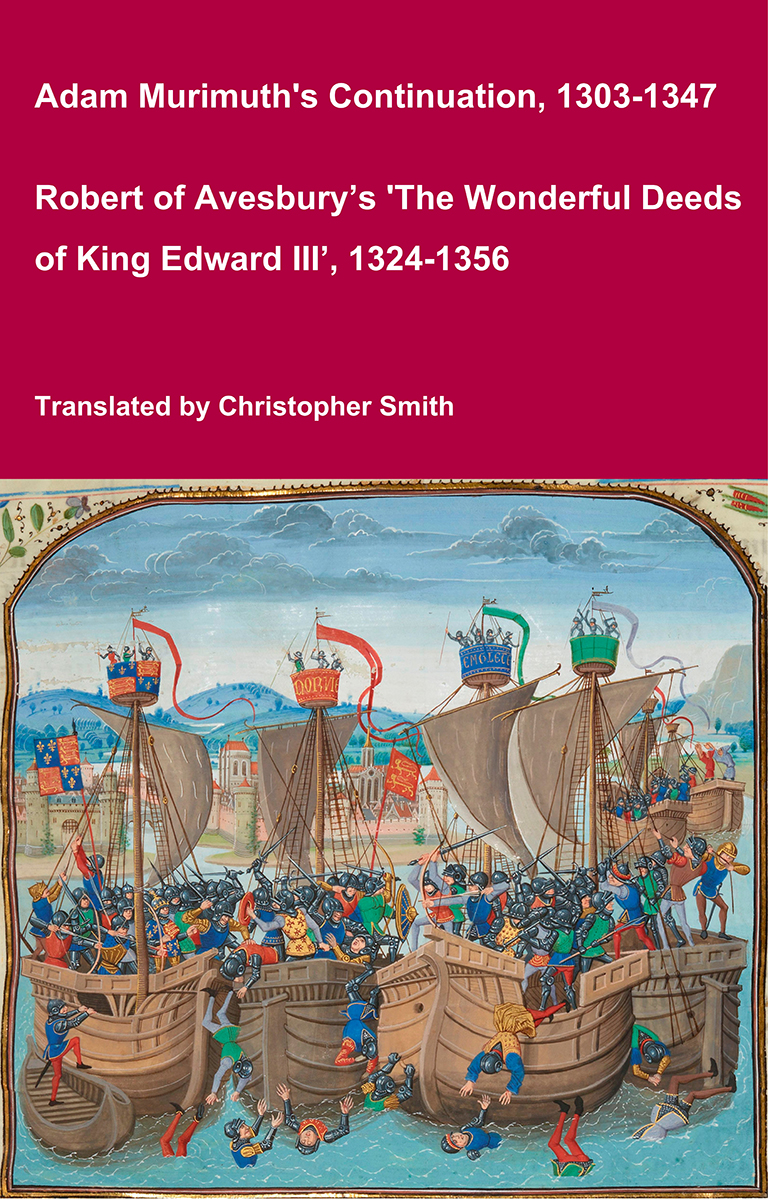
Adam Murimuth's Continuation and Robert of Avesbury’s 'The Wonderful Deeds of King Edward III'
This volume brings together two of the most important contemporary chronicles for the reign of Edward III and the opening phases of the Hundred Years’ War. Written in Latin by English clerical observers, these texts provide a vivid and authoritative window into the political, diplomatic, and military history of fourteenth-century England and its continental ambitions. Adam Murimuth Continuatio's Chronicarum continues an earlier chronicle into the mid-fourteenth century, offering concise but valuable notices on royal policy, foreign relations, and ecclesiastical affairs. Its annalistic structure makes it especially useful for establishing chronology and tracing the development of events year by year. Complementing it, Robert of Avesbury’s De gestis mirabilibus regis Edwardi tertii is a rich documentary chronicle preserving letters, treaties, and official records alongside narrative passages. It is an indispensable source for understanding Edward III’s claim to the French crown, the conduct of war, and the mechanisms of medieval diplomacy. Together, these works offer scholars, students, and enthusiasts a reliable and unembellished account of a transformative period in English and European history. Essential for anyone interested in medieval chronicles, the Hundred Years’ War, or the reign of Edward III.
Available at Amazon in eBook and Paperback format.
In 1606 William Child was born at Bristol, Gloucestershire [Map].
In 1632 William Child [aged 26] was appointed Master of the Choristers at St George's Chapel, Windsor Castle [Map].
Samuel Pepys' Diary. 21st December 1663. Thence, having enough of it, by coach to my Lord Sandwich's [aged 38], where I find him within with Captain Cooke [aged 47] and his boys, Dr. Childe [aged 57], Mr. Madge, and Mallard, playing and singing over my Lord's anthem which he hath made to sing in the King's Chappell: my Lord saluted me kindly and took me into the withdrawing-room, to hear it at a distance, and indeed it sounds very finely, and is a good thing, I believe, to be made by him, and they all commend it. And after that was done Captain Cooke and his two boys did sing some Italian songs, which I must in a word say I think was fully the best musique that I ever yet heard in all my life, and it was to me a very great pleasure to hear them.


Samuel Pepys' Diary. 26th February 1666. Thence took leave of the Doctor [aged 60], and so took coach, and finely, but sleepy, away home, and got thither about eight at night, and after a little at my office, I to bed; and an houre after, was waked with my wife's quarrelling with Mercer, at which I was angry, and my wife and I fell out. But with much ado to sleep again, I beginning to practise more temper, and to give her her way.
Samuel Pepys' Diary. 26th February 1666. This being done, to the King's house, and to observe the neatness and contrivance of the house and gates: it is the most romantique castle that is in the world. But, Lord! the prospect that is in the balcone in the Queene's [aged 56] lodgings, and the terrace and walk, are strange things to consider, being the best in the world, sure. Infinitely satisfied I and my wife with all this, she being in all points mightily pleased too, which added to my pleasure; and so giving a great deal of money to this and that man and woman, we to our taverne, and there dined, the Doctor with us; and so took coach and away to Eton [Map], the Doctor [aged 60] with me.


Samuel Pepys' Diary. 26th February 1666. So took coach and to Windsor, to the Garter, and thither sent for Dr. Childe [aged 60]; who come to us, and carried us to St. George's Chappell [Map]; and there placed us among the Knights' stalls (and pretty the observation, that no man, but a woman may sit in a Knight's place, where any brass-plates are set); and hither come cushions to us, and a young singing-boy to bring us a copy of the anthem to be sung. And here, for our sakes, had this anthem and the great service sung extraordinary, only to entertain us. It is a noble place indeed, and a good Quire of voices. Great bowing by all the people, the poor Knights particularly, to the Alter.
Samuel Pepys' Diary. 30th July 1666. At noon home to dinner and there did practise with Mercer one of my new tunes that I have got Dr. Childe [aged 60] to set me a base to and it goes prettily.
Samuel Pepys' Diary. 3rd April 1667. By and by up to the Duke of York [aged 33], where our usual business, and among other things I read two most dismal letters of the straits we are in (from Collonell Middleton and Commissioner Taylor) that ever were writ in the world, so as the Duke of York would have them to shew the King [aged 36], and to every demand of money, whereof we proposed many and very pressing ones, Sir G. Carteret [aged 57] could make no answer but no money, which I confess made me almost ready to cry for sorrow and vexation, but that which was the most considerable was when Sir G. Carteret did say that he had no funds to raise money on; and being asked by Sir W. Coventry [aged 39] whether the eleven months' tax was not a fund, and he answered, "No, that the bankers would not lend money upon it". Then Sir W. Coventry burst out and said he did supplicate his Royal Highness, and would do the same to the King, that he would remember who they were that did persuade the King from parting with the Chimney-money to the Parliament, and taking that in lieu which they would certainly have given, and which would have raised infallibly ready money; meaning the bankers and the farmers of the Chimney-money, whereof Sir, G. Carteret, I think, is one; saying plainly, that whoever did advise the King to that, did, as much as in them lay, cut the King's throat, and did wholly betray him; to which the Duke of York did assent; and remembered that the King did say again and again at the time, that he was assured, and did fully believe, the money would be raised presently upon a land-tax. This put as all into a stound; and Sir W. Coventry went on to declare, that he was glad he was come to have so lately concern in the Navy as he hath, for he cannot now give any good account of the Navy business; and that all his work now was to be able to provide such orders as would justify his Royal Highness in the business, when it shall be called to account; and that he do do, not concerning himself whether they are or can be performed, or no; and that when it comes to be examined, and falls on my Lord Treasurer [aged 60], he cannot help it, whatever the issue of it shall be. Hereupon Sir W. Batten [aged 66] did pray him to keep also by him all our letters that come from the office that may justify us, which he says he do do, and, God knows, it is an ill sign when we are once to come to study how to excuse ourselves. It is a sad consideration, and therewith we broke up, all in a sad posture, the most that ever I saw in my life. One thing more Sir W. Coventry did say to the Duke of York, when I moved again, that of about £9000 debt to Lanyon, at Plymouth, Devon [Map], he might pay £3700 worth of prize-goods, that he bought lately at the candle, out of this debt due to him from the King; and the Duke of York, and Sir G: Carteret, and Lord Barkeley [aged 65], saying, all of them, that my Lord Ashly [aged 45] would not be got to yield to it, who is Treasurer of the Prizes, Sir W. Coventry did plainly desire that it might be declared whether the proceeds of the prizes were to go to the helping on of the war, or no; and, if it were, how then could this be denied? which put them all into another stound; and it is true, God forgive us! Thence to the chappell, and there, by chance, hear that Dr. Crew [aged 34] is to preach; and so into the organ-loft, where I met Mr. Carteret, and my Lady Jemimah, and Sir Thomas Crew's [aged 43] two daughters, and Dr. Childe [aged 61] played; and Dr. Crew did make a very pretty, neat, sober, honest sermon; and delivered it very readily, decently, and gravely, beyond his years: so as I was exceedingly taken with it, and I believe the whole chappell, he being but young; but his manner of his delivery I do like exceedingly. His text was, "But seeke ye first the Kingdom of God, and his righteousness, and all these things shall be added unto you". Thence with my Lady to Sir G. Carteret's lodgings, and so up into the house, and there do hear that the Dutch letters are come, and say that the Dutch have ordered a passe to be sent for our Commissioners, and that it is now upon the way, coming with a trumpeter blinded, as is usual. But I perceive every body begins to doubt the success of the treaty, all their hopes being only that if it can be had on any terms, the Chancellor [aged 58] will have it; for he dare not come before a Parliament, nor a great many more of the courtiers, and the King himself do declare he do not desire it, nor intend it but on a strait; which God defend him from! Here I hear how the King is not so well pleased of this marriage between the Duke of Richmond and Mrs. Stewart [aged 19], as is talked; and that he [the Duke] by a wile did fetch her to the Beare [Map], at the bridge foot, where a coach was ready, and they are stole away into Kent, without the King's leave; and that the King hath said he will never see her more; but people do think that it is only a trick. This day I saw Prince Rupert [aged 47] abroad in the Vane-room, pretty well as he used to be, and looks as well, only something appears to be under his periwigg on the crown of his head.
 Become a Member via our Buy Me a Coffee page to read more.
Samuel Pepys' Diary. 15th April 1667. Lay long in bed, and by and by called up by Sir H. Cholmly [aged 34], who tells me that my Lord Middleton [aged 59] is for certain chosen Governor of Tangier; a man of moderate understanding, not covetous, but a soldier of fortune, and poor. Here comes Mr. Sanchy with an impertinent business to me of a ticket, which I put off. But by and by comes Dr. Childe [aged 61] by appointment, and sat with me all the morning making me bases and inward parts to several songs that I desired of him, to my great content. Then dined, and then abroad by coach, and I set him down at Hatton Garden, and I to the King's house by chance, where a new play: so full as I never saw it; I forced to stand all the while close to the very door till I took cold, and many people went away for want of room. The King [aged 36], and Queene [aged 57], and Duke of York [aged 33] and Duchess [aged 30] there, and all the Court, and Sir W. Coventry [aged 39]. The play called "The Change of Crownes"; a play of Ned Howard's [aged 42], the best that ever I saw at that house, being a great play and serious; only Lacy [aged 52] did act the country-gentleman come up to Court, who do abuse the Court with all the imaginable wit and plainness about selling of places, and doing every thing for money. The play took very much.
On 23rd March 1697 William Child [aged 91] died.