

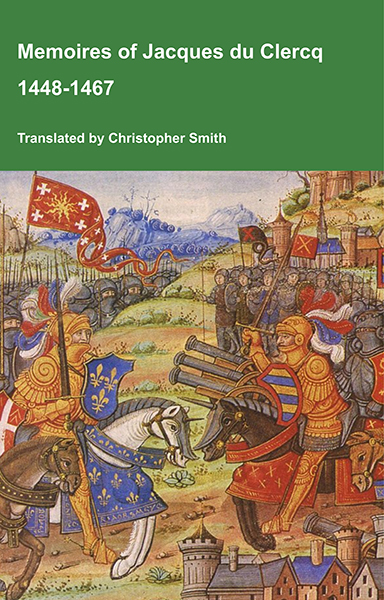
This is a translation of the 'Memoires of Jacques du Clercq', published in 1823 in two volumes, edited by Frederic, Baron de Reissenberg. In his introduction Reissenberg writes: 'Jacques du Clercq tells us that he was born in 1424, and that he was a licentiate in law and a counsellor to Philip the Good, Duke of Burgundy, in the castellany of Douai, Lille, and Orchies. It appears that he established his residence at Arras. In 1446, he married the daughter of Baldwin de la Lacherie, a gentleman who lived in Lille. We read in the fifth book of his Memoirs that his father, also named Jacques du Clercq, had married a lady of the Le Camelin family, from Compiègne. His ancestors, always attached to the counts of Flanders, had constantly served them, whether in their councils or in their armies.' The Memoires cover a period of nineteen years beginning in in 1448, ending in in 1467. It appears that the author had intended to extend the Memoirs beyond that date; no doubt illness or death prevented him from carrying out this plan. As Reissenberg writes the 'merit of this work lies in the simplicity of its narrative, in its tone of good faith, and in a certain air of frankness which naturally wins the reader’s confidence.' Du Clercq ranges from events of national and international importance, including events of the Wars of the Roses in England, to simple, everyday local events such as marriages, robberies, murders, trials and deaths, including that of his own father in Book 5; one of his last entries.
Available at Amazon in eBook and Paperback format.
Around 1542 William Dethick was born to [his father] Gilbert Dethick [aged 32]. He was educated at St John's College, Cambridge University [Map].
On 29th April 1550 [his father] Gilbert Dethick [aged 40] was appointed Garter King of Arms.
In 1567 William Dethick [aged 25] was appointed Rouge Croix Pursuivant of Arms in Ordinary.
In 1570 William Dethick [aged 28] was appointed York Herald of Arms in Ordinary.
On 3rd October 1584 [his father] Gilbert Dethick [aged 74] died. Robert Cooke [aged 49] served as Acting Garter King of Arms until the appointment of Gilbert's son William Dethick [aged 42] on 21st April 1586.
Archaeologia Volume 1 Section 55. On Sunday, being the 30th of July, 1587, in the 29th year of the reign of Elizabeth, the queens majestie of England, there went from Peterborough M.... Dethick [aged 45], alias Garter principal king of armes, and five heralds, accompanied with forty horse and men, to conduct the body of Mary, late queen of Scots, from Fotheringham Castle [Map] in Northamptonshire to Peterborough aforesaid, which queen had remained prisoner in England .... years; having for that purpose brought a royal coach, drawn by four horses, and covered with black velvet richly set forth with escotcheons of the armes of Scotland, and little penons, round about it; the body being inclosed in lead, and the same coffined in wood, was brought down and reverently put into the coach, at which time the heralds put on their coats of arms, and bare-headed, with torches light, brought the same forth of the castle, about ten of the clock at night, and so conveyed it to Peterborough .... miles distant from Fotheringham Castle,
Tudor Tracts Chapter 20. The following is a truer account of the actual interment:
On Sunday, being the 30th of July, 1587, in the 20th year of the reign of Elizabeth the Queen's Majesty of England, there went from Peterborough Master William Dethick [aged 45], alias Garter Principal King of Arms, and five Heralds, accompanied by 40 horse and men, to conduct the body of Mary, late Queen of Scots, from Fotheringhay Castle [Map] in Northamptonshire (which Queen had remained prisoner in England nineteen years): having for that purpose, brought a royal coach drawn by four horses, and covered with black velvet; richly set forth with escutcheons of the Arms of Scotland, and little pennons round about it.
The body (being enclosed in lead; and the same coffined in wood) was brought down, and reverently put into the coach.
At which time, the Heralds put on their Coats of Arms, and bareheaded, with torches' light, brought the same forth of the Castle, about ten of the clock at night: and so conveyed it to Peterborough [eleven] miles distant from Fotheringhay Castle.


On 13th May 1603 William Dethick [aged 61] was knighted by King James I of England and Ireland and VI of Scotland [aged 36].
In May 1604 Robert Spencer 1st Baron Spencer [aged 34] and William Dethick [aged 62] travelled to Frederick I Duke Württemberg [aged 46] to present jewels including two garters with diamonds and rubies, and two St Georges with diamonds and rubies, and a gold chain or collar, made by the London goldsmiths, John Spilman and William Herrick.
In 1612 William Dethick [aged 70] died. He was buried at St Paul's Cathedral [Map]. His grave was lost in the Great Fire of London.