

Henrici Quinti, Angliæ Regis, Gesta, is a first-hand account of the Agincourt Campaign, and subsequent events to his death in 1422. The author of the first part was a Chaplain in King Henry's retinue who was present from King Henry's departure at Southampton in 1415, at the siege of Harfleur, the battle of Agincourt, and the celebrations on King Henry's return to London. The second part, by another writer, relates the events that took place including the negotiations at Troye, Henry's marriage and his death in 1422.
Available at Amazon in eBook and Paperback format.
Paternal Family Tree: Flower
Maternal Family Tree: Jane Yarner 1708
On 11th March 1685 William Flower 1st Baron Castle Durrow was born to [his father] Thomas Flower and [his mother] Mary Temple.
Around 1687 William Flower 1st Baron Castle Durrow (age 1) educated at Christ Church College, Oxford University.
In 1715 William Flower 1st Baron Castle Durrow (age 29) was elected MP Kilkenny.
In 1717 William Flower 1st Baron Castle Durrow (age 31) and Edith Caulfeild Baroness Castle Durrow (age 23) were married.
In 1720 [his son] Henry Flower 1st Viscount Ashbrook was born to William Flower 1st Baron Castle Durrow (age 34) and [his wife] Edith Caulfeild Baroness Castle Durrow (age 26).
Around 1722 [his daughter] Rebecca Flower was born to William Flower 1st Baron Castle Durrow (age 36) and [his wife] Edith Caulfeild Baroness Castle Durrow (age 28). She married 6th July 1740 James Agar.
After 1727 William Flower 1st Baron Castle Durrow (age 41) was elected MP Portarlington.
In 1733 William Flower 1st Baron Castle Durrow (age 47) was created 1st Baron Castle Durrow of Castle Durrow in County Kilkenny. [his wife] Edith Caulfeild Baroness Castle Durrow (age 39) by marriage Baroness Castle Durrow of Castle Durrow in County Kilkenny.
In 1735 William Flower 1st Baron Castle Durrow (age 49) was appointed Privy Council.
On 6th July 1740 [his son-in-law] James Agar (age 26) and [his daughter] Rebecca Flower (age 18) were married.
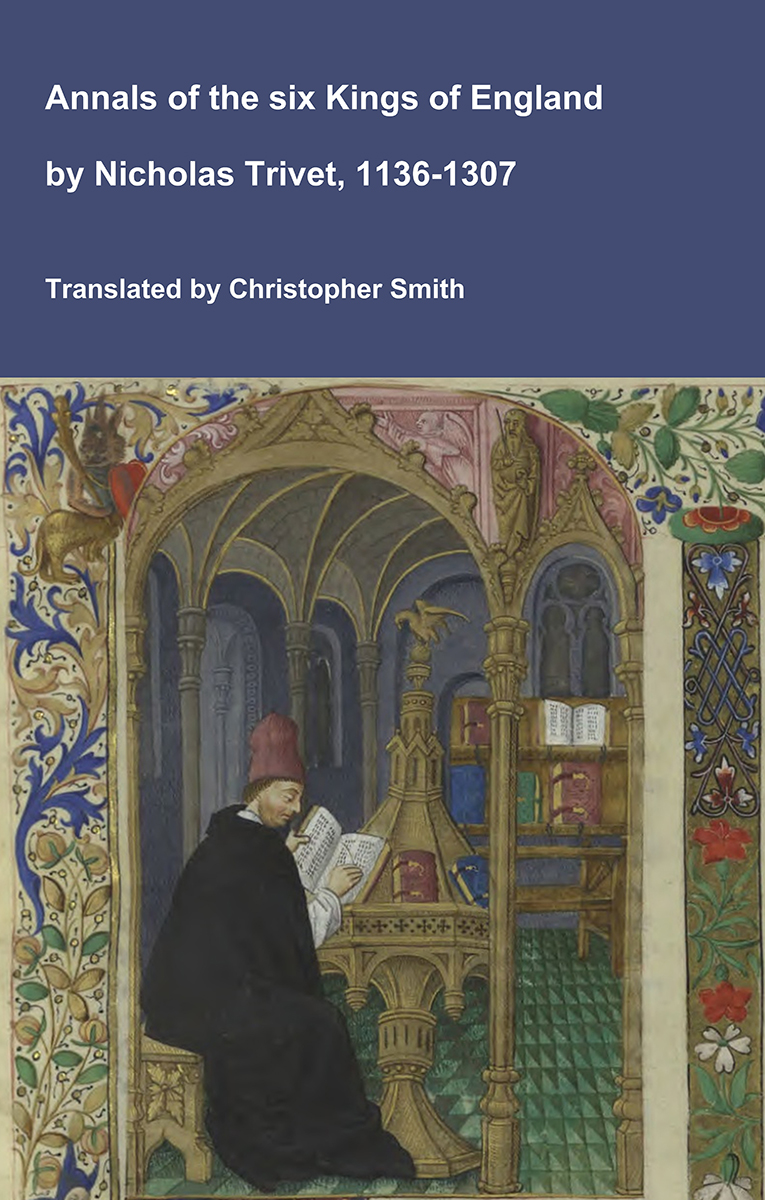
Annals of the six Kings of England by Nicholas Trivet
Translation of the Annals of the Six Kings of England by that traces the rise and rule of the Angevin aka Plantagenet dynasty from the mid-12th to early 14th century. Written by the Dominican scholar Nicholas Trivet, the work offers a vivid account of English history from the reign of King Stephen through to the death of King Edward I, blending political narrative with moral reflection. Covering the reigns of six monarchs—from Stephen to Edward I—the chronicle explores royal authority, rebellion, war, and the shifting balance between crown, church, and nobility. Trivet provides detailed insight into defining moments such as baronial conflicts, Anglo-French rivalry, and the consolidation of royal power under Edward I, whose reign he describes with particular immediacy. The Annals combines careful year-by-year reporting with thoughtful interpretation, presenting history not merely as a sequence of events but as a moral and political lesson. Ideal for readers interested in medieval history, kingship, and the origins of the English state, this chronicle remains a valuable and accessible window into the turbulent world of the Plantagenet kings.
Available at Amazon in eBook and Paperback format.
On 29th April 1746 William Flower 1st Baron Castle Durrow (age 61) died. He was buried at Finglas, County Dublin.
[his father] Thomas Flower and [his mother] Mary Temple were married.
Father: Thomas Flower
William Flower 1st Baron Castle Durrow
Great x 4 Grandfather: Peter Temple of Stowe 
Great x 3 Grandfather: Anthony Temple
Great x 2 Grandfather: William Temple
Great x 1 Grandfather: John Temple of Dublin
GrandFather: John Temple
Mother: Mary Temple
Great x 1 Grandfather: Abraham Yarner
GrandMother: Jane Yarner