

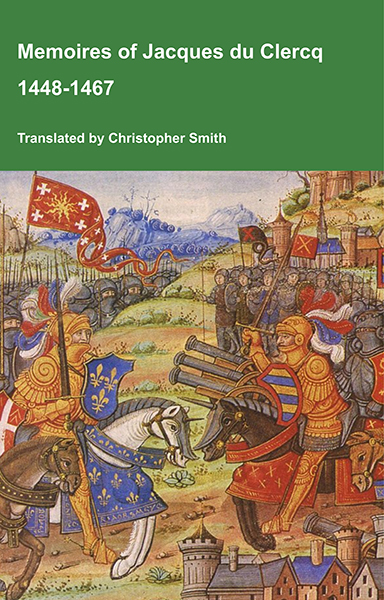
This is a translation of the 'Memoires of Jacques du Clercq', published in 1823 in two volumes, edited by Frederic, Baron de Reissenberg. In his introduction Reissenberg writes: 'Jacques du Clercq tells us that he was born in 1424, and that he was a licentiate in law and a counsellor to Philip the Good, Duke of Burgundy, in the castellany of Douai, Lille, and Orchies. It appears that he established his residence at Arras. In 1446, he married the daughter of Baldwin de la Lacherie, a gentleman who lived in Lille. We read in the fifth book of his Memoirs that his father, also named Jacques du Clercq, had married a lady of the Le Camelin family, from Compiègne. His ancestors, always attached to the counts of Flanders, had constantly served them, whether in their councils or in their armies.' The Memoires cover a period of nineteen years beginning in in 1448, ending in in 1467. It appears that the author had intended to extend the Memoirs beyond that date; no doubt illness or death prevented him from carrying out this plan. As Reissenberg writes the 'merit of this work lies in the simplicity of its narrative, in its tone of good faith, and in a certain air of frankness which naturally wins the reader’s confidence.' Du Clercq ranges from events of national and international importance, including events of the Wars of the Roses in England, to simple, everyday local events such as marriages, robberies, murders, trials and deaths, including that of his own father in Book 5; one of his last entries.
Available at Amazon in eBook and Paperback format.
William Hogarth is in Painters.
On 10th November 1697 William Hogarth was born.
In 1729 William Hogarth (age 31) and Jane Thornhill (age 20) were married in Paddington without the permission of her father James Thornhill (age 54).

In 1730 William Hogarth (age 32). Arthur Onslow (age 38) inviting Robert Walpole 1st Earl Orford (age 53) to speak.

In 1730 William Hogarth (age 32). John (age 19) and Elizabeth Jeffreys and their children.
John Jeffreys: On 10th August 1710 he was born. On 20th November 1798 he died.

After 1730 William Hogarth (age 32). Portrait of the artist's wife [his wife] Jane Thornhill (age 21).
Jane Thornhill: Around 1709 she was born to James Thornhill. In 1729 William Hogarth and she were married in Paddington without the permission of her father James Thornhill. In 1731 William Hogarth moved into his wife's family home in Covent Garden [Map]. On 13th November 1789 she died in Chiswick.
In 1731 William Hogarth (age 33) moved into his [his wife] wife's (age 22) family home in Covent Garden [Map].

In 1731 William Hogarth (age 33). Ashley Cowper (age 30) with his wife and daughter. The portrait was probably begun to mark the marriage of Hogarth's friend Ashley Cowper to Dorothy Oakes in about 1730. Their marriage is referred to through the priestly figure officiating at an altar on the Urn behind them, and by the Latin inscription on the Pedestal by the poet Virgil. The child is probably the couple's eldest daughter, Theodora, who was added to the picture at a later date.
Ashley Cowper: he was appointed Clerk of the Parliaments. Ashley Cowper and Dorothy Oakes were married. In 1701 he was born to Spencer Cowper.

Around 1732. William Hogarth (age 34). Conversation Piece with Andrew Fountaine (age 56), his sister Elizabeth Fountaine (age 56), his niece Elizabeth Clent (age 26) and the latter's future husband, Fountaine's 'right-hand man in collecting', Captain William Price.
Elizabeth Clent: Captain William Price and she were married. She inherited Narford Hall when her mother Elizabeth Fountaine died. In 1706 she was born to Colonel Edward Clent of Knightwick in Worcestershire and Elizabeth Fountaine. On 27th July 1746 she died. Her son Brigg Price inherited Narford Hall.
Captain William Price: by 1714 Andrew Fountaine had embarked on a second grand tour with his friend Captain William Price.

In 1734 William Hogarth (age 36). Titled "Edwards Hamilton family on a Terrace" the subjects are Anne Hamilton (age 24) and Mary Edwards (age 30) and their child Gerard Edwardes of Welham Grove. In her left hand she holds Addison's Spectator No.580 that describes the need to fill the mind with an awareness of the Divine Being. The books on the table beside her include poetry or sermons of Edward Young, the works of Swift, Pope's translation of the Iliad, and the devotional writings of Damuel Bowens and Archbishop Tillotson.
Anne Hamilton: On 12th October 1709 he was born to James Hamilton Duke Hamilton, 1st Duke Brandon and Elizabeth Gerard Duchess Brandon in St James' Square. He was named after his godmother Queen Anne of England Scotland and Ireland. His other godparents were John Churchill 1st Duke of Marlborough and Charles Spencer 3rd Earl of Sunderland. In or before 1731 Anne Hamilton and Mary Edwards were married in the Chapel of Fleet Prison [Map]. She was the richest woman in England at the time having aounrd £60000. Evidence of the marriage was scant; she never used the Hamilton name, although it was reported in the Gentleman's Magazine. She eventually separated from her husband making her children illegitimate. Somewhat curiously his baptism records show his surname as Edwardes. In October 1742 Anne Hamilton and Anna Charlotta Maria Powell were married. He the son of James Hamilton Duke Hamilton, 1st Duke Brandon and Elizabeth Gerard Duchess Brandon. On 25th December 1748 Anne Hamilton died.
Mary Edwards: In 1704 she was born. On 23rd August 1743 she died in Kensington.
Gerard Edwardes of Welham Grove: In 1734 he was born to Anne Hamilton and Mary Edwards. Before 17th July 1759 Gerard Edwardes of Welham Grove and Jane Noel were married. She the daughter of Baptist Noel 4th Earl Gainsborough and Elizabeth Chapman Countess Gainsborough. In 1773 Gerard Edwardes of Welham Grove died.
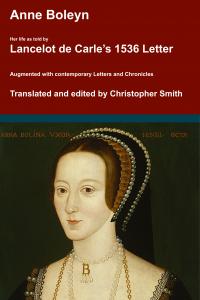
Anne Boleyn. Her Life as told by Lancelot de Carle's 1536 Letter.
In 1536, two weeks after the execution of Anne Boleyn, her brother George and four others, Lancelot du Carle, wrote an extraordinary letter that described Anne's life, and her trial and execution, to which he was a witness. This book presents a new translation of that letter, with additional material from other contemporary sources such as Letters, Hall's and Wriothesley's Chronicles, the pamphlets of Wynkyn the Worde, the Memorial of George Constantyne, the Portuguese Letter and the Baga de Secrets, all of which are provided in Appendices.
Available at Amazon in eBook and Paperback format.

In 1738. William Hogarth (age 40). "Night". The fourth and last of a series entitled "The Four Times of the Day".
The Rummer is introduced by Hogarth into his picture of "Night." and that a night of rejoicing, viz. the 29th of May; evident from the bonfires, the oaken bough upon the barber's pole, and the oak leaves fixed in the freemasons' hats. The scene is taken from the narrow part of Charing Cross, as it formerly stood before the way was widened, looking from Whitehall, and exhibits the Rummer Tavern on one side, and the Cardigan's Head on the other; at that time two noted bagnios. We see here the Salisbury flying coach, just set out from the inn, overturning, and its passengers in the utmost fright, increased by the entrance of a burning serpent into the coach, thrown by some unlucky boy. On the other side a waiter is leading home a freemason in his apron, overpowered with liquor, who, by a cut on his face, is shewn to have been in a fray; he is scarcely out of one dilemma, before he is in another, for a maid, from a window in the Rummer Tavern, is showering her favours upon his head. On the right of this man is the house of a barber surgeon, illuminated with candles, whose sign is a hand drawing a tooth, the head in exquisite pain; beneath is written, "Shaving, bleeding, and teeth drawn with a touch." "Ecce signum," behold the sign. An emblem of the operator's abilities. And through the window we have a view of the joint operation of shaving and bleeding, by a drunken apprentice. Beneath is a beggar's bagnio, a place to which such poor wretches as cannot find a better lodging, are obliged to resort in common. Though dark, we are able to discern these poor creatures by the light of the boy's link, which he is blowing in order to kindle a squib. Behind is a nightman, employed in his profession; and further back, a family carrying off their goods by stealth, fearing they should fall a prey to their landlord. Here Jack Sheppard committed his first robbery by stealing two silver spoons.
On September 17th 1738, or shortly before that date is recorded that: "Last Monday morning died Mr Finch, Master of the Rummer Tavern, Charing Cross." - Exposition on the Common Prayer 1737.
1740 William Hogarth (age 42). Portrait of Cæsar Hawkins 1st Baronet (age 28).
Cæsar Hawkins 1st Baronet: On 10th January 1711 he was born to Cæsar Hawkins and Ann Bright. In 1736 he was appointed surgeon at St. George's Hospital, London which position he held until 1774. He was a sergeant-surgeon to George II and George III. On 25th July 1778 Cæsar Hawkins 1st Baronet was created 1st Baronet Hawkins of Kelston in Somerset. On 13th February 1786 Cæsar Hawkins 1st Baronet died. He was buried at St Nicholas' Church, Kelston. His grandson Cæsar succeeded 2nd Baronet Hawkins of Kelston in Somerset.

In 1741 William Hogarth (age 43). Portrait of William Cavendish 4th Duke Devonshire (age 20).

In 1742 William Hogarth (age 44). Portrait of Mary Edwards (age 38).

In 1745 William Hogarth (age 47). Self-Portrait with Pug.

Around 1745 William Hogarth (age 47). Portrait of Archbishop Thomas Herring (age 52).
Around 1755 William Hogarth (age 57). Portrait of William Augustus Hanover 1st Duke Cumberland (age 33).

Around 1757 William Hogarth (age 59). Portrait of Inigo Jones. The portrait was commissioned by Edward Littleton 4th Baronet (age 30) when he was refurbishing his house Teddesley Hall, Penkridge.
On 26th October 1764 William Hogarth (age 66) died.
On 13th November 1789 [his former wife] Jane Thornhill (age 80) died in Chiswick.