Adam Murimuth's Continuation and Robert of Avesbury’s 'The Wonderful Deeds of King Edward III'
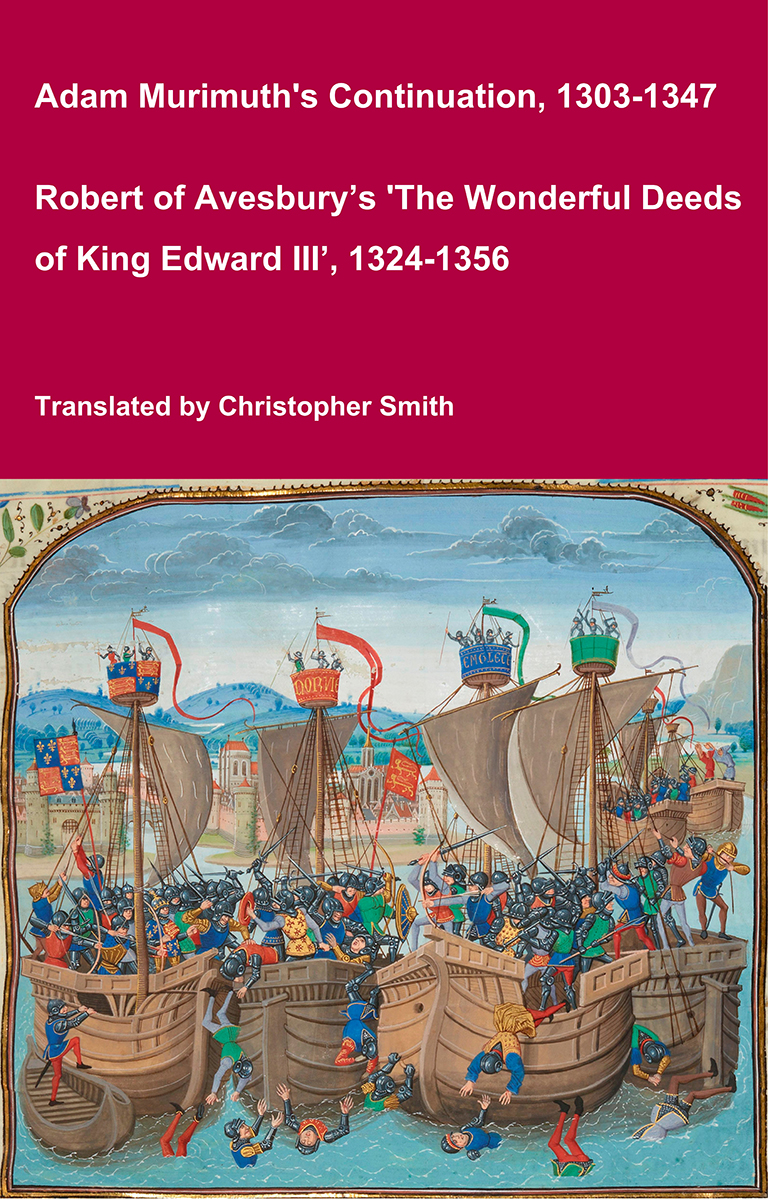
This volume brings together two of the most important contemporary chronicles for the reign of Edward III and the opening phases of the Hundred Years’ War. Written in Latin by English clerical observers, these texts provide a vivid and authoritative window into the political, diplomatic, and military history of fourteenth-century England and its continental ambitions. Adam Murimuth Continuatio's Chronicarum continues an earlier chronicle into the mid-fourteenth century, offering concise but valuable notices on royal policy, foreign relations, and ecclesiastical affairs. Its annalistic structure makes it especially useful for establishing chronology and tracing the development of events year by year. Complementing it, Robert of Avesbury’s De gestis mirabilibus regis Edwardi tertii is a rich documentary chronicle preserving letters, treaties, and official records alongside narrative passages. It is an indispensable source for understanding Edward III’s claim to the French crown, the conduct of war, and the mechanisms of medieval diplomacy. Together, these works offer scholars, students, and enthusiasts a reliable and unembellished account of a transformative period in English and European history. Essential for anyone interested in medieval chronicles, the Hundred Years’ War, or the reign of Edward III.
Available at Amazon in eBook and Paperback format.
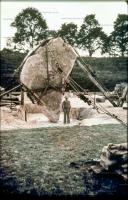
Avebury Outer Circle Stone 9 aka SW16 aka Barber Stone is in Avebury Outer Stone Circle Extant Stones.
Keiller's Slides TR000126. 1938. General view of the re-erection of stone 9 [Map] in the south west sector of the henge at Avebury, with a figure in the foreground
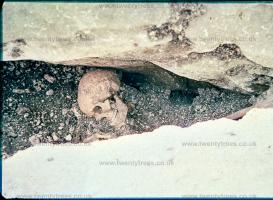
Keiller's Slides TR000034. 1938. General view of the skull of the Barber Surgeon in situ during the excavation of stone 9 [Map] in the south west sector of the henge at Avebury. Items found with the body including three silver coins dated to around 1320–25, as well as a pair of iron scissors and an iron probe led to him being identified as an itinerant mediaeval barber surgeon.
Antiquity 1939 Volume 13 Pages 223-233. During the excavation of the buried Stone 16 [Map], a complete skeleton was found within the narrow space between the stone and the only unfinished part of the side of the burial-pit. It is evident that the remains were those of an individual who had been accidentally killed while engaged in completing the pit for the burial of the stone, which had apparently slipped or fallen owing to a support giving way, fracturing the victim's pelvis, and also breaking his neck. The right foot was wedged beneath the fallen stone and it had consequently been impossible at the time of death to remove the corpse. It had therefore been covered over and the pit containing stone and body filled in. The date of the occurrence, and the burial of the stone, could be accurately fixed to within a few years by the discovery near the man's left hip of a discoloured patch of soil, doubtless representing the remains of a leather pouch, upon which lay thrce coins; two silver pennies of Edward I, minted at Canterbury in 1307, and a sterling of the City of Toul. Other finds beside the skeleton included a pair of pointed scissors, which were from their form definitely those rather of a barber than a tailor, and a small iron object, with the vestigial remains of a wooden handle, which had apparently been a lancet or probe. These objects were found beside the left thigh. The discovery of a pair of scissors in England accurately identifiable to so early a date as the first quarter of the fourteenth century A.D. is interesting.
In passing it may be remarked that the generally accepted explanation that is in order to facilitate agriculture-for the burial of so many of the stones at Avebury cannot, on other grounds than the employment of a barber for the task, be regarded as adequate, at any rate so far as the northwest and southeast sectors are concerned.
The skeleton has been accepted by the Museum of the Royal College of Surgeons, while the associated finds are housed in the Museum of the Morven Institute at Avebury.
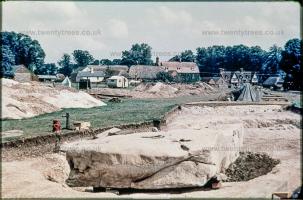
Keiller's Slides TR000003. General view of the excavation of stone 9 [Map] in the south west sector of the henge at Avebury