Text this colour links to Pages. Text this colour links to Family Trees. Text this colour are links that disabled for Guests.
Place the mouse over images to see a larger image. Click on paintings to see the painter's Biography Page.
Mouse over links for a preview. Move the mouse off the painting or link to close the popup.

William of Worcester's Chronicle of England

William of Worcester, born around 1415, and died around 1482 was secretary to John Fastolf, the renowned soldier of the Hundred Years War, during which time he collected documents, letters, and wrote a record of events. Following their return to England in 1440 William was witness to major events. Twice in his chronicle he uses the first person: 1. when writing about the murder of Thomas, 7th Baron Scales, in 1460, he writes '… and I saw him lying naked in the cemetery near the porch of the church of St. Mary Overie in Southwark …' and 2. describing King Edward IV's entry into London in 1461 he writes '… proclaimed that all the people themselves were to recognize and acknowledge Edward as king. I was present and heard this, and immediately went down with them into the city'. William’s Chronicle is rich in detail. It is the source of much information about the Wars of the Roses, including the term 'Diabolical Marriage' to describe the marriage of Queen Elizabeth Woodville’s brother John’s marriage to Katherine, Dowager Duchess of Norfolk, he aged twenty, she sixty-five or more, and the story about a paper crown being placed in mockery on the severed head of Richard, 3rd Duke of York.

Available at Amazon in eBook and Paperback format.

Buxton Museum and Art Gallery, High Peak, Derbyshire, North-Central England, British Isles [Map]

Buxton Museum and Art Gallery is in Buxton, Derbyshire [Map].

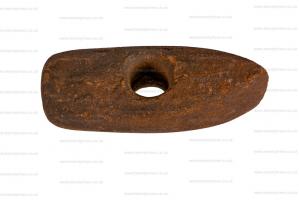
Between 2500BC and 700BC. Stone axehammer found at Arbor Low [Map]. In the collection of Buxton Museum and Art Gallery [Map]. Width 56mm; length 177mm; depth 57mm; diameter of hole 27mm.

Between 2500BC and 1500BC. Discoidal flint knife found at Arbor Low [Map]. In the collection of Buxton Museum and Art Gallery [Map]. Height 11mm; width 74mm; length 97mm; depth 3mm; diameter mm. This tool was purchased from a local farmer by Micah Salt in 1897. Micah Salt (1847-1915) was a tailor in Buxton who had a great interest in archaeology.

Between 2500BC and 2000BC. Barbed-and-tanged flint arrowhead found at Arbor Low [Map]. In the collection of Buxton Museum and Art Gallery [Map].

Between 1899 and 1901. Found at Five Wells Chambered Tomb [Map] collected by M Salt (age 52). In the collection of Buxton Museum and Art Gallery [Map].

Flint Scraper

Flint knife

Flint tool or fabricator