

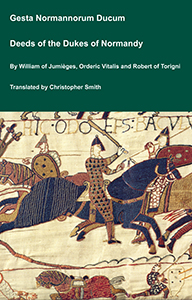
The Deeds of the Dukes of Normandy
The Gesta Normannorum Ducum [The Deeds of the Dukes of Normandy] is a landmark medieval chronicle tracing the rise and fall of the Norman dynasty from its early roots through the pivotal events surrounding the Norman Conquest of England. Originally penned in Latin by the monk William of Jumièges shortly before 1060 and later expanded at the behest of William the Conqueror, the work chronicles the deeds, politics, battles, and leadership of the Norman dukes, especially William’s own claim to the English throne. The narrative combines earlier historical sources with firsthand information and oral testimony to present an authoritative account of Normandy’s transformation from a Viking settlement into one of medieval Europe’s most powerful realms. William’s history emphasizes the legitimacy, military prowess, and governance of the Norman line, framing their expansion, including the conquest of England, as both divinely sanctioned and noble in purpose. Later chroniclers such as Orderic Vitalis and Robert of Torigni continued the history, extending the coverage into the 12th century, providing broader context on ducal rule and its impact. Today this classic work remains a foundational source for understanding Norman identity, medieval statesmanship, and the historical forces that reshaped England and Western Europe between 800AD and 1100AD.
Available at Amazon in eBook and Paperback format.
Carlisle Castle is in Carlisle, Cumberland [Map], Castles in Cumberland.
East to west Stanegate Roman Road started at Corbridge Roman Fort, Northumberland [Map], then passed through Wall, Northumberland [Map], Fourstones, Northumberland [Map], Newbrough, Northumberland [Map], Vindolandia, Northumberland [Map], Haltwhistle Roman Fort [Map], Magnis aka Carvoran Roman Fort [Map], Nether Denton Roman Fort [Map], Brampton Roman Fort [Map] to Carlisle [Map] where the Roman Fort was located where Carlisle Castle is now. The road may possibly have continued to Kirkbride, Cumberland [Map].
In October 1265 Roger Leybourne (age 50) was appointed Governor of Carlisle Castle and High Sheriff of Cumberland.
After 1296 Robert Clifford 1st Baron Clifford (age 21) was appointed Governor of Carlisle Castle.
On 25th February 1323 Andrew Harclay 1st Earl Carlisle (age 53) was arrested at Carlisle Castle [Map] by Anthony Lucy 1st Baron Lucy (age 40).
In 1484 Humphrey Dacre 1st Baron Dacre Gilsland (age 60) was appointed Governor of Carlisle Castle and Warden of the West Marches.
On 18th June 1525 Henry Fitzroy (age 6) was taken by barge to Bridewell Palace [Map] where he was enobled by his father King Henry VIII of England and Ireland (age 33).
In the morning Henry Fitzroy was created 1st Earl Nottingham.
In the afternoon Henry Fitzroy was created 1st Duke of Richmond and Somerset.
Henry Percy 5th Earl of Northumberland (age 47) carried the Sword of State. Thomas More (age 47) read the patents of nobility. Charles Brandon 1st Duke of Suffolk (age 41), Thomas Grey 2nd Marquess Dorset (age 47),
Henry Courtenay (age 29) was created 1st Marquess Exeter. Gertrude Blount Marchioness of Exeter (age 22) by marriage Marchioness Exeter.
Henry Clifford (age 32) was created 1st Earl of Cumberland, Warden of the West Marches and Governor of Carlisle Castle.
Thomas Manners (age 33) was created 1st Earl of Rutland. Eleanor Paston Countess Rutland (age 30) by marriage Countess of Rutland. He was given the Earldom of Rutland to reflect his descent from Anne York Duchess Exeter sister of the previous Earl of Rutland. At the same time his arms  Manners Arms were augmented with the
  Manners Augmented Arms
Henry Brandon (age 2) was created 1st Earl Lincoln.
Robert Radclyffe (age 42) was created 1st Viscount Fitzwalter.
Thomas Boleyn 1st Earl Wiltshire and Ormonde (age 48) was created 1st Viscount Rochford. Elizabeth Howard Countess of Wiltshire and Ormonde (age 45) by marriage Viscountess Rochford.
Thomas Howard 3rd Duke of Norfolk (age 52), William Fitzalan 11th or 18th Earl of Arundel (age 49) and John de Vere 14th Earl of Oxford (age 25) attended.


The following day, 18th May 1568 Mary Queen of Scots (age 25) was escorted to Carlisle Castle [Map].
After 1643 Philip Musgrave 2nd Baronet (age 35) was appointed Governor of Carlisle Castle.
On 8th July 1664 Mary Cogan died in childbirth at Carlisle Castle [Map] where her husband Christopher Musgrave 4th Baronet (age 32) was Governor. She was buried at St Cuthbert's Church, Edenhall [Map].
In 1677 Christopher Musgrave 4th Baronet (age 45) was appointed Governor of Carlisle Castle.
John Conyers 3rd Baron Conyers was appointed Governor of Carlisle Castle.