

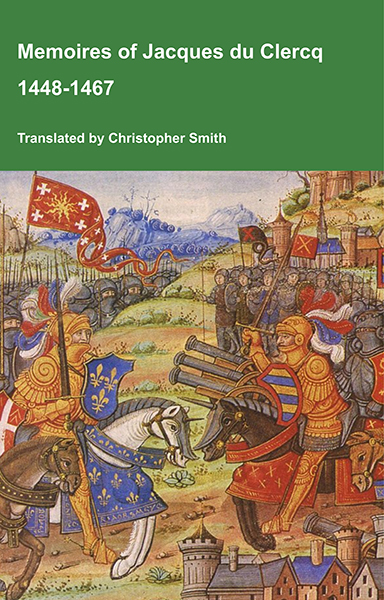
This is a translation of the 'Memoires of Jacques du Clercq', published in 1823 in two volumes, edited by Frederic, Baron de Reissenberg. In his introduction Reissenberg writes: 'Jacques du Clercq tells us that he was born in 1424, and that he was a licentiate in law and a counsellor to Philip the Good, Duke of Burgundy, in the castellany of Douai, Lille, and Orchies. It appears that he established his residence at Arras. In 1446, he married the daughter of Baldwin de la Lacherie, a gentleman who lived in Lille. We read in the fifth book of his Memoirs that his father, also named Jacques du Clercq, had married a lady of the Le Camelin family, from Compiègne. His ancestors, always attached to the counts of Flanders, had constantly served them, whether in their councils or in their armies.' The Memoires cover a period of nineteen years beginning in in 1448, ending in in 1467. It appears that the author had intended to extend the Memoirs beyond that date; no doubt illness or death prevented him from carrying out this plan. As Reissenberg writes the 'merit of this work lies in the simplicity of its narrative, in its tone of good faith, and in a certain air of frankness which naturally wins the reader’s confidence.' Du Clercq ranges from events of national and international importance, including events of the Wars of the Roses in England, to simple, everyday local events such as marriages, robberies, murders, trials and deaths, including that of his own father in Book 5; one of his last entries.
Available at Amazon in eBook and Paperback format.
 Calton Barrows, Chatsworth
 Calver Low Barrows
 Hob Hurst's House Barrow
 Rowsley Barrow
 Cavendish Club, Edensor
 St Peter's Church, Edensor
Chatsworth, Derbyshire is in Derbyshire Dales.
1759. Chatsworth Bridge [Map] spans the River Derwent. 1759-74 by James Paine, substantially completed by 1761. Sandstone ashlar and rock-faced sandstone. Three broad segmental arches with step moulding and moulded hoodmould.


The River Derwent rises on Bleaklow, Derbyshire [Map] after which it passes Bamford, Derbyshire [Map], Hope, Derbyshire [Map], Hathersage, Derbyshire [Map], Grindleford, Derbyshire [Map], Baslow, Derbyshire [Map], Chatsworth House, Derbyshire [Map] passing under Chatsworth Bridge [Map], Rowsley, Derbyshire [Map] which it is joined by the Derbyshire River Wye, Matlock, Derbyshire [Map], Matlock Bath, Derbyshire [Map], Cromford, Derbyshire [Map], Ambergate, Derbyshire [Map] where it is joined by the River Amber. After Ambergate, Derbyshire [Map] it passes Belper, Derbyshire [Map], Duffield, Derbyshire [Map] then flows through the centre of Derby, Derbyshire [Map] after which it joins the River Trent around 1.4 Km east of [Map].

Around 1785 Edensor, Chatsworth, Derbyshire William Cavendish 6th Duke Devonshire, working with Joseph Paxton relocated Edensor, Chatsworth, Derbyshire, possibly so that it could no longer be seen from Chatsworth House, Derbyshire [Map]. One the east of the original village one house was left in situ being occupied by an elderly retainer Anthony Holmes. It was walled around to protect it against deer and cattle. Six houses were left in-situ although they were modified to include ornamental chimneys. The new village was provided with allotments, a small prison and a mortuary.
1775. The Cavendish Club, Edensor [Map] was originally built as a Coaching Inn in, unusually for the area, red brick, although it was, originally, rendered in cement. It was called the Grape Inn - a bunch of grapes continues to hang in the portico. There were two ranges of coaching stables and accommodation at the rear. The Inn was used by travellers between Buxton, Dovedale and Sheffield.
After 1918 the Cavendish Club, Edensor [Map] was converted into a Village Club for estate staff including a dance hall, stage, dressing rooms, film projector, and two billiard rooms, a library, a games room and a bar for men only. In the buildings at the rear there was a surgery for the Chatsworth District Nurse.