


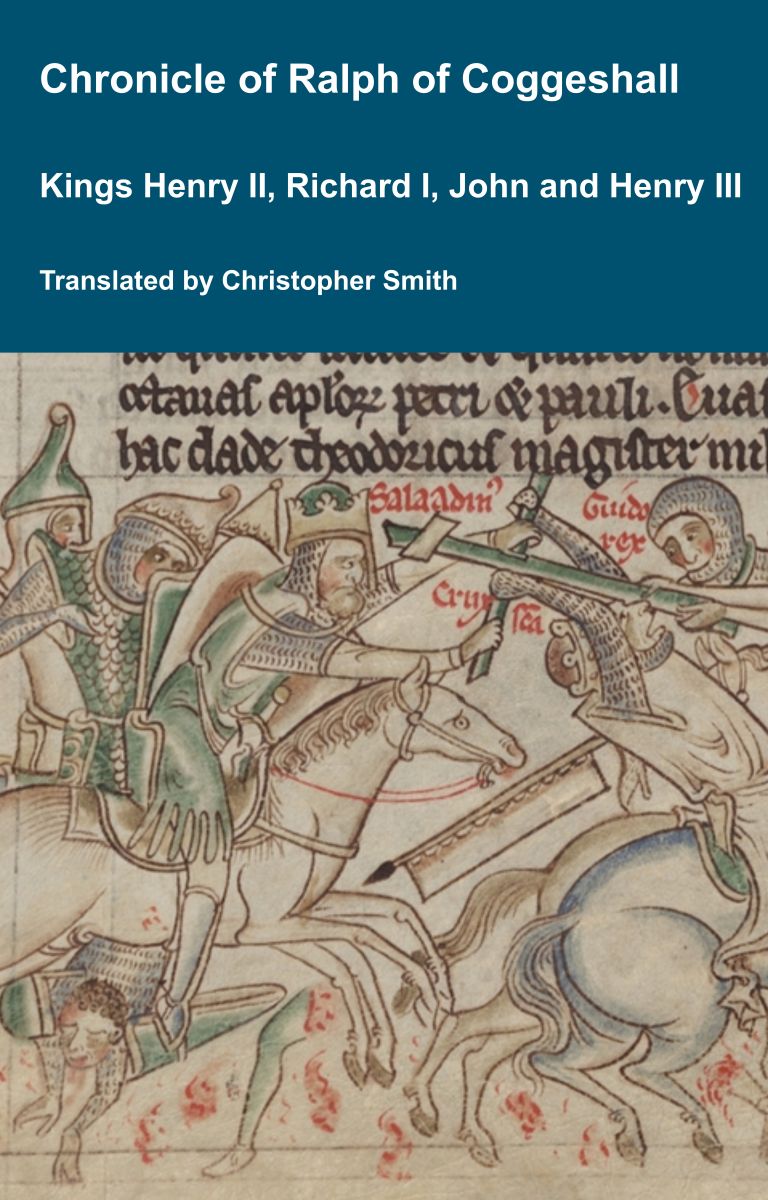
Chronicle of Abbot Ralph of Coggeshall
The Chronicle of Abbot Ralph of Coggeshall (Chronicon Anglicanum) is an indispensable medieval history that brings to life centuries of English and European affairs through the eyes of a learned Cistercian monk. Ralph of Coggeshall, abbot of the Abbey of Coggeshall in Essex in the early 13th century, continued and expanded his community’s chronicle, documenting events from the Norman Conquest of 1066 into the tumultuous reign of King Henry III. Blending eyewitness testimony, careful compilation, and the monastic commitment to record-keeping, this chronicle offers a rare narrative of political intrigue, royal power struggles, and social upheaval in England and beyond. Ralph’s work captures the reigns of pivotal figures such as Richard I and King John, providing invaluable insights into their characters, decisions, and the forces that shaped medieval rule. More than a simple annal, Chronicon Anglicanum conveys the texture of medieval life and governance, making it a rich source for scholars and readers fascinated by English history, monastic authorship, and the shaping of the medieval world.
Available at Amazon in eBook and Paperback format.
Devizes, Wiltshire is in Swanborough Hundred, Wiltshire.
Around May 1144 Roger Fitzmiles 2nd Earl Hereford (age 19) and Empress Matilda (age 42) were in Devizes, Wiltshire.
John Evelyn's Diary. 22nd July 1654. Now we arrived at Stonehenge, indeed a stupendous. Monument, appearing at a distance like a castle; how so many and huge Pillars of stone should have been brought together, some erect, others transverse on the tops of them, in a circular area as rudely representing a cloister or heathen and more natural temple, is wonderful. The stone is so exceedingly hard, that all my strength with a hammer could not break a fragment; which hardness I impute to their so long exposure. To number them exactly is very difficult, they lie in such variety of postures and confusion, though they seemed not to exceed 100; we counted only 95. As to their being brought thither, there being no navigable river near, is by some admired; but for the stone, there seems to be the same kind about 20 miles distant, some of which appear above ground. About the same hills, are divers mounts raised, conceived to be ancient intrenchments, or places of burial, after bloody fights. We now went by Devizes, a reasonable large town, and came late to Cadenham.
Minutes of the Society of Antiquaries. 12th June 1718. Mr Samuel Gale (age 35) presented to the Society a print of the Ground Plot and Prospect of Hull by Holler, for which their thanks and ordered to be returned to him.
He likewise brought a letter from the Reverend Dr Knight a Member of the Society containing an account of a large skeleton found near Chippenham, Cambs, with massey [?] chains and fetters, dug up near him and some penates dug up at Devizes.
Mr President (age 57) being obliged to be in the country for the summer season was pleased to propose for Vice-President during his absence, Mr George Holmes (age 56) which was unamimously approved of by the Society.


Devizes Castle is also in Castles in Wiltshire.
After 28th September 1106 Robert Curthose III Duke Normandy (age 55) was imprisoned at Devizes Castle [Map].
Chronicon ex Chronicis by Florence and John of Worcester. 1121. Pope Calixtus, assembling forces from all quarters, captured Maurice, surnamed Bourdin, already mentioned, who had been intruded by the emperor and his adherents into the papal see by the name of Gregory, and thrust him in disgrace, stripped of all he possessed, into a monastery; he having been a monk before. King Henry (age 53) led an army against the Welsh, and, taking hostages from them, reduced the whole of Wales under his dominion. A certain clerk, whose name was Gregory, an Irishman by birth, having been chosen by the king of Ireland, with the clergy and people, to fill the see of the city of Dublin, came over to England that he might be ordained, according to former custom, by the archbishop of Canterbury, the primate of England; whereupon, by the archbishop's command, Roger, bishop of Salisbury, conferred on him the orders of priest and deacon at his castle of Devizes [Map] on Saturday the eleventh of the calends of October [21st September]. He was ordained bishop on Sunday the sixth of the nones [the 2nd] of October at Lambeth by Ralph, archbishop of Canterbury; the following bishops, Richard of London, Roger of Salisbury, Robert of Lincoln, Everard of Norwich, and David of Bangor assisting at the consecration. The mother church at Tewkesbury was consecrated with great ceremony by Theowulf, bishop of Worcester, Richard, bishop of Hereford, Urban (age 45), bishop of Glamorgan, and the before-named Gregory, bishop of Durham, on Monday the ninth of the calends of November [24th October].
Chronicon ex Chronicis by Florence and John of Worcester. 24th June 1138. The Bishops arrested. Then the king, when the Nativity of St. John [24th June] was near, proceeded to Oxford, and hearing that the castle of Devizes [Map] was fortified against him, sent messengers to Roger, bishop of Salisbury, the founder of the castle, who was then at Malmesbury, commanding him to come and confer with him. It is said that the bishop undertook this journey with great reluctance, believing that he should never return; taking with him his two nephews, the bishops of Lincoln and Ely, and a large retinue of mounted and well-armed soldiers. Seeing this, the king, suspecting treason, ordered his followers to arm themselves and be ready to defend him, if need should arise. While the king was engaged with the bishops in treating of various affairs, a furious quarrel arose between the two parties of soldiers respecting their quarters; and the king's troops flying to arms, the bishops' men took to flight, leaving all their baggage behind. Roger, bishop of Salisbury, with the bishop of Lincoln and his son Roger, surnamed The Poor, were taken; the bishop of Ely made his escape, and having reached the castle of Devizes, fortified it and held it against the king. The king, much incensed, went in pursuit of him, placing the bishops he had arrested in custody; Roger in the crib of an ox-house, and the other in a mean hut, while he threatened to hang the third, unless the castle was speedily surrendered to him. Roger finding this, and alarmed for his son, bound himself by an oath that he would neither eat nor drink until the king had possession of the castle; which oath he kept, and neither ate nor drank for three days.1
Note 1. Cf. the account of the circumstances attending the seizure of the bishops and their castles, in Henry of Huntingdon s History, p. 271, Antiq. Lib.; Gesta Stephani, ibid, 370, &c.; and William of Malmesbury, ibid, 507.
In 1140 Harvey Le Breton 1st Earl of Wiltshire (age 30) negotiated the surrender of Devizes Castle [Map], preventing it from falling into the hands of Robert Normandy 1st Earl Gloucester (age 41).
In 1232 Hubert de Burgh Count Mortain 1st Earl Kent (age 62) was imprisoned at Devizes Castle [Map].
Flowers of History by Roger of Wendover 1233. Of the escape of Hubert de Burgh (age 63).
About this time Peter bishop of Winchester, who above all things desired the death of Hubert de Burgh, who was a prisoner in Devizes castle [Map], without mentioning Hubert's name, earnestly begged of the king to give him charge of the said castle, being, as was said, in hopes of thus obtaining a chance of putting him to death. Hubert however was forewarned of all these plans by his friends at the king's court, and disclosed them to two retainers of the garrison of the castle who attended on him, and they, pitying his sufferings, devised a plan by which he might escape from death. They therefore watched their opportunity, and on the night of Michaelmas eve, when the garrison were asleep, one of them, whilst the other kept watch, took Hubert, fettered as he was, on his shoulders, and descended from the tower carrying his pious theft with which he passed entirely through the castle, unheard by the garrison, till he reached the great gate, where he went out, and, crossing a deep trench, though with much difficulty, made his way to the parochial church, and did not set down his burden till he arrived before the great altar. The two men who had set Hubert at liberty then refused to leave him, considering that it would be to their glory if they should suffer a temporal death for preserving the life of such a great man.
Jean de Waurin's Chronicle of England Volume 6 Books 3-6: The Wars of the Roses
Jean de Waurin was a French Chronicler, from the Artois region, who was born around 1400, and died around 1474. Waurin’s Chronicle of England, Volume 6, covering the period 1450 to 1471, from which we have selected and translated Chapters relating to the Wars of the Roses, provides a vivid, original, contemporary description of key events some of which he witnessed first-hand, some of which he was told by the key people involved with whom Waurin had a personal relationship.
Available at Amazon in eBook and Paperback format.
Richard Grey was appointed Constable of Devizes Castle.
On 13th July 1643 a Royalist cavalry force under Lord Wilmot (age 30) won a crushing victory over the Parliamentarian Army of the West under Sir William Waller (age 46) at Roundway Down Devizes, Wiltshire.
Maurice Palatinate Simmern (age 22) fought.