


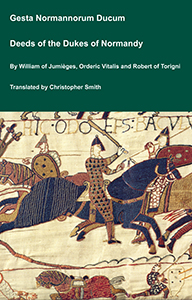
The Deeds of the Dukes of Normandy
The Gesta Normannorum Ducum [The Deeds of the Dukes of Normandy] is a landmark medieval chronicle tracing the rise and fall of the Norman dynasty from its early roots through the pivotal events surrounding the Norman Conquest of England. Originally penned in Latin by the monk William of Jumièges shortly before 1060 and later expanded at the behest of William the Conqueror, the work chronicles the deeds, politics, battles, and leadership of the Norman dukes, especially William’s own claim to the English throne. The narrative combines earlier historical sources with firsthand information and oral testimony to present an authoritative account of Normandy’s transformation from a Viking settlement into one of medieval Europe’s most powerful realms. William’s history emphasizes the legitimacy, military prowess, and governance of the Norman line, framing their expansion, including the conquest of England, as both divinely sanctioned and noble in purpose. Later chroniclers such as Orderic Vitalis and Robert of Torigni continued the history, extending the coverage into the 12th century, providing broader context on ducal rule and its impact. Today this classic work remains a foundational source for understanding Norman identity, medieval statesmanship, and the historical forces that reshaped England and Western Europe between 800AD and 1100AD.
Available at Amazon in eBook and Paperback format.
Dove Holes, Derbyshire is in High Peak, Derbyshire.
1881. Census. Dove Holes, Derbyshire [Map].
Joseph Fletcher (age 51). 51. Limestone Quarry Man.
Sarah Yates (age 45). Wife. 45.
John Fletcher (age 19). Son. 19. Limestone Getter.

On 31st December 1883 John Fletcher (age 21) and Emma Stafford were married at St Thomas Becket's Church, Chapel en le Frith [Map]. He was resident at Dove Holes, Derbyshire [Map], she at Wormhill, Derbyshire [Map].
After Townend [Map] The Street, Derbyshire continues past Lower Eaves [Map], Windy Walls Farm [Map], Sittinglow [Map], Martinside Cross [Map] and more or less through Dove Holes Railway Station [Map] where it makes a slight change in direction. Thereafter it intersects with another Roman Road from before reaching Brooke House Farm [Map] and continuing past St Peter's Church, Buxton [Map] aka Aquae Arnemetiae aka Baths of the Grove Goddess.
In Buxton the route is unknown other than the discovery in Jun 1862 of a milstone at a property called Silverlands [Map] in Buxton: 'In June 1862, there was found in a garden, in the occupation of Mr. Matthew Lees, near the Silverlands in Higher Buxton, the lower part of an inscribed Roman milestone.' The milestone appears to mark twelve miles from the station Navio.1
In 1913 the son of Matthew Lees returned to Buxton from Canada and stated that he was the actual discoverer of the milestone and that he found it while digging deep in his father's garden near an old lane in 1856, not 1862. The stone was lying flat, some 18ins below the surface and the exact spot so far as he could tell was just inside the gateway leading to the Upper Buxton Railway Station. It is suggested that it was found close to its original position and must therefore indicate the line of the Roman road between Buxton and Brough.2
The milestone is now in Buxton Museum.
1. Article in serial: Watkin, W. 1885. 'The Roman Stations Of Derbyshire' Derbyshire Archaeology Journal. Volume 7. pp 79-80.
2. Article in serial: Tristram, E. 1916. 'Roman Buxton', in Derbyshire Archaeological Journal. Vol. 38, pp. 84-104. pp 87-91.
Bull Ring Barrow is also in Peak District Bronze Age Barrows.
Bull Ring Barrow [Map]. Historic England:
On the south-west side of the henge, c.20m distant, is a large mound interpreted as an oval barrow overlain on its western end by a later bowl barrow. It is sub-rectangular in shape and measures 27m by 21m by c.2.5m high. Originally it would have been somewhat higher but has been disturbed on the summit by a World War II slit trench. Its current plan is due to modern disturbance round its edges, caused by ploughing and the construction and later removal of drystone walls on its east and north sides. No recorded excavation of the barrow has been carried out so it cannot be precisely dated.
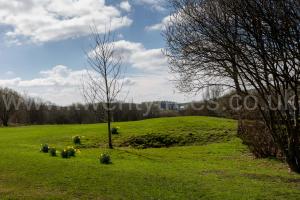
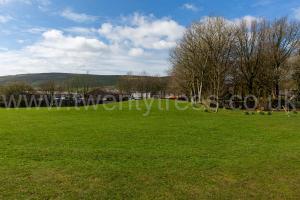
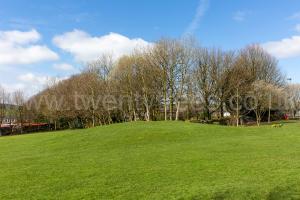
Derbyshire Archaeological Journal Volume 37 1915 Page 77. The Stone Circle, known as the Bull Ring [Map], at Dove Holes, and the Mound [Map] Adjoining1. By Edward Tristram, F.S.A
Note 1. This paper, in a somewhat curtailed form, was read at the Meeting of the Annual Meeting of the Society, at Buxton, in 1912.
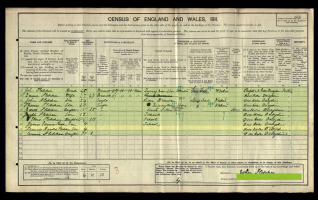
On 2nd April 1911. Census: Buxton Road [Map].
John Fletcher (age 49). Head. 48. Quarry man Stone Blaster.
Emma Stafford. Wife. 47.
Edith Fletcher (age 15). Daughter. 15.
Edith Fletcher: On 25th February 1896 she was born to John Fletcher and Emma Stafford. In January 1920 Charles Hadfield and she were married.
After Townend [Map] The Street, Derbyshire continues past Lower Eaves [Map], Windy Walls Farm [Map], Sittinglow [Map], Martinside Cross [Map] and more or less through Dove Holes Railway Station [Map] where it makes a slight change in direction. Thereafter it intersects with another Roman Road from before reaching Brooke House Farm [Map] and continuing past St Peter's Church, Buxton [Map] aka Aquae Arnemetiae aka Baths of the Grove Goddess.
In Buxton the route is unknown other than the discovery in Jun 1862 of a milstone at a property called Silverlands [Map] in Buxton: 'In June 1862, there was found in a garden, in the occupation of Mr. Matthew Lees, near the Silverlands in Higher Buxton, the lower part of an inscribed Roman milestone.' The milestone appears to mark twelve miles from the station Navio.1
In 1913 the son of Matthew Lees returned to Buxton from Canada and stated that he was the actual discoverer of the milestone and that he found it while digging deep in his father's garden near an old lane in 1856, not 1862. The stone was lying flat, some 18ins below the surface and the exact spot so far as he could tell was just inside the gateway leading to the Upper Buxton Railway Station. It is suggested that it was found close to its original position and must therefore indicate the line of the Roman road between Buxton and Brough.2
The milestone is now in Buxton Museum.
1. Article in serial: Watkin, W. 1885. 'The Roman Stations Of Derbyshire' Derbyshire Archaeology Journal. Volume 7. pp 79-80.
2. Article in serial: Tristram, E. 1916. 'Roman Buxton', in Derbyshire Archaeological Journal. Vol. 38, pp. 84-104. pp 87-91.
After Townend [Map] The Street, Derbyshire continues past Lower Eaves [Map], Windy Walls Farm [Map], Sittinglow [Map], Martinside Cross [Map] and more or less through Dove Holes Railway Station [Map] where it makes a slight change in direction. Thereafter it intersects with another Roman Road from before reaching Brooke House Farm [Map] and continuing past St Peter's Church, Buxton [Map] aka Aquae Arnemetiae aka Baths of the Grove Goddess.
In Buxton the route is unknown other than the discovery in Jun 1862 of a milstone at a property called Silverlands [Map] in Buxton: 'In June 1862, there was found in a garden, in the occupation of Mr. Matthew Lees, near the Silverlands in Higher Buxton, the lower part of an inscribed Roman milestone.' The milestone appears to mark twelve miles from the station Navio.1
In 1913 the son of Matthew Lees returned to Buxton from Canada and stated that he was the actual discoverer of the milestone and that he found it while digging deep in his father's garden near an old lane in 1856, not 1862. The stone was lying flat, some 18ins below the surface and the exact spot so far as he could tell was just inside the gateway leading to the Upper Buxton Railway Station. It is suggested that it was found close to its original position and must therefore indicate the line of the Roman road between Buxton and Brough.2
The milestone is now in Buxton Museum.
1. Article in serial: Watkin, W. 1885. 'The Roman Stations Of Derbyshire' Derbyshire Archaeology Journal. Volume 7. pp 79-80.
2. Article in serial: Tristram, E. 1916. 'Roman Buxton', in Derbyshire Archaeological Journal. Vol. 38, pp. 84-104. pp 87-91.
After Townend [Map] The Street, Derbyshire continues past Lower Eaves [Map], Windy Walls Farm [Map], Sittinglow [Map], Martinside Cross [Map] and more or less through Dove Holes Railway Station [Map] where it makes a slight change in direction. Thereafter it intersects with another Roman Road from before reaching Brooke House Farm [Map] and continuing past St Peter's Church, Buxton [Map] aka Aquae Arnemetiae aka Baths of the Grove Goddess.
In Buxton the route is unknown other than the discovery in Jun 1862 of a milstone at a property called Silverlands [Map] in Buxton: 'In June 1862, there was found in a garden, in the occupation of Mr. Matthew Lees, near the Silverlands in Higher Buxton, the lower part of an inscribed Roman milestone.' The milestone appears to mark twelve miles from the station Navio.1
In 1913 the son of Matthew Lees returned to Buxton from Canada and stated that he was the actual discoverer of the milestone and that he found it while digging deep in his father's garden near an old lane in 1856, not 1862. The stone was lying flat, some 18ins below the surface and the exact spot so far as he could tell was just inside the gateway leading to the Upper Buxton Railway Station. It is suggested that it was found close to its original position and must therefore indicate the line of the Roman road between Buxton and Brough.2
The milestone is now in Buxton Museum.
1. Article in serial: Watkin, W. 1885. 'The Roman Stations Of Derbyshire' Derbyshire Archaeology Journal. Volume 7. pp 79-80.
2. Article in serial: Tristram, E. 1916. 'Roman Buxton', in Derbyshire Archaeological Journal. Vol. 38, pp. 84-104. pp 87-91.
Henrici Quinti, Angliæ Regis, Gesta, is a first-hand account of the Agincourt Campaign, and subsequent events to his death in 1422. The author of the first part was a Chaplain in King Henry's retinue who was present from King Henry's departure at Southampton in 1415, at the siege of Harfleur, the battle of Agincourt, and the celebrations on King Henry's return to London. The second part, by another writer, relates the events that took place including the negotiations at Troye, Henry's marriage and his death in 1422.
Available at Amazon in eBook and Paperback format.
After Townend [Map] The Street, Derbyshire continues past Lower Eaves [Map], Windy Walls Farm [Map], Sittinglow [Map], Martinside Cross [Map] and more or less through Dove Holes Railway Station [Map] where it makes a slight change in direction. Thereafter it intersects with another Roman Road from before reaching Brooke House Farm [Map] and continuing past St Peter's Church, Buxton [Map] aka Aquae Arnemetiae aka Baths of the Grove Goddess.
In Buxton the route is unknown other than the discovery in Jun 1862 of a milstone at a property called Silverlands [Map] in Buxton: 'In June 1862, there was found in a garden, in the occupation of Mr. Matthew Lees, near the Silverlands in Higher Buxton, the lower part of an inscribed Roman milestone.' The milestone appears to mark twelve miles from the station Navio.1
In 1913 the son of Matthew Lees returned to Buxton from Canada and stated that he was the actual discoverer of the milestone and that he found it while digging deep in his father's garden near an old lane in 1856, not 1862. The stone was lying flat, some 18ins below the surface and the exact spot so far as he could tell was just inside the gateway leading to the Upper Buxton Railway Station. It is suggested that it was found close to its original position and must therefore indicate the line of the Roman road between Buxton and Brough.2
The milestone is now in Buxton Museum.
1. Article in serial: Watkin, W. 1885. 'The Roman Stations Of Derbyshire' Derbyshire Archaeology Journal. Volume 7. pp 79-80.
2. Article in serial: Tristram, E. 1916. 'Roman Buxton', in Derbyshire Archaeological Journal. Vol. 38, pp. 84-104. pp 87-91.
After Townend [Map] The Street, Derbyshire continues past Lower Eaves [Map], Windy Walls Farm [Map], Sittinglow [Map], Martinside Cross [Map] and more or less through Dove Holes Railway Station [Map] where it makes a slight change in direction. Thereafter it intersects with another Roman Road from before reaching Brooke House Farm [Map] and continuing past St Peter's Church, Buxton [Map] aka Aquae Arnemetiae aka Baths of the Grove Goddess.
In Buxton the route is unknown other than the discovery in Jun 1862 of a milstone at a property called Silverlands [Map] in Buxton: 'In June 1862, there was found in a garden, in the occupation of Mr. Matthew Lees, near the Silverlands in Higher Buxton, the lower part of an inscribed Roman milestone.' The milestone appears to mark twelve miles from the station Navio.1
In 1913 the son of Matthew Lees returned to Buxton from Canada and stated that he was the actual discoverer of the milestone and that he found it while digging deep in his father's garden near an old lane in 1856, not 1862. The stone was lying flat, some 18ins below the surface and the exact spot so far as he could tell was just inside the gateway leading to the Upper Buxton Railway Station. It is suggested that it was found close to its original position and must therefore indicate the line of the Roman road between Buxton and Brough.2
The milestone is now in Buxton Museum.
1. Article in serial: Watkin, W. 1885. 'The Roman Stations Of Derbyshire' Derbyshire Archaeology Journal. Volume 7. pp 79-80.
2. Article in serial: Tristram, E. 1916. 'Roman Buxton', in Derbyshire Archaeological Journal. Vol. 38, pp. 84-104. pp 87-91.