


Text this colour is a link for Members only. Support us by becoming a Member for only £3 a month by joining our 'Buy Me A Coffee page'; Membership gives you access to all content and removes ads.
Text this colour links to Pages. Text this colour links to Family Trees. Place the mouse over images to see a larger image. Click on paintings to see the painter's Biography Page. Mouse over links for a preview. Move the mouse off the painting or link to close the popup.
Falmouth, Cornwall is in Cornwall.
On 13th January 1403 Joanna of Navarre Queen Consort England (age 33) with her two daughters Marguerite Montfort Viscountess Rohan (age 11) and Blanche Montfort Countess Armagnac (age 6) departed from Camaret to travel to England intending to land at Southampton. A storm caused them to land at Falmouth, Cornwall from where they travelled to Winchester.
Samuel Pepys' Diary. 3rd December 1666. So to bed, and with more cheerfulness than I have done a good while, to hear that for certain the Scott rebells are all routed; they having been so bold as to come within three miles of Edinburgh, and there given two or three repulses to the King's forces, but at last were mastered. Three or four hundred killed or taken, among which their leader, one Wallis, and seven ministers, they having all taken the Covenant a few days before, and sworn to live and die in it, as they did; and so all is likely to be there quiet again. There is also the very good newes come of four New-England ships come home safe to Falmouth, Cornwall with masts for the King (age 36); which is a blessing mighty unexpected, and without which, if for nothing else, we must have failed the next year. But God be praised for thus much good fortune, and send us the continuance of his favour in other things! So to bed.

1678. Hendrick Danckerts (age 53). A View of Falmouth Harbour.
In May 1694 Bourchier Wrey 4th Baronet (age 41) duelled with James Praed (age 39). He was run through the body, Praed being only hurt slightly in the face at Falmouth, Cornwall.
On 28th May 1747 Elizabeth Boscawen Duchess Beaufort was born to Edward Boscawen (age 35) and Frances Evelyn Evelyn (age 27) in Falmouth, Cornwall.
On 22nd January 1809 Edward William Waldegrave (age 21) drowned at sea off Falmouth, Cornwall.
On 20th March 1913 William Ayerst Ingram (age 57) died at Falmouth, Cornwall.
Pendennis Castle, Falmouth, Cornwall, South-West England, British Isles [Map]
Pendennis Castle, Falmouth is also in Castles in Cornwall.

In 1629 William Killigrew (age 23) was appointed Governor of Pendennis Castle.
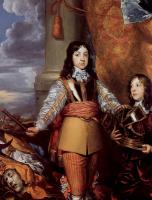
Around April 1646 King Charles II of England Scotland and Ireland (age 15) stayed at Pendennis Castle, Falmouth [Map].


On 10th June 1940 Charles Howard 20th Earl of Suffolk, 13th Earl Berkshire (age 34) left Paris and travelled to Bordeaux [Map] where British Embassy representatives introduced them to the master of the British tramp ship SS Broompark. They embarked 33 eminent scientists, with their families. Two more scientists, Lew Kowarski and Hans Halban, arrived with the entire world stockpile of heavy water. Then the managing director of the Antwerp Diamond Bank, Paul Timbal, joined, with $10 million worth of gem diamonds. They discovered 600 tons of machine tools in wagons on the quay, which were also loaded. The Broompark carried them safely to Pendennis Castle, Falmouth [Map].
John Killigrew was appointed Governor of Pendennis Castle.