

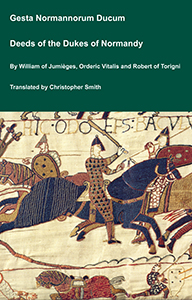
The Deeds of the Dukes of Normandy
The Gesta Normannorum Ducum [The Deeds of the Dukes of Normandy] is a landmark medieval chronicle tracing the rise and fall of the Norman dynasty from its early roots through the pivotal events surrounding the Norman Conquest of England. Originally penned in Latin by the monk William of Jumièges shortly before 1060 and later expanded at the behest of William the Conqueror, the work chronicles the deeds, politics, battles, and leadership of the Norman dukes, especially William’s own claim to the English throne. The narrative combines earlier historical sources with firsthand information and oral testimony to present an authoritative account of Normandy’s transformation from a Viking settlement into one of medieval Europe’s most powerful realms. William’s history emphasizes the legitimacy, military prowess, and governance of the Norman line, framing their expansion, including the conquest of England, as both divinely sanctioned and noble in purpose. Later chroniclers such as Orderic Vitalis and Robert of Torigni continued the history, extending the coverage into the 12th century, providing broader context on ducal rule and its impact. Today this classic work remains a foundational source for understanding Norman identity, medieval statesmanship, and the historical forces that reshaped England and Western Europe between 800AD and 1100AD.
Available at Amazon in eBook and Paperback format.
Golden Square Soho is in Soho.
See: 6 Golden Square, Soho, Tabernacle.
John Evelyn's Diary. 19th February 1693. The Bishop of Lincoln [aged 56] preached in the afternoon at the Tabernacle near Golden Square, set up by him. Proposals of a marriage between Mr. Draper and my daughter Susanna [aged 24]. Hitherto an exceedingly warm winter, such as has seldom been known, and portending an unprosperous spring as to the fruits of the earth; our climate requires more cold and winterly weather. The dreadful and astonishing earthquake swallowing up Catania, and other famous and ancient cities, with more than 100,000 persons in Sicily [Map], on 11th January last, came now to be reported among us.
John Evelyn's Diary. 3rd December 1693. Mr. Bentley preached at the Tabernacle, near Golden Square. I gave my voice for him to proceed on his former subject the following year in Mr. Boyle's lecture, in which he had been interrupted by the importunity of Sir J. Rotheram that the Bishop of Chichester [aged 59] might be chosen the year before, to the great dissatisfaction of the Bishop of Lincoln [aged 57] and myself. We chose Mr. Bentley again. The Duchess of Grafton's [aged 25] appeal to the House of Lords for the Prothonotary's place given to the late Duke and to her son by King Charles II, now challenged by the Lord Chief Justice. The judges were severely reproved on something they said.


On 21st June 1721 John Reade 5th Baronet was born to Thomas Reade 4th Baronet [aged 38] and Jane Mary Dutton Lady Reade at Golden Square Soho. He was baptised 27th June 1721 at St James' Church, Piccadilly. He married 18th October 1759 Harriet Barker and had issue.
In January 1735 a great storm occurred in London and elsewhere causing significant damage.
From London Prints:
Yesterday Morning the Wind being at W. and W.S.W. it blew hard; and in the Afternoon we had one of the strongest Storms that has been known for many Years, in which several Lighters and Boats in the River were sunk, and others dashed to Pieces; but all the Ships in the River rode out with Safety. On Shore, great Damage was done in the Houses, by ripping off the Tiles, blowing down Stacks of Chimneys, &c. and many People were killed and wounded; particularly, Five Houses were blown down in St. Giles's Parish [Map], and another in Hartshorn Lane in the Strand, by which two Persons lost their Lives. A Stack of Chimneys fell upon a Footman near Gray's-Inn, and killed him. A House in the Broad-Way, Westminster, was blown down, and a Man and Boy killed. And Mr. Lancashire, a Carpenter in Two-Swan-Yard near Bishopsgate, was blown from the Top of a Twelve-Foot Ladder, by which he fractured his Skull, and died on the Spot.
It likewise blew up by the Roots several large Trees in St. James's Park, and did incredible Damage to a great many Houses, in all Parts of the Cities of London and Westminster.
From Tunbridge-Wells [Map] we have an Account that the Land-Floods came down upon them so suddenly, that all the Bridges upon the Brook which runs by the Walks, were carried away by the Torrent, and great Damages done besides, so that the like has not been known before in any one's Memory.
They write from [illegible] Abbey in Yorkshire that [several words illegible] happened such a Storm as had not been known in the Memory of Man; tho' it lasted no longer than three quarters of an Hour, yet four Houses were blown down, and several others damaged, and a great Number of large Trees were either broken or blown up by the Roots.
Moulsey in Surrey, Jan. 9. The River Thames is now rising here, and yet it is already so high, we are forced to live above Stairs; and when the Land Waters come down from the Hills in the West-Country, God knows the Consequence: The Thames rose between 5 and 12 this Morning, very near a Foot in Height.
On the 8th Instant there were near 100 Elm Trees (and other Sorts) blown up by the Roots in this Parish during the violent Storm, all fine tall Sticks, and of a load of Timber in a Stick one with another; which will afford the Navy a fine Opportunity of furnishing the Stores in his Majesty's Dockyard this Year.
Extract of a Letter from Dover, dated Jan. 10. Our Accounts from Deal yesterday bring that 40 Sail were missing, that there is scarce a Ship but has met with Damage, and most people think the Gale of Wind little inferior to the November Storm, and lasted longer.
From several LONDON PRINTS Jan. 11. We have received further Accounts of the Misfortunes occasioned by the terrible Storm on Wednesday last: It was observed to be at the highest at 12 o'Clock, about which Time a Stack of Chimnies fell upon a Coachman near Golden-Square, and fractured his Skull: At Barnet [Map], and the Villages adjacent, they perceived three loud Claps of Thunder, accompanied by Lightning; several Barns were blown down in that Neighbourhood; and in several of the Roads near London, the Trees lie in the Highway in such manner, that it is difficult to pass: The Seat was blow from the Mount in Kensington Gardens. At all Parts of the Town are seen Houses untiled, stript of their Lead, and the Chimnies demolish'd.
The Kitchen Chimney of the Lord Bruce was blown down, which broke thro' the Stables of his Royal Highness the Duke of Cumberland, and did very considerable Damage, some of the Servants narrowly escaping with their Lives.
36 Trees were broke down, and tore up by the Roots, in St. James's Park, particularly the large Tree entering the Mall, from St. James's Palace, under which stood a Centry-Box, which was blown down at the same Time, with the Soldier in it, who narrowly escaped with his Life.
About 300 Weight of Lead was blown off the House of Arundel, Esq; in Burlington Gardens, Surveyor of his Majesty's Roads.
About 500 Wt. of Lead was ript off the Parish Church of St. Laurence Jewry, by Guild-Hall.
At the Marquis de Montandre's House in Brook-street, a large Stack of Chimnies was blown down, which demolished an Office in the back Part of the House, dashing in Pieces a Table at which 9 Servants were to dine a quarter of an Hour after.
At Riskins, the seat of the Lord Bathurst [aged 50] in Buckinghamshire, above 40 large Trees in his Lordship's Grounds were blown down.
At Fulham [Map] 2 or 3 Houses were blown down, and a Barn belonging to Mr. Gray, a Farmer.
A great many Wallnut-trees in the Park of Tryon, Esq; at Mickleham, Surrey [Map], were destroyed. We hear he has made above 300£. per Annum of the Wallnuts which the said Trees produced.
The same Day, as a Servant of Messieurs Frame and Berkley was going along the North Side of St. Paul's, he was thrown down by the Violence of the Winds, at which time his Letter-Case fell from his Side, and the Wind blew his Notes about; all which he found again, except one of £300. one of £139. 16s one of £40. and one of £25. for which Notes a Reward is offered.
 Become a Member via our Buy Me a Coffee page to read more.
On 17th May 1758 John St Aubyn 5th Baronet was born to John St Aubyn 4th Baronet [aged 31] and Elizabeth Wingfield Lady St Aubyn at Golden Square Soho.
On 9th November 1773 John Reade 5th Baronet [aged 52] died at Golden Square Soho. He was buried at St Mary the Virgin Church, Shipton-under-Wychwood. His son John [aged 11] succeeded 6th Baronet Reade of Barton in Berkshire.
On 24th May 1774 Charles Merrik Burrell 3rd Baronet was born to William Burrell 2nd Baronet [aged 41] at Golden Square Soho. He married 4th July 1808 Frances Wyndham Lady Burrell, daughter of George O'Brien Wyndham 3rd Earl Egremont and Elizabeth Ilive Countess Egremont, and had issue.
On 17th October 1788 John Brown [aged 53] died at Golden Square Soho.
On 14th May 1750 William Windham was born to William Windham [aged 33] at 6 Golden Square, Soho.


John Evelyn's Diary. 19th February 1693. The Bishop of Lincoln [aged 56] preached in the afternoon at the Tabernacle near Golden Square, set up by him. Proposals of a marriage between Mr. Draper and my daughter Susanna [aged 24]. Hitherto an exceedingly warm winter, such as has seldom been known, and portending an unprosperous spring as to the fruits of the earth; our climate requires more cold and winterly weather. The dreadful and astonishing earthquake swallowing up Catania, and other famous and ancient cities, with more than 100,000 persons in Sicily [Map], on 11th January last, came now to be reported among us.
The Deeds of the Dukes of Normandy
The Gesta Normannorum Ducum [The Deeds of the Dukes of Normandy] is a landmark medieval chronicle tracing the rise and fall of the Norman dynasty from its early roots through the pivotal events surrounding the Norman Conquest of England. Originally penned in Latin by the monk William of Jumièges shortly before 1060 and later expanded at the behest of William the Conqueror, the work chronicles the deeds, politics, battles, and leadership of the Norman dukes, especially William’s own claim to the English throne. The narrative combines earlier historical sources with firsthand information and oral testimony to present an authoritative account of Normandy’s transformation from a Viking settlement into one of medieval Europe’s most powerful realms. William’s history emphasizes the legitimacy, military prowess, and governance of the Norman line, framing their expansion, including the conquest of England, as both divinely sanctioned and noble in purpose. Later chroniclers such as Orderic Vitalis and Robert of Torigni continued the history, extending the coverage into the 12th century, providing broader context on ducal rule and its impact. Today this classic work remains a foundational source for understanding Norman identity, medieval statesmanship, and the historical forces that reshaped England and Western Europe between 800AD and 1100AD.
Available at Amazon in eBook and Paperback format.
John Evelyn's Diary. 3rd December 1693. Mr. Bentley preached at the Tabernacle, near Golden Square. I gave my voice for him to proceed on his former subject the following year in Mr. Boyle's lecture, in which he had been interrupted by the importunity of Sir J. Rotheram that the Bishop of Chichester [aged 59] might be chosen the year before, to the great dissatisfaction of the Bishop of Lincoln [aged 57] and myself. We chose Mr. Bentley again. The Duchess of Grafton's [aged 25] appeal to the House of Lords for the Prothonotary's place given to the late Duke and to her son by King Charles II, now challenged by the Lord Chief Justice. The judges were severely reproved on something they said.
John Evelyn's Diary. 1st April 1694. Dr. Sharp [aged 49], Archbishop of York, preached in the afternoon at the Tabernacle, by Soho.