

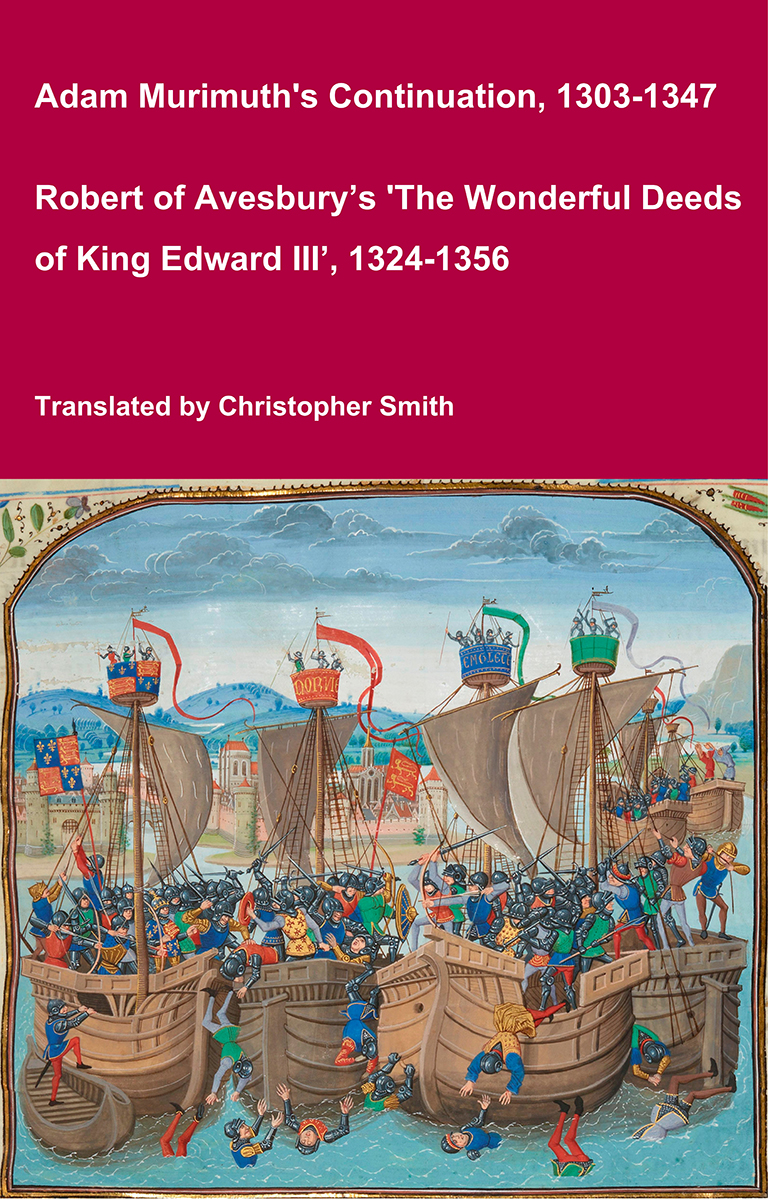
Adam Murimuth's Continuation and Robert of Avesbury’s 'The Wonderful Deeds of King Edward III'
This volume brings together two of the most important contemporary chronicles for the reign of Edward III and the opening phases of the Hundred Years’ War. Written in Latin by English clerical observers, these texts provide a vivid and authoritative window into the political, diplomatic, and military history of fourteenth-century England and its continental ambitions. Adam Murimuth Continuatio's Chronicarum continues an earlier chronicle into the mid-fourteenth century, offering concise but valuable notices on royal policy, foreign relations, and ecclesiastical affairs. Its annalistic structure makes it especially useful for establishing chronology and tracing the development of events year by year. Complementing it, Robert of Avesbury’s De gestis mirabilibus regis Edwardi tertii is a rich documentary chronicle preserving letters, treaties, and official records alongside narrative passages. It is an indispensable source for understanding Edward III’s claim to the French crown, the conduct of war, and the mechanisms of medieval diplomacy. Together, these works offer scholars, students, and enthusiasts a reliable and unembellished account of a transformative period in English and European history. Essential for anyone interested in medieval chronicles, the Hundred Years’ War, or the reign of Edward III.
Available at Amazon in eBook and Paperback format.
Ipswich, Suffolk is in Suffolk.
Anglo-Saxon Chronicle. 11th August 991. This year was Ipswich, Suffolk plundered; and very soon afterwards was Alderman Britnoth47 slain at Maldon, Essex. In this same year it was resolved that tribute should be given, for the first time, to the Danes, for the great terror they occasioned by the sea-coast. That was first 10,000 pounds. The first who advised this measure was Archbishop Siric.
Note 47. Vid. "Hist. Eliens." ii. 6. He was a great benefactor to the church of Ely.
Anglo-Saxon Chronicle. 11th August 991. This year came Anlaf with three and ninety ships to Staines, which he plundered without, and went thence to Sandwich, Kent. Thence to Ipswich, Suffolk, which he laid waste; and so to Maldon, Essex, where Alderman Britnoth came against him with his force, and fought with him; and there they slew the alderman, and gained the field of battle; whereupon peace was made with him, and the king received him afterwards at episcopal hands by the advice of Siric, Bishop of Canterbury, and Elfeah of Winchester.
Anglo-Saxon Chronicle. This year came the aforesaid army, after Easter, into East Anglia; and went up at Ipswich, Suffolk, marching continually till they came where they understood Ulfcytel was with his army. This was on the day called the first of the Ascension of our Lord [5th May 1010]. The East-Angles soon fled. Cambridgeshire stood firm against them. There was slain Athelstan, the king's relative, and Oswy, and his son, and Wulfric, son of Leofwin, and Edwy, brother of Efy, and many other good thanes, and a multitude of the people. Thurkytel Myrehead first began the flight; and the Danes remained masters of the field of slaughter. There were they horsed; and afterwards took possession of East-Anglia, where they plundered and burned three months; and then proceeded further into the wild fens, slaying both men and cattle, and burning throughout the fens. Thetford, Norfolk also they burned, and Cambridge; and afterwards went back southward into the Thames; and the horsemen rode towards the ships.
On 8th January 1297 John Gerulfing I Count Holland and Princess Elizabeth of Rhuddlan Countess Essex, Hereford and Holland were married at Ipswich, Suffolk. She by marriage Countess Holland. The wedding was attended by her sister Margaret Plantagenet Duchess Brabant, her father King Edward I, her brother Edward and her future second husband Humphrey Bohun 4th Earl Hereford 3rd Earl Essex. She the daughter of King Edward I of England and Eleanor of Castile Queen Consort England. He the son of Floris Gerulfing V Count Holland and Beatrix Dampierre.
On 26th December 1502 Edmund Pole 3rd Duke of Suffolk was proclaimed an outlaw at Ipswich, Suffolk for assuming his former title Duke Suffolk.
On 24th July 1553 Robert Wingfield hosted Queen Mary I of England and Ireland during her journey to London to claim the throne from Lady Jane Grey at Ipswich, Suffolk.


Henry Machyn's Diary. 23rd November 1560. The xxiij day of November was bered in s[aint Stephen's] in Colmanstrett ser John Jermy knyght of Suff[olke be]yonde Epwyche iiij mylles, the wyche was a goo[d man] of the age of iiijxx and ode [odd], the wyche he left iiij sunes [sons] and iij dowthers [daughters], and he had a standard and a pennon of armes, and cott armur, elmett, targett, and sword, and mantyll, and a iij dosen of skochyons and alff a dosen of bokeram; and the chyrche was hangyd with blake, and with armes; and ther was mony morners; and gohyng to the chyrche a mornar beyryng the standard in blake, and anodur a pennon of armes, and then serten mornars; then cam master Somersett the harold bere the elme [helmet] and crest, and after cam master Clarenshux beyryng ys cote armur and the clarke(s) syngyng; and (then) cam the corse with a palle of blake velvett with skochyons on yt, and (then) cam the cheyff morners, and after ys servandes in blake; and master Mollens the archdeacon dyd pryche; and after all done hom to a fleccher('s) howse to dener.
Note. P. 244. Funeral of sir John Jermy. Sir John Jermy was of Metfield and Brightwell in Suffolk, the latter of which is about five miles from Ipswich, and was therefore the residence to which our diarist alludes. He had been one of the knights of the Bath made at the coronation of quene Anne Boleyne.

John Evelyn's Diary. 8th July 1656. Hence to Ipswich, Suffolk, doubtless one of the sweetest, most pleasant, well-built towns in England. It has twelve fair churches, many noble houses, especially the Lord Devereux's; a brave quay, and commodious harbor, being about seven miles from the main; an ample market place. Here was born the great Cardinal Wolsey, who began a palace here, which was not finished.
John Evelyn's Diary. 10th September 1677. To divert me, my Lord would needs carry me to see Ipswich, Suffolk, when we dined with one Mr. Mann by the way, who was Recorder of the town. There were in our company my Lord Huntingtower, son to the Duchess of Lauderdale, Sir Edward Bacon, a learned gentleman of the family of the great Chancellor Verulam, and Sir John Felton, with some other knights and gentlemen. After dinner came the bailiff and magistrates in their formalities with their maces to compliment my Lord, and invite him to the town-house, where they presented us a collation of dried sweetmeats and wine, the bells ringing, etc. Then, we went to see the town, and first, the Lord Viscount Hereford's house, which stands in a park near the town, like that at Brussels, in Flanders; the house not great, yet pretty, especially the hall. The stews for fish succeeded one another, and feed one the other, all paved at bottom. There is a good picture of the blessed virgin in one of the parlors, seeming to be of Holbein, or some good master. Then we saw the Haven, seven miles from Harwich, Essex. The tide runs out every day, but the bedding being soft mud, it is safe for shipping and a station. The trade of Ipswich, Suffolk is for the most part Newcastle upon Tyne, Northumberland coals, with which they supply London; but it was formerly a clothing town. There is not any beggar asks alms in the whole place, a thing very extraordinary, so ordered by the prudence of the magistrates. It has in it fourteen or fifteen beautiful churches: in a word, it is for building, cleanness, and good order, one of the best towns in England. Cardinal Wolsey was a butcher's son of Ipswich, but there is little of that magnificent Prelate's foundation here, besides a school and I think a library, which I did not see. His intentions were to build some great thing. We returned late to Euston, Suffolk, having traveled about fifty miles this day.


The River Gipping rises near Mendlesham Green, Suffolk from where it flows through Stowmarket, Suffolk, past Needham Market, Suffolk, Great Blakenham, Suffolk, Bramford, Suffolk to Ipswich, Suffolk where its name changes to become the River Orwell. At Ipswich it widens significantly before it is joined by the Suffolk River Stour at Harwich, Essex before joining the North Sea.
Around 1561 Robert Wingfield died. He was buried at Brantham, Ipswich.
In 1527 Trinity Hall, Cambridge University preached a series of sermons to which serious objection was taken. He was dragged from the pulpit while preaching in St George's Chapel, Ipswich, arrested and imprisoned in the Tower of London. He was arraigned Wolsey and William Warham, Archbishop of Canterbury, among others, at the chapter-house at Westminster Abbey. He was convicted of heresy, sentence being deferred while efforts were made to induce him to recant, which eventually he did.


After 1530 Richard Cavendish was born to Richard Gernon at Trimley St Martin, Ipswich. He married in or before 1601 Ann Sandys.
In 1535 William Cavendish was born to Richard Gernon at Trimley St Martin, Ipswich. He married Mary Wentworth, daughter of Thomas Wentworth 1st Baron Wentworth and Margaret Fortescue Baroness Wentworth, and had issue.
On 19th September 1560 Thomas "The Navigator" Cavendish was born to William Cavendish and Mary Wentworth at Trimley St Martin, Ipswich.