

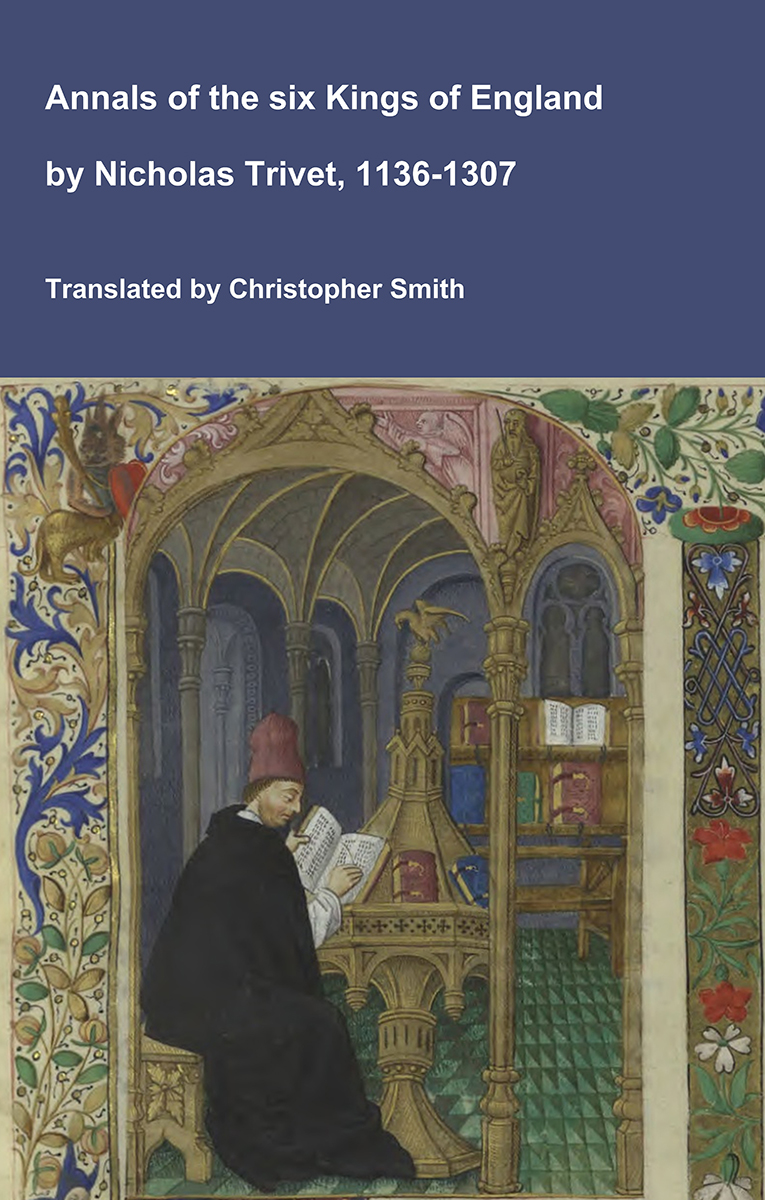
Annals of the six Kings of England by Nicholas Trivet
Translation of the Annals of the Six Kings of England by that traces the rise and rule of the Angevin aka Plantagenet dynasty from the mid-12th to early 14th century. Written by the Dominican scholar Nicholas Trivet, the work offers a vivid account of English history from the reign of King Stephen through to the death of King Edward I, blending political narrative with moral reflection. Covering the reigns of six monarchs—from Stephen to Edward I—the chronicle explores royal authority, rebellion, war, and the shifting balance between crown, church, and nobility. Trivet provides detailed insight into defining moments such as baronial conflicts, Anglo-French rivalry, and the consolidation of royal power under Edward I, whose reign he describes with particular immediacy. The Annals combines careful year-by-year reporting with thoughtful interpretation, presenting history not merely as a sequence of events but as a moral and political lesson. Ideal for readers interested in medieval history, kingship, and the origins of the English state, this chronicle remains a valuable and accessible window into the turbulent world of the Plantagenet kings.
Available at Amazon in eBook and Paperback format.
Kingsbridge Hundred, Wiltshire is in Wiltshire.

St Peter's Church, Clyffe Pypard, Wiltshire is also in Churches in Wiltshire.
St Peter's Church, Clyffe Pypard, Wiltshire [Map]. Monument to Thomas Spackman by John Devall who was the Royal Master Mason. And Pevsner and his wife are buried there.
On 10th January 1419 George Darrell of Littlecote was born to William Darrell (age 35) at Littlecote House. He married (1) in or before 1454 Margaret Stourtron, daughter of John Stourton 1st Baron Stourton, and had issue (2) in or before 1466 Joan Haute and had issue.
In 1429 Richard Darrell was born to William Darrell (age 45) at Littlecote House. He married after 1455 Margaret Beaufort, daughter of Edmund Beaufort 1st or 2nd Duke of Somerset and Eleanor Beauchamp Duchess Somerset, and had issue.
In 1605 Alexander Popham was born to Francis Popham (age 32) at Littlecote House.
On 21st August 1619 John Borlase 1st Baronet was born to William Borlase (age 30) and Jane Popham at Littlecote House. He married 4th December 1637 Alice Bankes Lady Borlase and had issue.
On 15th October 1620 William Borlase was born to William Borlase (age 31) and Jane Popham at Littlecote House. He married before 1660 Joanna Bankes and had issue.
Samuel Pepys' Diary. 16th June 1668. Tuesday. So paying the reckoning, 14s. 4d., and servants, 2s., poor 1s., set out; and overtook one coach and kept a while company with it, till one of our horses losing a shoe, we stopped and drank and spent 1s. So on, and passing through a good part of this county of Wiltshire, saw a good house of Alexander Popham's (age 63), and another of my Lord Craven's (age 60), I think in Barkeshire. Come to Newbery [Map], and there dined, which cost me, and musick, which a song of the old courtier of Queen Elizabeth's, and how he was changed upon the coming in of the King (age 38), did please me mightily, and I did cause W. Hewer (age 26) to write it out, 3s. 6d. Then comes the reckoning, forced to change gold, 8s. 7d.; servants and poor, 1s. 6d. So out, and lost our way, which made me vexed, but come into it again; and in the evening betimes come to Reading [Map], and there heard my wife read more of "Mustapha", and then to supper, and then I to walk about the town, which is a very great one, I think bigger than Salsbury: a river runs through it, in seven branches, and unite in one, in one part of the town, and runs into the Thames half-a-mile off one odd sign of the Broad Face. W. Hewer troubled with the headake we had none of his company last night, nor all this day nor night to talk. Then to my inn, and so to bed.


On 18th March 1686 John Sheffield 1st Duke of Buckingham and Normanby (age 37) and Ursula Stawell Countess Mulgrave and Conway were married at the chapel of Littlecote House. She by marriage Countess Mulgrave. He the son of Edmund Sheffield 2nd Earl Mulgrave and Elizabeth Cranfield Countess Mulgrave (age 78).
Ann Borlase was born to William Borlase and Jane Popham at Littlecote House. She married Arthur Warren of Stapleford in Nottinghamshire and had issue.

The History of William Marshal was commissioned by his son shortly after William’s death in 1219 to celebrate the Marshal’s remarkable life; it is an authentic, contemporary voice. The manuscript was discovered in 1861 by French historian Paul Meyer. Meyer published the manuscript in its original Anglo-French in 1891 in two books. This book is a line by line translation of the first of Meyer’s books; lines 1-10152. Book 1 of the History begins in 1139 and ends in 1194. It describes the events of the Anarchy, the role of William’s father John, John’s marriages, William’s childhood, his role as a hostage at the siege of Newbury, his injury and imprisonment in Poitou where he met Eleanor of Aquitaine and his life as a knight errant. It continues with the accusation against him of an improper relationship with Margaret, wife of Henry the Young King, his exile, and return, the death of Henry the Young King, the rebellion of Richard, the future King Richard I, war with France, the death of King Henry II, and the capture of King Richard, and the rebellion of John, the future King John. It ends with the release of King Richard and the death of John Marshal.
Available at Amazon in eBook and Paperback format.
Time Team Series 2 Episode 3: The Lost Villa was filmed between 6th May 1994 and 8th May 1994. It was originally shown on 22nd January 1995.
Location: Tockenham, Wiltshire [Map].
Category: Time Team Early Medieval.
The Time Team:
Tony Robinson (age 48), Presenter
Mick Aston (age 48), Bristol University Landscape Archaeologist
Carenza Lewis (age 31), Field Archaeologist
Phil Harding (age 44), Wessex Archaeological Trust Field Archaeologist
Robin Bush (age 51), Archivist
Victor Ambrus (age 59), Historical Illustrator
Stewart Ainsworth (age 43), Landscape Archaeologist
Dr Mike Allen, Environmental Archaeologist
John Gator, Chris Gaffney, Geophysics
Martin Henig, Oxford University
Bryn Walters, Romano-British Archaeologist
Roy Canham, County Archaeologist
Mark Horton, Digger
Louise Shenstone, Mosaic Artist
Amanda Chadburn, English Heritage
Techniques: Coring, Resistivity, Field Walking
Sources: Pevsner who suggests the Roman Figure in the church wall is Asclepius, Plato's Phaedo 118a, Sites and Monuments Record, Tockenham Tithe Map 1866 on linen, 1764 Estate Map.
Outcomes: Martin Henig determines Roman Statue is a Genius; an individual instance of a general divine nature that is present in every individual person, place, or thing like a guardian angel. And Roman Fountain Head in the form of a fish; the finest work of art in Roman Britain. Geophyics identified Roman Villa; Provincial Governors Palace? Carbonised processed grain from Environmental Archaeology. Hypocaust tiles. Saxon pot. Roman Painted Plaster. Roman bowl, glass, mosaic. Monument scheduled.
Around 1200 St Giles' Church, Tockenham was built. There is a Roman Statue embedded in the wall and the church reuses Roman stones. The church was originally dedicated to St John the Evangelist.
After 1147 Philip Fitzrobert (deceased) died at Wootton Bassett, Wiltshire.