

Anne Boleyn. Her Life as told by Lancelot de Carle's 1536 Letter.
In 1536, two weeks after the execution of Anne Boleyn, her brother George and four others, Lancelot du Carle, wrote an extraordinary letter that described Anne's life, and her trial and execution, to which he was a witness. This book presents a new translation of that letter, with additional material from other contemporary sources such as Letters, Hall's and Wriothesley's Chronicles, the pamphlets of Wynkyn the Worde, the Memorial of George Constantyne, the Portuguese Letter and the Baga de Secrets, all of which are provided in Appendices.
Available at Amazon in eBook and Paperback format.
Knaresborough is in Kexby.
Around 1088 Eustace Fitzjohn 4th Baron Halton was born to John "Monoculus" Fitzrichard de Burgh [aged 28] and Magdelena Cecily Blois [aged 40] at Knaresborough [Map]. He married (1) before 1130 Agnes Fitznigel, daughter of William Fitznigel 2nd Baron of Halton, and had issue (2) before 1130 Beatrix Vesci and had issue.
Close Rolls Edward II 1307-1313. On 16th January 1310 King Edward II of England [aged 25]. Stamford [Map]. To the Sheriff of York. Order to proclaim that the king does not intend to change the money current in the Kingdom in the late King's time, as had been rumoured, and to forbid anyone from thinking little of it, whereby victuals and other necessaries may be sold more dearly.
The like to all the Sheriffs of England [Ibid].
Enrolment of deed of Peter de Gavaston [aged 26], knight, surrendering to the king the castle, manor, and honour of Knaresborough [Map], with the free chase of Knaresborough, and the manors of Routheclyve and Auldburgh, lately granted to him by the King for his lifetime. Witnesses: Gilbert de Clare 8th Earl Gloucester 7th Earl Hertford [aged 18], Henry Lacy 4th Earl Lincoln, Earl Salisbury [aged 59], John Warenne 7th Earl of Surrey [aged 23], John de Brittania, Earl of Richmond, Hugh "Elder" Despencer 1st Earl Winchester [aged 48], Henry Percy 9th and 1st Baron Percy [aged 36], Robert son of Walter, Robert son of Payn, William de Burford, William Inge. Dated at Stamford [Map] July 26, 3 Edward II.
Enrolment of like surrender by the said Peter of the county of Gaure and the castles of Talanon, Tantalon, and Mauleon, the provostships (preposituras) and Camparian(um) called 'la Cointal' and of the city of Bayonne, the manor of Erebafaveyra, Born, Comtad, Salmun, Dagenes, and the island of Oleron, and the lands of Marempne and of Lancras in Saintogne, and all rights, appurtenances, etc., etc., thereto pertaining to the king, which the king lately granted him for life. Witnesses as above. Dated August 4, 3 Edward II.
Memorandum, that this deed was delivered to the king in his chamber in the House of the Friars Preachers, Stamford [Map] at Stamford, by the hands of the said Peter and the king delivered the said deed to J his chancellor, to be enrolled in the chancery, and it was afterwards delivered to Ingelard de Warle, keeper of the King's Wardrobe to be kept in the king's wardrobe, but the king's charters that the said Peter hereof were not then restored.[CONTINUES].
 Become a Member via our Buy Me a Coffee page to read more.
In 1376 John Savile of Shelley and Golcar [aged 51] was elected MP Yorkshire in the Good Parliament. During the Good Parliament, he was sufficiently trusted to conduct Thomas Caterton from Queenborough Castle [Map] for interrogation before Parliament. Caterton had been appealed for treason by Sir John Annesley, and the court party, including Gaunt [aged 35], was anxious to protect him from attack. In the event, they were able to hold off the opposition, despite some damning revelations about their conduct of the war-effort. The duke himself was singled out for particular criticism, and during the Peasants' Revolt of 1381 he fled into Scotland, leaving his Savoy Palace [Map] to be destroyed by the London mob. Gaunt was, understandably, reluctant to cross the border again without the protection of a sizeable bodyguard. In late June 1376, therefore, his leading retainers in the north were instructed to provide an escort for his journey to Knaresborough [Map]. Not only did John Savile of Shelley and Golcar mobilize a personal retinue of ten men-at-arms and 40 archers; he also helped to suppress the rebellion in the north by serving on two commissions for the punishment of insurgents.
Around November 1938 Harry Oxley [aged 60] died at Knaresborough [Map].
On 26th October 1849 Gerald William Lascelles was born to Henry Thynne Lascelles 4th Earl Harewood [aged 25] and Elizabeth Joanna Burgh [aged 23] at Goldsborough Hall, Knaresborough. He married 9th February 1875 Constance Augusta Mary Fitz-Clarence Phillipson and had issue.
On 21st August 1924 Gerald David Lascelles was born to Henry Lascelles 6th Earl Harewood [aged 41] and Princess Mary Windsor Countess Harewood [aged 27] at Goldsborough Hall, Knaresborough. He a grandson of King George V of the United Kingdom.


Knaresborough Castle is also in Castles in North Yorkshire.
Around 1125 William Fitzeustace was born to Eustace Fitzjohn 4th Baron Halton [aged 37] and Beatrix Vesci at Knaresborough Castle [Map]. He married Burga Stuteville and had issue.

15th April 1210. King John [aged 43] performs the first Royal Maundy Thursday alms giving at Knaresborough Castle [Map]. Note Maundy Thursday described as "Jovis Cene" i.e. "[Last] Supper Thursday". From the Mise Roll 11: "Supper Thursday at Knaresborough: For royal orders to the amount of ... 3s 1d. For sewing three robes for the poor — 2s 2d. For 13 belts, 13 knives, and 13 pairs of breeches for the same poor — 4s 4½d."
Source: Mise Roll 11.
In 1290 William "Hardy" Douglas 2nd Lord Douglas [aged 50] was imprisoned at Knaresborough Castle [Map].
On 13th January 1312 King Edward II of England [aged 27] and Piers Gaveston 1st Earl Cornwall [aged 28] were reunited at Knaresborough Castle [Map].
In 1485 George Stanley 9th Baron Strange Knockin 5th Baron Mohun Dunster [aged 25] was appointed Constable of Pontefract Castle and Constable of Knaresborough Castle.

Vesta Monumenta. 1734. Plate 1.44. Knaresborough Castle [Map]. Engraving by George [aged 50] Vertue after a drawing originally produced for a survey of the properties of the Duchy of Lancaster conducted by the Chancellor of the Duchy, Ambrose Cave, in 1561.
The Deeds of the Dukes of Normandy
The Gesta Normannorum Ducum [The Deeds of the Dukes of Normandy] is a landmark medieval chronicle tracing the rise and fall of the Norman dynasty from its early roots through the pivotal events surrounding the Norman Conquest of England. Originally penned in Latin by the monk William of Jumièges shortly before 1060 and later expanded at the behest of William the Conqueror, the work chronicles the deeds, politics, battles, and leadership of the Norman dukes, especially William’s own claim to the English throne. The narrative combines earlier historical sources with firsthand information and oral testimony to present an authoritative account of Normandy’s transformation from a Viking settlement into one of medieval Europe’s most powerful realms. William’s history emphasizes the legitimacy, military prowess, and governance of the Norman line, framing their expansion, including the conquest of England, as both divinely sanctioned and noble in purpose. Later chroniclers such as Orderic Vitalis and Robert of Torigni continued the history, extending the coverage into the 12th century, providing broader context on ducal rule and its impact. Today this classic work remains a foundational source for understanding Norman identity, medieval statesmanship, and the historical forces that reshaped England and Western Europe between 800AD and 1100AD.
Available at Amazon in eBook and Paperback format.
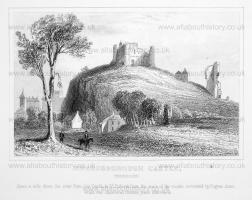
Knaresborough Castle [Map]. Dugdale's England & Wales, 1853.
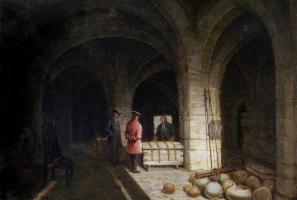
1896. William Harold Cubley [aged 79]. "The Crypt, Knaresborough Castle [Map]".
The River Nidd rises at Nidd Head Spring, North Yorkshire [Map] after which it travels under Pateley Bridge, North Yorkshire [Map], then past Knaresborough Castle [Map] before joining the River Ouse at Nun Monkton, North Yorkshire [Map].