

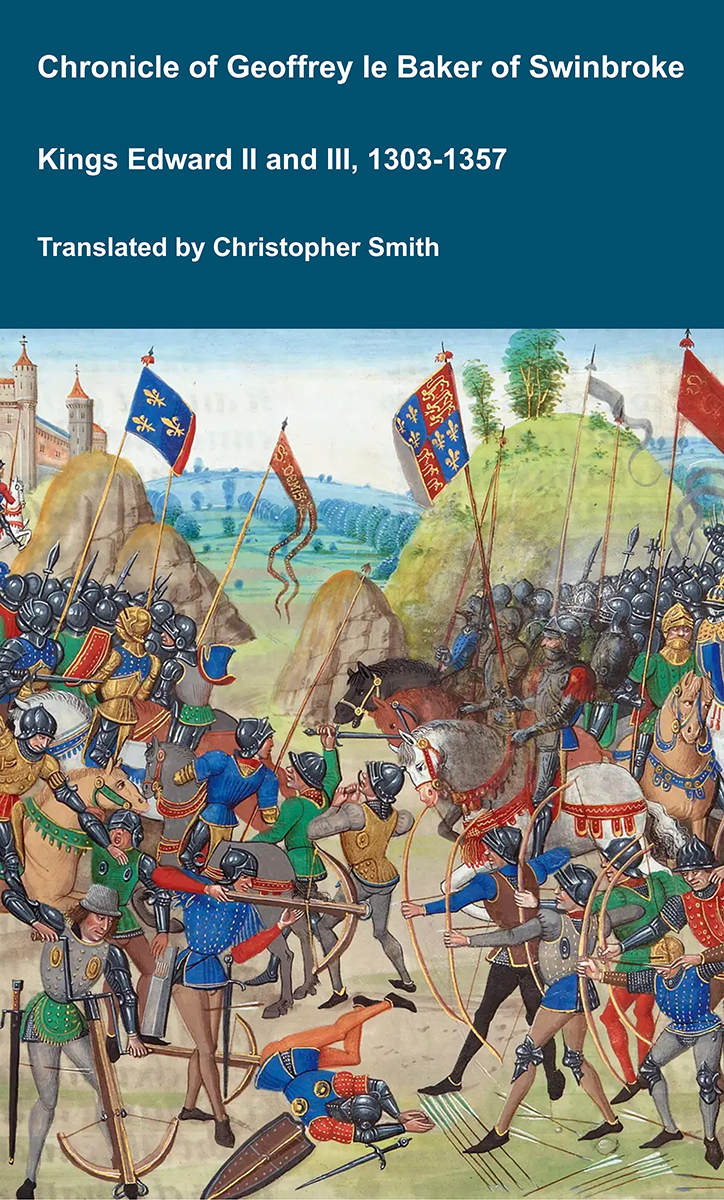
Chronicle of Geoffrey le Baker of Swinbroke
Baker was a secular clerk from Swinbroke, now Swinbrook, an Oxfordshire village two miles east of Burford. His Chronicle describes the events of the period 1303-1356: Gaveston, Bannockburn, Boroughbridge, the murder of King Edward II, the Scottish Wars, Sluys, Crécy, the Black Death, Winchelsea and Poitiers. To quote Herbert Bruce 'it possesses a vigorous and characteristic style, and its value for particular events between 1303 and 1356 has been recognised by its editor and by subsequent writers'. The book provides remarkable detail about the events it describes. Baker's text has been augmented with hundreds of notes, including extracts from other contemporary chronicles, such as the Annales Londonienses, Annales Paulini, Murimuth, Lanercost, Avesbury, Guisborough and Froissart to enrich the reader's understanding. The translation takes as its source the 'Chronicon Galfridi le Baker de Swynebroke' published in 1889, edited by Edward Maunde Thompson.
Available at Amazon in eBook and Paperback format.
Leintwardine, Herefordshire is in Herefordshire.
Around 200AD. Bravinium Roman Station [Map] on the XII Antonine Iter, 22 M.P. from Magnis (Kenchester) and 27 M.P. from Uriconium (Wroxeter [Map]). The Roman site forms a roughly rectangular area with an internal extent of about 10 acres, formerly enclosed by earth banks but these are now partly obliterated by the village which occupies much of the area.
1086. Domesday Leintwardine. Land of Picot (of Sai).
Land and resources: Ploughland: 2 ploughlands.
Valuation: Annual value to lord: 5 shillings in 1086.
Owners: Tenant-in-chief in 1086: Picot (of Sai).
Lord in 1086: Fulco (of Le Pin).
1086. Domesday Leintwardine. Land of Ralph of Mortimer (age 17)Domesday Leintwardine.
Households: Households: 15 villagers. 11 smallholders. 5 slaves. 1 priest. 11 other.
Land and resources: Ploughland: 14 ploughlands. 4 lord's plough teams. 10 men's plough teams.
Other resources: Woodland 1 leagues. 1 mill, value 6 shillings and 7 pence. 1 church.
Valuation: Annual value to lord: 4 pounds in 1086; 1 pound 10 shillings when acquired by the 1086 owner; 2 pounds in 1066.
Owners: Tenant-in-chief in 1086: Ralph of Mortimer. Lords in 1086: Ralph of Mortimer; man-at-arms, one. Lord in 1066: King Edward.
1086. Leintwardine, Herefordshire [Map] is listed in the Domesday Book of 1086 as "Lenteurde", and was recorded as being a large settlement for its time. Its name is apparently derived from the Celtic name for the River Teme – formerly known as the Lent which means simply 'torrent, stream'.
Domesday Leintwardine. 1086. Leintwardine [Map] was a settlement in Domesday Book, in the hundred of Leintwardine, mentioned in the chapters for Herefordshire and Shropshire. It had a recorded population of 43 households in 1086, putting it in the largest 20% of settlements recorded in Domesday, and is listed under 2 owners in Domesday Book.

On 15th January 1833 Banastre Tarleton 1st Baronet (age 78) died at Leintwardine, Herefordshire [Map]. Baronet Tarleton of Liverpool in Lancashire extinct.
The River Teme rises around three miles south of Dolfor [Map] in Powys. For much of its upper course it forms the border between England and Wales. It passes through, or near, Felindre, Radnoshire [Map], Knighton, Radnorshire [Map], Leintwardine, Herefordshire [Map], Bromfield, Shropshire [Map], Ludlow, Shropshire [Map], Tenbury Wells, Worcestershire [Map], Stanford Bridge, Worcestershire [Map], Shelsey Beauchamp, Worcestershire [Map], Leigh, Worcestershire [Map] and Bransford, Worcestershire [Map] after which it joins the River Severn around 3 km south of Worcester, Worcestershire [Map].
The River Clun rises near Anchor, Shropshire [Map], 400m from the England and Wales border, after which it travels past Hall in the Forest, Clun [Map], Clun Castle [Map] and NO IMAGE [Map] before joining the River Teme at Leintwardine, Herefordshire [Map].
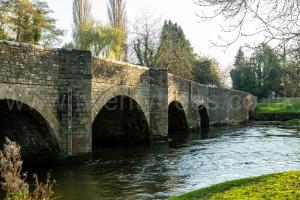
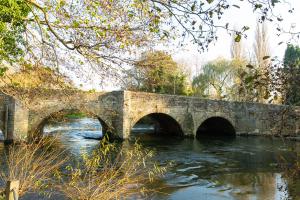
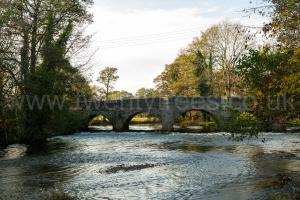
Leintwardine Bridge, Herefordshire [Map] crosses the River Teme just below its confluence with the River Clun. Originally the crossing point of a Roman Road known locally as Watling Street; a spur or extension of the Welsh Border Road which terminated at Wroxeter, Shropshire [Map] around thirty-five kilometres north of Leintwardine, Herefordshire [Map] and which may have connected Wroxeter to Usk, Monmouthshire [Map]. The current bridge is around 1850 widened by twelve feet in 1930.
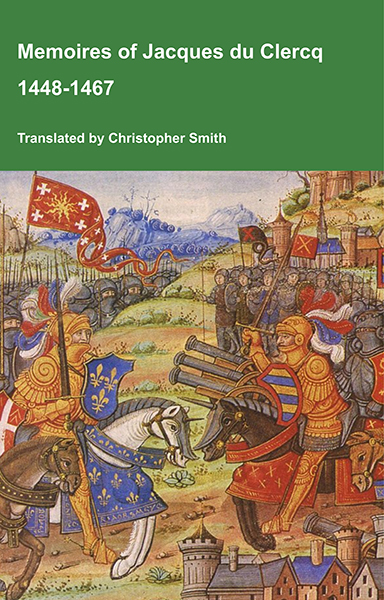
This is a translation of the 'Memoires of Jacques du Clercq', published in 1823 in two volumes, edited by Frederic, Baron de Reissenberg. In his introduction Reissenberg writes: 'Jacques du Clercq tells us that he was born in 1424, and that he was a licentiate in law and a counsellor to Philip the Good, Duke of Burgundy, in the castellany of Douai, Lille, and Orchies. It appears that he established his residence at Arras. In 1446, he married the daughter of Baldwin de la Lacherie, a gentleman who lived in Lille. We read in the fifth book of his Memoirs that his father, also named Jacques du Clercq, had married a lady of the Le Camelin family, from Compiègne. His ancestors, always attached to the counts of Flanders, had constantly served them, whether in their councils or in their armies.' The Memoires cover a period of nineteen years beginning in in 1448, ending in in 1467. It appears that the author had intended to extend the Memoirs beyond that date; no doubt illness or death prevented him from carrying out this plan. As Reissenberg writes the 'merit of this work lies in the simplicity of its narrative, in its tone of good faith, and in a certain air of frankness which naturally wins the reader’s confidence.' Du Clercq ranges from events of national and international importance, including events of the Wars of the Roses in England, to simple, everyday local events such as marriages, robberies, murders, trials and deaths, including that of his own father in Book 5; one of his last entries.
Available at Amazon in eBook and Paperback format.
Welsh Border Road describes an unamed Roman Road, and unnumbered by Margery, that went from Caerleon [Map] to Wroxeter, Shropshire [Map], passing through Usk, Monmouthshire [Map], Abergavenny, Monmouthshire [Map], Hereford [Map], Mortimer's Cross, Herefordshire [Map], Wigmore, Herefordshire [Map] and Leintwardine Bridge, Herefordshire [Map] where it crosses the River Teme just after its convergence with the River Clun.