

The History of William Marshal was commissioned by his son shortly after William’s death in 1219 to celebrate the Marshal’s remarkable life; it is an authentic, contemporary voice. The manuscript was discovered in 1861 by French historian Paul Meyer. Meyer published the manuscript in its original Anglo-French in 1891 in two books. This book is a line by line translation of the first of Meyer’s books; lines 1-10152. Book 1 of the History begins in 1139 and ends in 1194. It describes the events of the Anarchy, the role of William’s father John, John’s marriages, William’s childhood, his role as a hostage at the siege of Newbury, his injury and imprisonment in Poitou where he met Eleanor of Aquitaine and his life as a knight errant. It continues with the accusation against him of an improper relationship with Margaret, wife of Henry the Young King, his exile, and return, the death of Henry the Young King, the rebellion of Richard, the future King Richard I, war with France, the death of King Henry II, and the capture of King Richard, and the rebellion of John, the future King John. It ends with the release of King Richard and the death of John Marshal.
Available at Amazon in eBook and Paperback format.
Ludlow Castle is in Ludlow, Shropshire [Map], Castles in Shropshire.
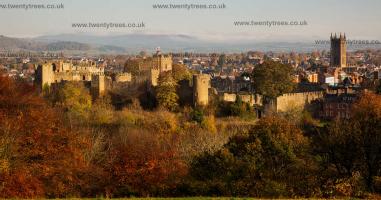
Ludlow Castle [Map] from the south of Ludlow, across the River Teme.
Before 1106 Roger de Lacy undertook building works at Ludlow Castle [Map].
After 1106 Roger de Lacy died. His kinswoman Sybil de Lacy inherited Ludlow Castle [Map].
Around 1115 Payn Fitzjohn [aged 29] and Sybil de Lacy were married. Through her marriage, Sybil transferred lands in several shires to her husband, including lands around Ludlow Castle [Map].
In 1139 Josce de Dinan and Sybil de Lacy were married by which he gained control of Ludlow Castle [Map]. The marriage arranged by King Stephen I England [aged 45].
The Itinerary of Archbishop Baldwin through Wales: Book 2 Chapter 13. From Wenloch, we passed by the little cell of Brumfeld,180 the noble castle of Ludlow [Map], through Leominster [Map] to Hereford [Map] leaving on our right hand the districts of Melenyth and Elvel; thus (describing as it were a circle) we came to the same point from which we had commenced this laborious journey through Wales.
Note 180. It appears that a small college of prebendaries, or secular canons, resided at Bromfield in the reign of king Henry I.; Osbert, the prior, being recorded as a witness to a deed made before the year 1148. In 1155, they became Benedictines, and surrendered church and lands to the abbey of St. Peter's at Gloucester, whereupon a prior and monks were placed there, and continued till the dissolution. An ancient gateway and some remains of the priory still testify the existence of this religious house, the local situation of which, near the confluence of the rivers Oney and Teme, has been accurately described by Leland.
Around 1207 Philip de Albini was appointed Governor of Ludlow Castle.
On 21st October 1314 Geoffrey Geneville 1st Baron Geneville [aged 88] died at Trim, County Meath. He was buried at Black Friary, Trim, County Meath. His granddaughter Joan [aged 28] succeeded 2nd Baroness Geneville. She and her husband Roger Mortimer 1st Earl March [aged 27] inherited the vast legacy of the de Lacy dynasty, including Ludlow Castle [Map].
On 11th November 1328 Roger Mortimer 2nd Earl March was born to Edmund Mortimer [aged 25] and Elizabeth Badlesmere Countess Northampton [aged 15] at Ludlow Castle [Map]. He married before 1352 Philippa Montagu Countess March, daughter of William Montagu 1st Earl Salisbury and Catherine Grandison Countess of Salisbury, and had issue.
Adam Murimuth's Continuation and Robert of Avesbury’s 'The Wonderful Deeds of King Edward III'
This volume brings together two of the most important contemporary chronicles for the reign of Edward III and the opening phases of the Hundred Years’ War. Written in Latin by English clerical observers, these texts provide a vivid and authoritative window into the political, diplomatic, and military history of fourteenth-century England and its continental ambitions. Adam Murimuth Continuatio's Chronicarum continues an earlier chronicle into the mid-fourteenth century, offering concise but valuable notices on royal policy, foreign relations, and ecclesiastical affairs. Its annalistic structure makes it especially useful for establishing chronology and tracing the development of events year by year. Complementing it, Robert of Avesbury’s De gestis mirabilibus regis Edwardi tertii is a rich documentary chronicle preserving letters, treaties, and official records alongside narrative passages. It is an indispensable source for understanding Edward III’s claim to the French crown, the conduct of war, and the mechanisms of medieval diplomacy. Together, these works offer scholars, students, and enthusiasts a reliable and unembellished account of a transformative period in English and European history. Essential for anyone interested in medieval chronicles, the Hundred Years’ War, or the reign of Edward III.
Available at Amazon in eBook and Paperback format.
On 10th December 1376 Edmund Mortimer was born to Edmund Mortimer 3rd Earl March, Earl of Ulster [aged 24] and Philippa Plantagenet Countess March 2nd Countess Ulster [aged 21] at Ludlow Castle [Map]. He a great grandson of King Edward III of England. He married 30th November 1402 his fourth cousin once removed Catrin Mathrafal, daughter of Owain ap Gruffudd "Glyndŵr" Mathrafal Prince Powys and Margaret Hamner, and had issue.
In 1402 Thomas Beaufort 1st Duke Exeter [aged 24] was appointed Captain Ludlow Castle.
On 2nd April 1502 Prince Arthur Tudor [aged 15] died at Ludlow Castle [Map]. Earl Chester extinct. The cause of death unknown other than being reported as "a malign vapour which proceeded from the air". Catherine of Aragon [aged 16] had recovered.


Wriothesley's Chronicle [1508-1562]. 2nd April 1502. And in Easter weeke followinge the saide Prince Arthure [aged 15] deceased at Ludlowe [Map], in Wales, and was buried at Worcester [Map].b
Note b. Prince Arthur died on the Saturday following Easter Sunday in 1503, being April 2nd, and was buried in Worcester cathedral on the 27th April.
On 14th October 1559 John Williams 1st Baron Williams [aged 59] died at Ludlow Castle [Map]. He was buried at St Mary the Virgin Church, Thame. Isabel Williams [aged 37] inherited Thame, Oxfordshire. His son Francis succeeded 2nd Baron Williams of Thame although he died four months later at which time the Barony became extinct. Some sources don't mention Francis William 2nd Baron Thame regarding the Barony as extinct following the death of John Williams 1st Baron Williams.
On 22nd February 1574 Ambrosia Sidney [aged 9] died at Ludlow Castle [Map] where her father Henry Sidney [aged 45] was President of the Council of the Marches in Wales.


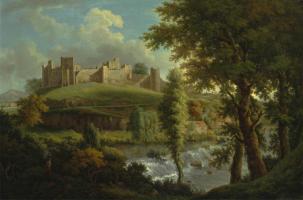
Around 1755 Samuel Scott [aged 53]. Ludlow Castle [Map] with Dinham Weir, from the South-West
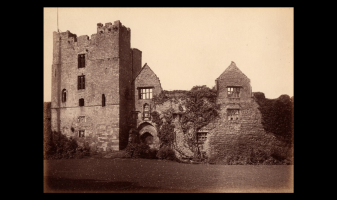
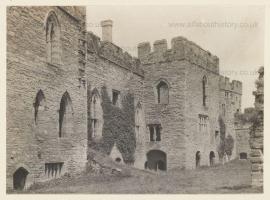
Around 1855. Benjamin Brecknell Turner [aged 40]. Ludlow Castle [Map].
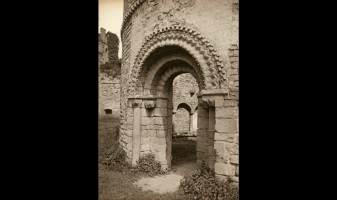
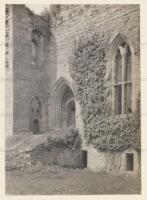
Around 1855. Benjamin Brecknell Turner [aged 40]. Ludlow Castle [Map].
18th July 1907. Godfrey Bingley [aged 65]. Ludlow Castle [Map].
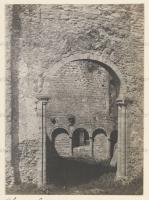
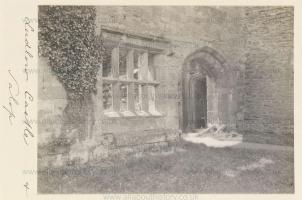
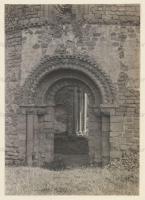
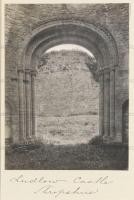
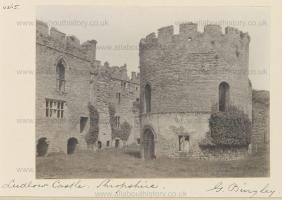
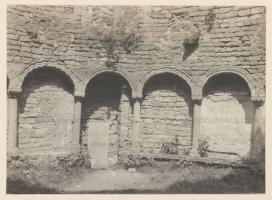
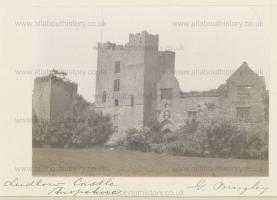
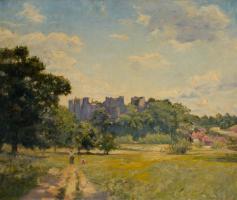
1908. Susan Isabel Dacre [aged 64]. "Ludlow Castle [Map]".