

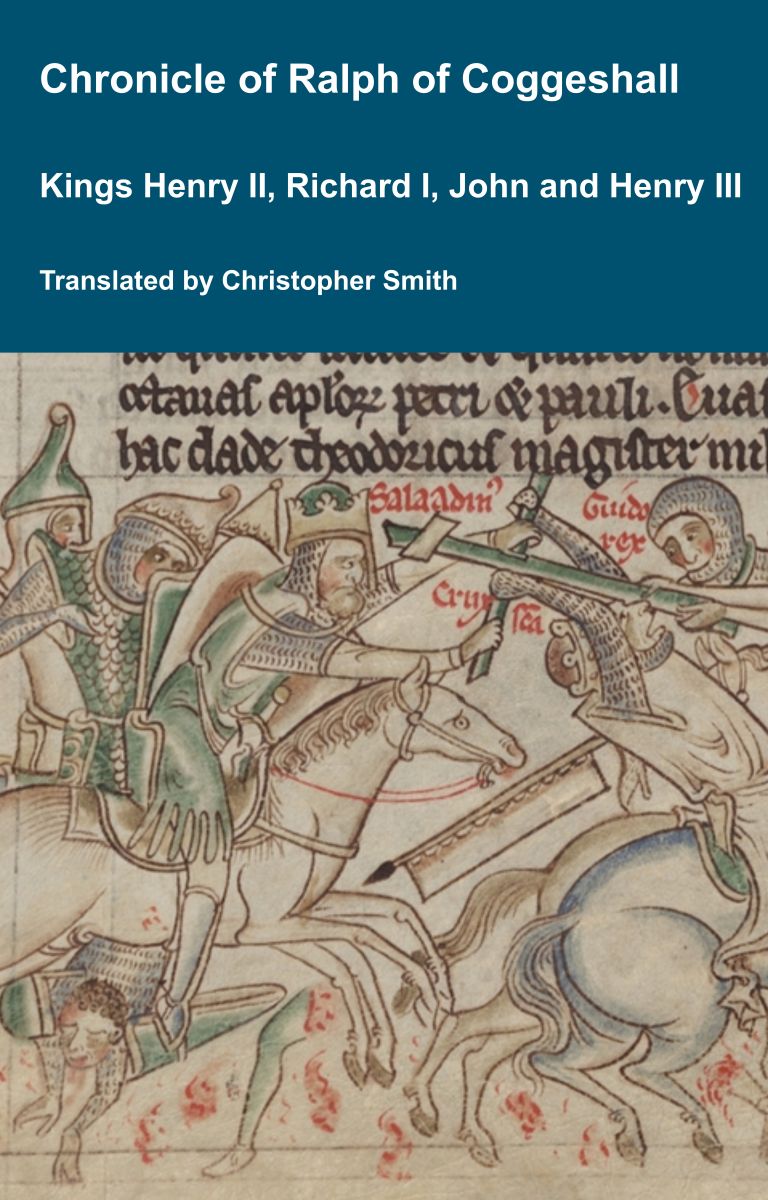
Chronicle of Abbot Ralph of Coggeshall
The Chronicle of Abbot Ralph of Coggeshall (Chronicon Anglicanum) is an indispensable medieval history that brings to life centuries of English and European affairs through the eyes of a learned Cistercian monk. Ralph of Coggeshall, abbot of the Abbey of Coggeshall in Essex in the early 13th century, continued and expanded his community’s chronicle, documenting events from the Norman Conquest of 1066 into the tumultuous reign of King Henry III. Blending eyewitness testimony, careful compilation, and the monastic commitment to record-keeping, this chronicle offers a rare narrative of political intrigue, royal power struggles, and social upheaval in England and beyond. Ralph’s work captures the reigns of pivotal figures such as Richard I and King John, providing invaluable insights into their characters, decisions, and the forces that shaped medieval rule. More than a simple annal, Chronicon Anglicanum conveys the texture of medieval life and governance, making it a rich source for scholars and readers fascinated by English history, monastic authorship, and the shaping of the medieval world.
Available at Amazon in eBook and Paperback format.
Malmesbury, Wiltshire is in Cicementone Hundred, Wiltshire.
See: Malmesbury Abbey [Map].
Bede. In the year of our Lord 705, Aldfrid, king of the Northumbrians, died before the end of the twentieth year of his reign. His son Osred [aged 8], a boy about eight years of age, succeeding him in the throne, reigned eleven years. In the beginning of his reign, Haedde, bishop of the West Saxons, departed to the heavenly life; for he was a good man and a just, and his life and doctrine as a bishop were guided rather by his innate love of virtue, than by what he had gained from books. The most reverend bishop, Pechthelm, of whom we shall speak hereafter in the proper place, and who while still deacon or monk was for a long time with his successor Aldhelm [aged 66], was wont to relate that many miracles of healing have been wrought in the place where he died, through the merit of his sanctity; and that the men of that province used to carry the dust thence for the sick, and put it into water, and the drinking thereof, or sprinkling with it, brought health to many sick men and beasts; so that the holy dust being frequently carried away, a great hole was made there.
Upon his death, the bishopric of that province was divided into two dioceses. One of them was given to Daniel, which he governs to this day; the other to Aldhelm, wherein he presided most vigorously four years; both of them were fully instructed, as well in matters touching the Church as in the knowledge of the Scriptures. Aldhelm, when he was as yet only a priest and abbot of the monastery which is called the city of Maildufus [Map], by order of a synod of his own nation, wrote a notable book against the error of the Britons, in not celebrating Easter at the due time, and in doing divers other things contrary to the purity of doctrine and the peace of the church; and through the reading of this book many of the Britons, who were subject to the West Saxons, were led by him to adopt the Catholic celebration of our Lord's Paschal Feast. He likewise wrote a famous book on Virginity, which, after the example of Sedulius, he composed in twofold form, in hexameters and in prose. He wrote some other books, being a man most instructed in all respects, for he had a polished style, and was, as I have said, of marvellous learning both in liberal and ecclesiastical studies. On his death, Forthere was made bishop in his stead, and is living at this time, being likewise a man very learned in the Holy Scriptures.
Whilst they administered the bishopric, it was determined by a synodal decree, that the province of the South Saxons, which till that time belonged to the diocese of the city of Winchester, where Daniel then presided, should itself have an episcopal see, and a bishop of its own. Eadbert, at that time abbot of the monastery [Map] of Bishop Wilfrid, of blessed memory, called Selaeseu [Map], was consecrated their first bishop. On his death, Eolla succeeded to the office of bishop. He also died some years ago, and the bishopric has been vacant to this day.
 Become a Member via our Buy Me a Coffee page to read more.
Anglo-Saxon Chronicle. 1015. This year was the great council at Oxford, Oxfordshire [Map]; where Earldorman Eadric Streona betrayed Sigferth and Morcar, the eldest thanes belonging to the Seven Towns. He allured them into his bower, where they were shamefully slain. Then the king took all their possessions, and ordered the widow of Sigferth to be secured, and brought within Malmsbury [Map]. After a little interval, Edmund Etheling [aged 25] went and seized her, against the king's [aged 49] will, and had her to wife. Then, before the Nativity of St. Mary, went the etheling west-north into the Five Towns58, and soon plundered all the property of Sigferth and Morcar; and all the people submitted to him. At the same time came King Knute [aged 20] to Sandwich, Kent [Map], and went soon all about Kent into Wessex, until he came to the mouth of the Frome; and then plundered in Dorset, and in Wiltshire, and in Somerset. King Ethelred, meanwhile, lay sick at Corsham, Wiltshire; and Earldorman Eadric Streona collected an army there, and Edmund the etheling in the north. When they came together, the alderman designed to betray Edmund the etheling, but he could not; whereupon they separated without an engagement, and sheered off from their enemies. Earldorman Eadric Streona then seduced forty ships from the king, and submitted to Knute. The West-Saxons also submitted, and gave hostages, and horsed the army. And he continued there until midwinter.
Note 58. The "seven" towns mentioned above are reduced here to "five"; probably because two had already submitted to the king on the death of the two thanes, Sigferth and Morcar. These five were, as originally, Leicester, Lincoln, Stamford, Nottingham, and Derby. Vid. an. 942, 1013.
The Manuscripts of His Grace the Duke of Rutland Volume 1. 30th March 1471. The Duke of Clarence [aged 21] to Henry Vernon [aged 26].
[1471,] March 30. Malmesbury. — Henry, We can you right goode thanke for the goode devoir that ye have doon in sending furth men to understand of the rule and guyding of E[dward]-late King, and thanke you for the writing that ye laste sent to us, wherby we understande the goode and lovyng disposiccion towardes us of our cousin of Shrovesbury (offering to do us service erased), wherof we bee right glad. Praying you that ye will haste you towardes us as soon as ye may, making the mor spede and gretter haste inasmuch as it is nedeful and expedient as ye may wele conceyve. Warnyng all our servauntes nigh you and by the way as ye shall comme, that thay spede thaim to us in all haste possible, doing your feythefull devoir herin at this tyme, as our special trust is in you. Writen at Malmesbury [Map] the xxx day of March. (Signed: — ) Gr. Clarence. Signet.
John Evelyn's Diary. 20th May 1639. Accompanied with one Mr. J. Crafford (who afterward being my fellow-traveler in Italy, there changed his religion), I took a journey of pleasure to see the Somersetshire baths [Map], Bristol, Gloucestershire [Map], Cirencester, Gloucestershire [Map], Malmesbury, Wiltshire [Map], Abington, and divers other towns of lesser note; and returned the 25th.
John Evelyn's Diary. 7th September 1651. I went to visit Mr. Hobbes [aged 63], the famous philosopher of Malmesbury, Wiltshire [Map], with whom I had long acquaintance. From his window we saw the whole equipage and glorious cavalcade of the young French Monarch, Louis XIV [aged 13], passing to Parliament, when first he took the kingly government on him, now being in his 14th year, out of his minority and the Queen Regent's [aged 49] pupilage. First came the captain of the King's Aids, at the head of 50, richly liveried; next, the Queen-Mother's Light Horse, 100, the lieutenant being all over covered with embroidery and ribbons, having before him four trumpets habited in black velvet, full of lace, and casques of the same. Then, the King's Light Horse, 200, richly habited, with four trumpets in blue velvet embroidered with gold, before whom rode the Count d'Olonne coronet [cornet], whose belt was set with pearl. Next went the grand Prévôt's company on foot, with the Prévôt on horseback; after them, the Swiss in black velvet toques, led by two gallant cavaliers habited in scarlet-colored satin, after their country fashion, which is very fantastic; he had in his cap a pennach of heron, with a band of diamonds, and about him twelve little Swiss boys, with halberds. Then, came the Aide des Cérémonies; next, the grandees of court, governors of places and lieutenants-general of provinces, magnificently habited and mounted; among whom I must not forget the Chevalier Paul, famous for many sea-fights and signal exploits there, because it is said he had never been an Academist, and yet governed a very unruly horse, and besides his rich suit his Malta Cross was esteemed at 10,000 crowns. These were headed by two trumpets, and the whole troop, covered with gold, jewels, and rich caparisons, were followed by six trumpets in blue velvet also, preceding as many heralds in blue velvet semée with fleurs-de-lis, caduces in their hands, and velvet caps on their heads; behind them, came one of the masters of the ceremonies; then, divers marshals and many of the nobility, exceeding splendid; behind them Count d'Harcourt, grand Ecuyer, alone, carrying the King's sword in a scarf, which he held up in a blue sheath studded with fleurs-de-lis; his horse had for reins two scarfs of black taffeta.


Become a Member via our Buy Me a Coffee page to read more.
John Evelyn's Diary. 14th December 1655. I visited Mr. Hobbes [aged 67], the famous philosopher of Malmesbury, Wiltshire [Map], with whom I had been long acquainted in France.
The Gloucestershire River Avon rises near Acton Turville, Gloucestershire [Map] after which it flows past Luckington, Wiltshire [Map], Sherston, Wiltshire [Map], Easton Grey, Wiltshire [Map], Malmesbury, Wiltshire [Map], Great Somerford, Wiltshire [Map], Christian Malford, Wiltshire [Map], Chippenham, Wiltshire [Map], Melksham, Wiltshire [Map], Bradford on Avon [Map], under the Dundas Aquaduct, Wiltshire [Map], through Bath, Somerset [Map], past Keynsham, Gloucestershire [Map], through Bristol [Map] under the Clifton Suspension Bridge [Map] to Avonmouth, Gloucestershire [Map] where it joins the Severn Estuary.
Malmesbury Abbey is also in Abbeys in England.
In 675 Saint Aldhelm [aged 36] was appointed Abbot Malmesbury.
Around 937 Aelfwine Wessex was buried at Malmesbury Abbey [Map].
William of Worcester's Chronicle of England
William of Worcester, born around 1415, and died around 1482 was secretary to John Fastolf, the renowned soldier of the Hundred Years War, during which time he collected documents, letters, and wrote a record of events. Following their return to England in 1440 William was witness to major events. Twice in his chronicle he uses the first person: 1. when writing about the murder of Thomas, 7th Baron Scales, in 1460, he writes '… and I saw him lying naked in the cemetery near the porch of the church of St. Mary Overie in Southwark …' and 2. describing King Edward IV's entry into London in 1461 he writes '… proclaimed that all the people themselves were to recognize and acknowledge Edward as king. I was present and heard this, and immediately went down with them into the city'. William’s Chronicle is rich in detail. It is the source of much information about the Wars of the Roses, including the term 'Diabolical Marriage' to describe the marriage of Queen Elizabeth Woodville’s brother John’s marriage to Katherine, Dowager Duchess of Norfolk, he aged twenty, she sixty-five or more, and the story about a paper crown being placed in mockery on the severed head of Richard, 3rd Duke of York.
Available at Amazon in eBook and Paperback format.
Around 937 Æthelwine Wessex was buried at Malmesbury Abbey [Map].
Chronicon ex Chronicis by Florence and John of Worcester. 1140. Robert Fitz-Hubert, a Freebooter. There was a certain knight, whose name was Robert, the son of a nobleman named Hubert. This man, fearing neither God nor man, but trusting solely to his own might, took the castle of Malmesbury by a well-devised stratagem. Some of the king's knights, who were quartered there, took refuge in the church of St. Aldhelm [Map], the bishop, for sanctuary. Pressing these to surrender, he one day burst into the chapter-house of the monks, at the head of armed men, and with terrible threats required them, on pain of confiscation of their property, to give up the illustrious royalists, with their horses. They, however, in horror at permitting the peace of God, and their patron, St. Aldhelm, being broken, refused to consent to his demand; but at last, although reluctantly, to appease his fury, they gave up the horses. After Robert Fitz-Hubert had held the castle for ome time, and had exhausted the whole neighbourhood by his ravages, the king came to its succour, and besieged the place for nearly eight days. William d'Ypres, a kinsman, they say, of this Robert, was the go-between for the surrender of the castle, and settled, at last, with the king, terms of peacethe castle being given up, with entire submission to his royal rights; which was done.