

Chronicle of Geoffrey le Baker of Swinbroke
Baker was a secular clerk from Swinbroke, now Swinbrook, an Oxfordshire village two miles east of Burford. His Chronicle describes the events of the period 1303-1356: Gaveston, Bannockburn, Boroughbridge, the murder of King Edward II, the Scottish Wars, Sluys, Crécy, the Black Death, Winchelsea and Poitiers. To quote Herbert Bruce 'it possesses a vigorous and characteristic style, and its value for particular events between 1303 and 1356 has been recognised by its editor and by subsequent writers'. The book provides remarkable detail about the events it describes. Baker's text has been augmented with hundreds of notes, including extracts from other contemporary chronicles, such as the Annales Londonienses, Annales Paulini, Murimuth, Lanercost, Avesbury, Guisborough and Froissart to enrich the reader's understanding. The translation takes as its source the 'Chronicon Galfridi le Baker de Swynebroke' published in 1889, edited by Edward Maunde Thompson.
Available at Amazon in eBook and Paperback format.
Newark Castle, Nottinghamshire is in Newark on Trent, Nottinghamshire [Map], Castles in Nottinghamshire.
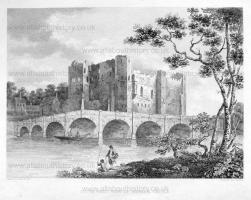
Newark Castle, Nottinghamshire [Map]. W F Sherlock.
During the night of 18th and 19th October 1216 King John of England [aged 49] died at Newark Castle, Nottinghamshire [Map]. His son Henry [aged 9] succeeded III King of England.
John Monmouth [aged 34] was present.
On his deathbed, John appointed a council of thirteen executors to help Henry reclaim the kingdom and requested that his son be placed into the guardianship of William Marshal 1st Earl Pembroke [aged 70].
King John's will is the earliest English royal will to survive in its original form. The document is quite small, roughly the size of a postcard and the seals of those who were present at the time would have been attached to it. Translation of the will taken from an article by Professor S.D. Church in the English Historical Review, June 2010:
I, John, by the grace of God king of England, lord of Ireland, duke of Normandy and Aquitaine, count of Anjou, hindered by grave infirmity and not being able at this time of my infirmity to itemize all my things so that I may make a testament, commit the arbitration and administration of my testament to the trust and to the legitimate administration of my faithful men whose names are written below, without whose counsel, even in good health, I would have by no means arranged my testament in their presence, so that what they will faithfully arrange and determine concerning my things as much as in making satisfaction to God and to holy Church for damages and injuries done to them as in sending succour to the land of Jerusalem and in providing support to my sons towards obtaining and defending their inheritance and in making reward to those who have served us faithfully and in making distribution to the poor and to religious houses for the salvation of my soul, be right and sure. I ask, furthermore, that whoever shall give them counsel and assistance in the arranging of my testament shall receive the grace and favour of God. Whoever shall infringe their arrangement and disposition, may he incur the curse and indignation of almighty God and the blessed Mary and all the saints.
In the first place, therefore, I desire that my body be buried in the church of St Mary and St Wulfstan at Worcester. I appoint, moreover, the following arbiters and administrators: the lord Guala, by the grace of God, cardinal-priest of the title of St Martin and legate of the apostolic see; the lord Peter bishop of Winchester; the lord Richard bishop of Chichester; the lord Silvester bishop of Worcester; Brother Aimery de St-Maur; William Marshal earl of Pembroke; Ranulf earl of Chester; William earl Ferrers; William Brewer; Walter de Lacy and John of Monmouth; Savaric de Mauléon; Falkes de Bréauté.
The signatories were:
Guala Bicchieri [aged 66] (ca 1150 - 1227) Papal Legate.
Bishop Peter de Roches, Bishop of Winchester.
Richard le Poer (? - 1237), Bishop of Chichester.
Sylvester of Worcester, Bishop of Worcester.
Aimery de St-Maur (? -?1219), Master of the English Templars.
William Marshal 1st Earl Pembroke.
Ranulf de Blondeville Gernon 6th Earl Chester 1st Earl Lincoln [aged 46].
William Ferrers 4th Earl of Derby [aged 48].
William Brewer (? - 1226), 1st Baron Brewer.
Walter de Lacy (ca 1172-1241) Lord of Meath.
John: (1182 - 1248) Lord of Monmouth.
Savaric de Mauléon (? - 1236) Seneschal of Poitou from 1205.
Falkes de Bréauté (? - 1226) Seneschal of Cardiff Castle.
Chronica Majora by Matthew Paris. [15th October 1216] Nevertheless, at dawn he departed from there with difficulty, and went to lodge at the castle of Sleaford. There, being overcome by great bodily weakness, he came on the next day, carried on horseback, to the castle of Newark [Map].
Veruntamen summo inde diluculo, licet cum labore recedens, ad castellum de Laford hospitaturus perrexit. Ubi maxima corporis prægravatus molestia, in crastino vis ad castellum de Newerc equo vehente pervenit.
Annals of Tewkesbury. King John of England dies at Newark [Map] on the day after [16th October 1216] the feast of St. Lucy the Virgin1. Peter of Worcester is made abbot of Tewkesbury on the Nativity of the Blessed Virgin Mary. Guala, the legate of the lord Pope, arrives in England and excommunicates Louis and all his accomplices. Pope Innocent dies, and Honorius succeeds him. All the barons of King John, except the Earl of Chester and a few barons of the Marches, turn away from him and submit to Louis. The city of Worcester, having used bad counsel, submits to Louis and receives in his name William Marshal the Younger. However, on the day of St. Kenelm, the Earl of Chester, Falkes, and other faithful followers of the king, arriving, burst into the city not faithfully guarded through the castle, captured it, seized the cathedral church, and took Hugh Poitou there, demanding also three hundred marks from the monks.
Johannes rex Angliæ obiit apud Newerk, in crastino Sanctæ Luciæ virginis. Petrus de Wigornia factus est abbas Theokesberiæ ad Nativitatem beatæ Mariæ. Gwala legatus domini Papæ applicuit in Angliam, et excommunicavit Ludovicum et omnes complices suos. Innocentius Papa obiit. Honorius successit. Omnes barones Johannis regis, excepto comite Cestriæ et paucis baronibus Marchiæ, diverterunt ab eo, subdiderunt se Ludovico. Civitas Wigorniæ malo usa consilio, subdidit se Ludovico, et recepit nomine ejus Willelmum Marescallum juniorem; sed die Sancti Kinelmi supervenientibus comite Cestriæ, Falchisio, et aliis fidelibus regis, ipsam per castrum non usquequaquam fideliter observatum irruperunt, et urbem ceperunt, et ecclesiam cathedralem deprendaverunt, et Hugonem Pontium ibidem ceperunt, sed et ccc. marcas a monachis exegerunt.
Note 1. Feast of St. Lucy of Catania's Feast Day is the 15th of October. Other sources describe King John dying on the 19th of October.
Rotuli Litterarum Clausarum. The King to the constable of Hertford, etc., greetings. We order you to cause Walter de Mungumi, knight of the Earl of Ferrers, to have seisin of his land in Hoddesdon, such as he held it before the war was begun between us, from which he was disseised on account of that war. Witness myself at Newark [Map], on the 17th day of October.
Rex Constabulo de Hertford tc. Mandam vob qd tale saisina hre faciatis Walto de Mungumi militi Comitis de Ferar de tra sua in Houdesdoni qualé inde huit ante guerram mota int nos [t unde occoe guerre fuit] disseisit. T. me ipo apd Newerk, xvij. die Oct.
Rotuli Litterarum Clausarum. The King to William, nephew of Warin, etc., greetings. We order you that you make yourself surety for one hundred pounds' worth of cloths, which our beloved and faithful Walter de Lacy will take on credit in the town of Lincoln, until the octave of Saint Andrew next to come, when he will pay his creditors for them. And if by that term he shall not have paid those one hundred pounds to them, then we will repay you from our merchandise which we are sending from Lynn to your town. Witness myself at Newark [Map], on the 17th day of October[1216].
Rex Witto nepoti Warin tc. Mandam vob qd centulibatas pannoz quas dilcus t fidet nr Walter de Lascy capiet ad credencia in villa Linc manucapiatis usq, ad Octab SCi Andr instantis qui [tuc illas creditoribz suis psolvet t nisi ad] tminu illu illas centu libas eis solvit illas tuc vob reddem de mcandisa nra qua mittim de Lennia usq, villa vram. T. me ipo apd Newerk, xvij. die Oct.
 Chronicum Anglicanum by Ralph Coggeshall. The king, learning that the barons had ceased from pursuing him, turned his reins and returned to Lynn, and there he placed Savaric de Mauleon, a Poitevin, in charge, and began to strengthen the town of Lynn1. But there, as it is said, through excessive gluttony, for his belly was ever insatiable, having gorged himself to the point of surfeit2, he was released by indigestion of the stomach into dysentery. Afterwards, when the flux had somewhat abated, he was blood-let at a village in Lindsey which is called Laxton. Then, when messengers came from those shut up in the castle of Dover and explained the cause of their coming, the sickness flared up again from the grief he conceived. Moreover, he was sorely afflicted with great distress because, on that journey, he had lost his chapel with its relics, and some of his sumpter-horses with various furnishings, near Wellstream [the Wash], and many of his household were drowned in the sea-waters and swallowed up in the quicksands there, because they had rashly and hastily pressed forward before the tide of the sea had receded. But his illness, increasing over a few days, carried him off intestate at Newark Castle [Map] on the feast of St. Luke the Evangelist [18th October 1216]. His body, disembowelled, was brought to Worcester and there buried in the church. But his household plundered everything he had with him, and fled from him in headlong flight, leaving nothing with the corpse from which the body could be decently covered; but the castellan of the place, so far as he could, took care of the exenterated and naked body.
But around the middle of the night, at the very hour when he died, such a crash of wind and storm resounded in the city alone that the citizens feared for the overthrow of their houses, as Lord John of Savigny told us he had heard from the townsmen. He, going out to the town at dawn of that night, met the household of the dead king, who would tell him nothing of his death. Then, being asked by the constable, he lingered for some time beside the disembowelled body, and there celebrated Mass for his soul. Many dreadful and fantastic visions concerning him were afterwards recounted by many, the tenor of which we here refrain from describing. He reigned, with much toil as is clear from what has been said, seventeen years and five months.
De morte regis Johannes.
Rex, comperto quod barones cessassent ab ejus insecutione, conversis habenis, reversus est ad Len, et præfecto ibidem Savarico de Malo-leone, Pictavino, cœpit firmare Len. Sed ibidem, ut dicitur, ex nimia voracitate qua semper insatiabilis erat venter ejus, ingurgitatus usque ad crapulam, ex ventris indigerie solutus est in dysenteriam. Postea vero cum paululum cessasset fluxus, phlebotomatus est apud villam in Lindessi, quæ dicitur Lacford. Huc ergo cum venissent nuncii inclusorum castri Doveræ, et intimassent causam adventus sui, morbus ex dolore concepto recruduit. Præterea maximus dolor eum angebat, quod capellam suam cum suis reliquiis, et quosdam summarios suos cum varia supellectili, in itinere illo amiserat apud Wellestrem, et multi de familia ejus submersi sunt in aquis marinis, et in vivo sabulone ibidem absorpti, quia incaute et præcipitanter se ingesserant, æstu maris nondum recedente. Ægritudo autem ejus per dies paucos invalescens, apud castellum de Neuwerc intestatus decessit, in festo Sancti Lucæ evangelistæ, cujus corpus exenteratum delatum est Wigorniam, ibique in ecclesia sepultum. Familia autem ejus, omnia quæ secum habuerat, diripuerunt, et concito cursu ab eo diffugerunt, nihil cum corpore relinquentes unde cadaver honeste operiri posset; sed castellanus ejusdem, in quantum potuit, de corpore exenterato et nudo procuravit.
Circa vero mediam noctem, hora scilicet qua decessit, tantus fragor venti et turbinis in urbe sola insonuit, quod cives timerent de subversione domorum suarum, sicut domnus Johannes Saviniensis a civibus se audisse nobis. narravit: qui, ad urbem in aurora illius noctis progrediens, obviam habuit regis defuncti familiam, qui nihil de ejus morte ei referre voluerunt; qui a constabulario rogatus, circa corpus extenteratum per aliquam horam moratus, missam pro anima ejus ibidem celebravit. Multæ autem horribiles et phantasticæ visiones a multis de eo postmodum narratæ sunt, quarum tenorem hic describere supersedimus. Regnavit autem satis laboriose, ut ex præmissis patet, decem ac septem annis ac quinque mensibus, cui successit Henricus filius ejus, decennis puer;
Note 1. On Sunday, 9th October 1216, the king arrived at King's Lynn from Spalding, and remained until the following Wednesday, when, having passed through Wisbeach, he reached Swineshead. He spent Thursday in the same place, and Friday and Saturday at Sleaford. On Sunday, 16th, we find him at Newark, where he spent the following two days, and there died on St Luke's day, 18th October 1216.
Note 2. Roger of Wendover: "But the severity of his sickness was increased by his harmful gluttony, for on that night he had gorged himself excessively on peaches and on new ale made from fresh beans, and so greatly inflamed and intensified the feverish heat within him. Nevertheless, at dawn he departed from there with difficulty, and went to lodge at the castle of Sleaford. There, being overcome by great bodily weakness, he came on the next day, carried on horseback, to the castle of Newark."
Chronica Majora by Matthew Paris. And in that place [Newark Castle, Nottinghamshire [Map]], as his illness grew worse, he received the counsel of confession and the Eucharist from the abbot of Croxton. Then he appointed his eldest son Henry as heir to his kingdom, and caused the kingdom of England to swear fealty to him. He also sent letters sealed with his own seal to all the sheriffs and castellans of the realm, commanding that each of them should henceforth be obedient to him. And when these things had been done, the abbot of Croxton asked him, since it was clear he must die, where he would choose to be buried. To whom the king, replying, said: "To God and Saint Wulfstan I commend my body and my soul." And afterwards, in the night [18th October 1216] which followed the day of Saint Luke the Evangelist, he departed from this life.
Quo in loco invalescente morbo, ab abbate de Crocstuna consilium confessionis et Eucbaristiam suscepit. Deinde Henricum filium suum primogenitum regni sui hæredem constituit, regnumque Angliæ illi jiu'are fecit. Litteras etiam sigillo suo munitas ad omnes vicecomites regni et castellanos direxit, præscipiens ut ei essent singuli intendentes. Et his ita gestis, sciscitavit ab eo abbas de Crocstuna, si ipsum mori contiugeret, ubi vellet eligere sepulturam. Cui rex respondens dixit, "Deo et sancto Wlstano corpus et animam nieam commendo." Qui postea, in nocte quæ diem sancti Lucæ Evaugelistæ proximo secuta est, ex hac vita migravit.
Note 1. The Feast Day of St Luke the Evangelist is the 18th October.
Annals of Margam. 1216. King John died at Newark [Map]; he was succeeded by his son Henry III, who was crowned at Gloucester by the legate1 of the Apostolic See, Walonem.
MCCXVI. Obiit Johannes rex Angliæ apud Newerke; cui successit Henricus tertius filius suus, coronatus Gloucestriæ per Walonem legatum sedis Apostolicæ.
Note 1. The exact date of John's death is cited by the Annals of Waverley as 19th October 1216, the Annals of Tewkesbury as the 16th October 1216 and the
Chronicle of Ralph of Coggeshall as the 18th October 1216.
Note 2. Cardinal Guala Bicchieri [aged 66].
Annals of Waverley. In the month of October, namely on the fourteenth day before the Kalends of November [19th October 1216], King John, because things had by no means turned out according to his wishes, after being ill for only three or four days, died on the morrow of Saint Luke1, at the castle of Newark [Map], and was buried at Worcester. He reigned in England seventeen years, five months, and five days.
Mense Octobri, scilicet xiv. kal. Novembris, rex Johannes, quia res ei minime cesserant ad votum, non plus quam iii. aut iv. diebus infirmatus, in crastino Sancti Lucæ in fata discessit apud castrum de Newerc, et Wigornia sepultus est. Regnavit autem in Anglia xvii. annis, mensibus v., et diebus v.
Note 1. The Feast Day of Saint Luke is the 18th of October.
Archaeologia Volume 22 Section XVI. How Ales Peres [aged 29] returned to the Kynge, of the lenitye of the Bishopp, and imprysonment of Peter de la Mare.
[1377] The kynge now whoe had bene longe oppressed with the discomodityes of ould age,g callynge the statutes of the laste parlement unto hym selffe for the which beynge evill affected he fell sicke, & as ys supposed not of any natural disease that cometh unto oulde men, but of an accidental sickness as ys sayed that afflicteth younge men, that ys of an inordinate luste of the fleshe; but that disease ys much more difficult to be cured in olde men than in younge for sundrye causes in olde men, that ys to say, for the coldnes in oulde men & naturall heate in younge men, wherfor the kynge for that now he was consumed. Wherfor the kynge, for that naturall moysture was now almost consumed in hym, & inwarde heate greatly weakened, hys strength & force began more & more to fail, & truly yt was affirmed by many, that he fell into thys sickness for the desyre of that harlott Ales Perres, because she was seperated from hym, which afterwards was playnly founde to be true, for that he called agayne the sayed Ales to hys oulde frendshipp agaynst the foresayed statute & othe that she made in the parlement. Whereuppon great murmuryng was amongst the people as the kynge hymselffe colde witnes, & the curse of the whoole comonaltye was wyshed to Ales when they proved no remedye to be founde agaynst her wickednes, but beheld her wicked actes to be exalted more than was accustomed above the ceder trees of Libanus, whose fall the common people of the realme so greatly desyred. The archbishopp & hys suffragans, whoe ought to have geven sentence agaynste her if she chaunced to doo any thynge agaynst the decree of the parlement, were mayed like dume dogs not able to barke, for truly to speake the very trueth they were not pastoures, but devourers & hirelyngs, & therfor for fear of the wulf forsaikers of the sheepe; I do not speake of all, for perchance God hath left some unto hymselffe that have not bowed there knee before Baal whos vertue peradventure in due tyme shall be declared, but I speake of those whoe when they had taiken the sworde of Peter to cutt off such diseases, they had rather feel the wounds of a syner than prycke them; & so throughe neglygence of the prelates, the oulde scarrs of woundes do waxe greene agayne in the wandrynge sheepe, & the foresayed Ales returneth to her vanitye, & she ys mayd so familier with the kynge with her companions, that yt ys to say the Lorde Latymer & Syr Rychard Stiry, that att there beck the kynge permytted all matters of the realme to be disposed, & commytted also to the government of hym selffe; but they desyrous to be quyte with like revenge upon there accusers, ceased not untill by the kynges & dukes authoritye they had goten Syr Peter de Lamare to the kynges court, whom without any answeare, agaynst all justice, they sent to the castle of Newercke [Map],h there to be comytted to pryson, & there were that sayed that the duke gave commandment to behead hym in the nexte wood,& so he shold have been, had not Syr Henry Percye persuaded the duke to the contrary.
Note g. Concerning the "old age" of the king, so repeatedly noticed in the text, it should be observed that he had at this time scarcely completed his sixty-fourth year-a period of life which would not at the present day call forth such an epithet. It may be further remarked that, on reference to Dugdale's Baronage, it will appear that, in the middle ages, the deaths of a great proportion of the English nobility, even when occasioned by natural causes (for war and pestilence had their full share), occurred under the age of forty, and that their eldest sons, though commonly the offspring of very early marriages, very frequently became wards of the Crown, by reason of their minority.
Note h. Walsingham and the Continuator of Murimuth relate, that Sir Peter de la Mare was imprisoned in Nottingham castle, and they are followed in this statement by Holinshed, Speed, and most of our later historians. But Stow, upon the authority (as it would appear) of the present Chronicle, fixes the imprisonment at Newark [Map]. Mr. Godwin supposes that he was first conveyed to Newark, and afterwards to Nottingham. Life of Chaucer, vol. ii. p. 243.
Jean de Waurin's Chronicle of England Volume 6 Books 3-6: The Wars of the Roses
Jean de Waurin was a French Chronicler, from the Artois region, who was born around 1400, and died around 1474. Waurin’s Chronicle of England, Volume 6, covering the period 1450 to 1471, from which we have selected and translated Chapters relating to the Wars of the Roses, provides a vivid, original, contemporary description of key events some of which he witnessed first-hand, some of which he was told by the key people involved with whom Waurin had a personal relationship.
Available at Amazon in eBook and Paperback format.
Chronicle of John Benet. [March 1461] And on the 3rd of the Ides of March, that is, on a Friday, King Edward IV departed from London, and with him were John, Duke of Norfolk; Richard, Earl of Warwick; and Lord Fauconberg, with 200,000 fighting men. And the King rode as far as Newark [Map], and the Earl of Warwick to Lichfield, with sixty thousand well-armed men, and there he met the king [i.e., Edward] at Doncaster.
Et iij Idus Marcii pro tunc die Veneris Rex Edwardus quartus exivit London' et cum illo Johannes dux Norfolchie, Ricardus Comes Warwyci, dominus la Faucunbrege cum ducentis milibus hominum bellatorum. Et equitavit Rex usque Newarke Et Comes Warvyci usque Lychefeld et cum eo sexaginta milia hominum optime armatorum et obviavit Regi apud Dancastriam.
Chronicle of Jean Molinet Chapter 158. [16th June 1487] King Edward, driving his enemies before him and seeking out the adversary, rode through the forest of Nottingham. Without entering the town, he came to Newark [Map], where he crossed the river, which is very wide, and marched along its banks for about two or three leagues. At the end of a meadow, he came upon King Henry's army, near a village with two wings. At the head of the vanguard was the Earl of Oxford, accompanied by the Lord of Scaudale, the Lord of Salisbury, the Lord of Estingles, the son of the Duke of Norfolk (brother to the Earl of Lincoln), and several great nobles and powerful barons of England. On the right wing of the said vanguard was Lord Scales, commanding two thousand horsemen; and on the left wing, Sir John Savage, with fourteen hundred horsemen. In the main battle was King Henry himself, accompanied by noble princes and distinguished knights, numbering twenty thousand; and in the rearguard was Lord Strange, with fourteen to fifteen thousand. But King Edward's army was drawn up in a single mass, numbering only eight thousand. When the two sides came to blows, Edward's army could not withstand the volleys of English archers, especially the Germans, who were only half-armored; and although they showed great valor, indeed, as much as could be expected given their small numbers, they were nevertheless broken and defeated, pierced and overwhelmed with arrows like hedgehogs.
There died the Earl of Lincoln, a very valiant man and renowned in arms, along with Sir Martin Schwartz, a bold knight of great courage, as well as many notable persons, in such great number that only two hundred from their entire army escaped. Of those who were found two days later, the Irish and English were hanged, while the foreigners were pardoned and dismissed. As for King Edward, he was captured and led as a prisoner to the town of Newark [Map], four leagues away, where King Henry, joyful over his victory, without stopping on the way, went to give thanks to God for his triumph and good fortune. The canons of the great church, in solemn procession, came out to meet him; he saluted the Virgin Mary and offered his standard to the image of Saint George. And two days later, he dismissed his army so thoroughly that there remained around him no more than four or five thousand men.
En l'esle dextre de ladite avant-garde estoit en chief le seigneur d'Escales, ayant deux mille chevaulx; et, en la senestre, sire Jehan Saulvaige, à tout quatorze cents chevaulx . En la grande bataille, estoit le roy Henry, en personne, accompaignié des nobles princes et notables chevaliers, en nombre de vingt mille; et, en l'arrière-garde, estoit le seigneur d'Estranges, en nombre de quatorze à quinze mille . Mais la bataille du roi Edouard estoit en une masse, montant en nombre de huict mille seulement; lesquels, quant vint au joindre d'un parti contre l'autre, ne peult porter le traict des archiers d'Angleterre, souverainement les Allemans, qui n'estoient armés qu'à demi; et jàsoit-ce que ils montrassent grant vaillance, voire autant que possible, estoit, selon leur petit nombre et quantités: toutesfois ils furent rompus et desfaicts, sagettés et chargés de traicts comme hérichons . Le roy Édouard chassant ses ennemis devant lui, et quérant adversaire, chevaucha parmi la forest de Nottinghen; et sans entrer en la ville, vint à Nieuwerque, où il passa la rivière, qui est fort grande, au long de laquelle il marcha au pays, environ deux ou trois lieues; et, au bout d'une prairie, trouva l'armée du roy Henry, lez un villaige à deux aesles . L'avant-garde estoit en chief, le comte d'Occenfort, accompagné du seigneur de Scaudale, du seigneur de Saresbry duseigneur d'Estingles, du fils du duc deNorfolque, frère au seigneur de Linconne, et de plusieurs grands nobles et puissants barons d'Angleterre .
Illecq morut le comte de Linconne, très preux et renommé en armes, sire Martin Zwatre, chevalier fort entreprenant et de très hardi couraige, ensemble plusieurs notables personnaiges, en si grand nombre, que de toute leur armée n'eschappèrent que deux cens; desquels, deux jours après, ceux qui furent trouvés Irlandois et Anglois furent pendus, et les estrangiers furent congiés . Et le roy Edouard fut prins et menè prisonnier en la ville de Nieuwercq, à quatre lieues près, où le roy Henry, joyeulx de sa victoire, sans descendre en chemin, alla rendre grâce à Dieu de sa victoire et de sa bonne fortune . Les colléges de la grande église, à solennelle procession, lui vindrent audevant: il salua la vierge Marie, et donna son estendard à l'image de Sainct-George; et deux jours après, rompit son armée tant nettement qu'il n'avoit autour de lui plus haut de quatre à cinq mille hommes .
In January 1589 William Cecil 2nd Earl Exeter [aged 23] and Elizabeth Manners 15th Baroness Ros of Helmsley [aged 14] were married at Newark Castle, Nottinghamshire [Map]. She the daughter of Edward Manners 3rd Earl of Rutland and Isabel Holcroft Countess Rutland [aged 39]. He the son of Thomas Cecil 1st Earl Exeter [aged 46] and Dorothy Neville Countess Exeter [aged 41]. They were fifth cousins.
In May 1590 William Cecil 16th Baron Ros Helmsley was born to William Cecil 2nd Earl Exeter [aged 24] and Elizabeth Manners 15th Baroness Ros of Helmsley [aged 15] at Newark Castle, Nottinghamshire [Map]. He married 12th February 1615 Anne Lake Baroness Ros of Helmsley.
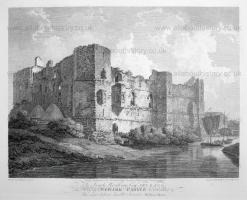
Newark Castle, Nottinghamshire [Map]. Thomas Hearne, 1796.

Around 1890. William Harold Cubley [aged 73]. "The Keep, Newark Castle, Nottinghamshire [Map]".

Around 1890. William Harold Cubley [aged 73]. "Newark Castle, Nottinghamshire [Map]".

Around 1890. William Harold Cubley [aged 73]. "Newark Castle, Nottinghamshire [Map], with Sebastopol Cannon".
Robert Pierrepont was appointed Governor of Newark Castle.