

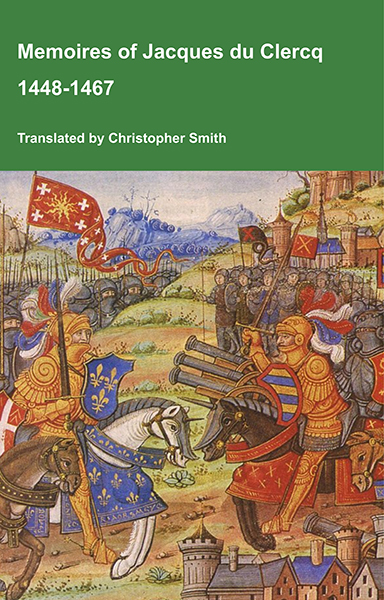
This is a translation of the 'Memoires of Jacques du Clercq', published in 1823 in two volumes, edited by Frederic, Baron de Reissenberg. In his introduction Reissenberg writes: 'Jacques du Clercq tells us that he was born in 1424, and that he was a licentiate in law and a counsellor to Philip the Good, Duke of Burgundy, in the castellany of Douai, Lille, and Orchies. It appears that he established his residence at Arras. In 1446, he married the daughter of Baldwin de la Lacherie, a gentleman who lived in Lille. We read in the fifth book of his Memoirs that his father, also named Jacques du Clercq, had married a lady of the Le Camelin family, from Compiègne. His ancestors, always attached to the counts of Flanders, had constantly served them, whether in their councils or in their armies.' The Memoires cover a period of nineteen years beginning in in 1448, ending in in 1467. It appears that the author had intended to extend the Memoirs beyond that date; no doubt illness or death prevented him from carrying out this plan. As Reissenberg writes the 'merit of this work lies in the simplicity of its narrative, in its tone of good faith, and in a certain air of frankness which naturally wins the reader’s confidence.' Du Clercq ranges from events of national and international importance, including events of the Wars of the Roses in England, to simple, everyday local events such as marriages, robberies, murders, trials and deaths, including that of his own father in Book 5; one of his last entries.
Available at Amazon in eBook and Paperback format.
Pembroke College, Cambridge University is in Cambridge University.
In 1347 Marie Chatillon Countess Pembroke [aged 44] founded Pembroke College, Cambridge University; it was originally known as he Hall of Valence-Mary.
In 1355 and 1366, Marie Chatillon Countess Pembroke [aged 52] acquired papal bulls to allow the Pembroke College, Cambridge University its own chapel, which was the first college chapel to be built in Cambridge.
Around 1505 John Rogers was born at Deritend. He was educated at Pembroke College, Cambridge University where he graduated BA in 1526.
In 1541 Bishop John Christopherson became a Fellow of Pembroke College, Cambridge University.
In 1550 Nicholas Longford [aged 18] educated at Pembroke College, Cambridge University.
In July 1559 Archbishop Edmund Grindal [aged 40] was elected Master of Pembroke College, Cambridge University.
In 1562 Archbishop Matthew Hutton [aged 33] was elected Master of Pembroke College, Cambridge University.
On 13th April 1693 William Coventry 5th Earl Coventry [aged 17] matriculated Pembroke College, Cambridge University.
On 5th May 1697 Edmund Bacon 6th Baronet [aged 16] was admitted to Pembroke College, Cambridge University; he didn't take a degree.
The History of William Marshal was commissioned by his son shortly after William’s death in 1219 to celebrate the Marshal’s remarkable life; it is an authentic, contemporary voice. The manuscript was discovered in 1861 by French historian Paul Meyer. Meyer published the manuscript in its original Anglo-French in 1891 in two books. This book is a line by line translation of the first of Meyer’s books; lines 1-10152. Book 1 of the History begins in 1139 and ends in 1194. It describes the events of the Anarchy, the role of William’s father John, John’s marriages, William’s childhood, his role as a hostage at the siege of Newbury, his injury and imprisonment in Poitou where he met Eleanor of Aquitaine and his life as a knight errant. It continues with the accusation against him of an improper relationship with Margaret, wife of Henry the Young King, his exile, and return, the death of Henry the Young King, the rebellion of Richard, the future King Richard I, war with France, the death of King Henry II, and the capture of King Richard, and the rebellion of John, the future King John. It ends with the release of King Richard and the death of John Marshal.
Available at Amazon in eBook and Paperback format.
On 27th October 1777 Bishop Bowyer Sparke [aged 18] was admitted as a Pensioner to Pembroke College, Cambridge University. He matriculated in 1778, graduated BA in 1782 as Seventh Wrangler, second Member's Prize in 1784 and 1784, MA in 1785 and DD in 1803. In 1784 he became a Fellow of Pembroke College, Cambridge University.

In 1786 William Eliot 2nd Earl St Germans [aged 18] was awarded Master of Arts: Cambridge University at Pembroke College, Cambridge University.