

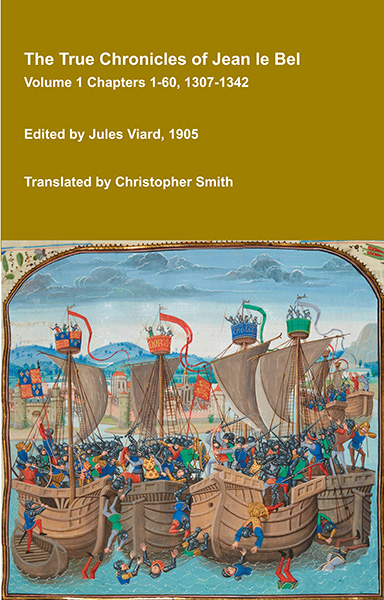
The True Chronicles of Jean le Bel Volume 1 Chapters 1-60 1307-1342
The True Chronicles of Jean le Bel offer one of the most vivid and immediate accounts of 14th-century Europe, written by a knight who lived through the events he describes, and experienced some of them first hand. Covering the early decades of the Hundred Years’ War, this remarkable chronicle follows the campaigns of Edward III of England, the politics of France and the Low Countries, and the shifting alliances that shaped medieval warfare. Unlike later historians, Jean le Bel writes with a strong sense of eyewitness authenticity, drawing on personal experience and the testimony of fellow soldiers. His narrative captures not only battles and sieges, but also the realities of military life, diplomacy, and the ideals of chivalry that governed noble society. A key source for Jean Froissart, Le Bel’s chronicle stands on its own as a compelling and insightful work, at once historical record and literary achievement. This translation builds on the 1905 edition published in French by Jules Viard, adding extensive translations from other sources Rymer's Fœdera, the Chronicles of Adam Murimuth, William Nangis, Walter of Guisborough, a Bourgeois of Valenciennes, Geoffrey le Baker of Swinbroke and Richard Lescot to enrich the original text and Viard's notes.
Available at Amazon in eBook and Paperback format.
Reading, Berkshire is in Berkshire.
See: Englefield, Reading, Olympia Ballroom Reading, Reading Abbey, Berkshire [Map], Reading Museum, Reading School, Berkshire, Woodcote, Reading.
Reading, Berkshire [Map] is located where the River Kennet meets the River Thames.
On 31st December 870 Æthelwulf Mercia Earldorman Berkshire [aged 45] defeated the Viking army at the Battle of Englefield at Englefield, Reading. The Viking Army retreated to Reading, Berkshire [Map]. Sidrac Viking was killed.
Assers Life of Alfred 871. 871. 35. The Danes defeated at Englefield.77 In the year of our Lord's incarnation 871, which was the twenty-third of King Alfred's life, the heathen army, of hateful memory, left East Anglia, and, entering the kingdom of the West Saxons, came to the royal vill called Reading [Map], situated on the south bank of the Thames, in the district called Berkshire; and there, on the third day after their arrival, their [two] ealdormen, with great part of the army, rode forth for plunder, while the others made an entrenchment between the rivers Thames and Kennet, on the southern side of the same royal vill. They were encountered by Æthelwulf [aged 46], Ealdorman of Berkshire, with his men, at a place called Englefield78 [in English, and in Latin 'The Field of the Angles'].79 Both sides fought bravely, and made long resistance to each other. At length one of the heathen ealdormen was slain, and the greater part of the army destroyed; upon which the rest saved themselves by flight, and the Christians gained the victory and held the battle-field.
Note 77. Chiefly from the Chronicle.
Note 78. Five and one-half miles southwest of Reading.
Note 79. Added from Florence of Worcester by Stevenson.
In 1492 Thomas White was born to William White of Reading and Mary Kibblewhite at Reading, Berkshire [Map]. He married (1) before 26th February 1558 Avice Unknown (2) 25th November 1558 Joan Trelake.
On 7th October 1573 Archbishop William Laud was born to William Laud and Lucy Webbe at Reading, Berkshire [Map].


In 1591 Dean Thomas Turner was born to Thomas Turner of Heckfield in Hampshire in Reading, Berkshire [Map]. He married before 23rd August 1637 Margaret Windebank and had issue.
In 1656 Constantine Henry Phipps was born to Francis Phipps at Reading, Berkshire [Map].
Patent Rolls. 26th September 1664. Reading, Berkshire [Map]. Grant to Thomas Metcalf and Miles Metcalf, brothers of Edmund Metcalf, for their good service to the king, the king's father Richard, late duke of York, and the king's uncle Richard, late Earl of Salisbury, of the custody of the body of Catharine Metcalf, late the wife of the said Edmund, and of all her lands and tenements in the county of York and in Kingeston on Hull, to hold during her idiotcy without rendering anything to the king, but finding a competent sustenance for her and supporting all charges, in the same manner as the same was granted to Thomas Witham, chancellor of the Exchequer, by letters patent, surrendered.
Samuel Pepys' Diary. 16th June 1668. Tuesday. So paying the reckoning, 14s. 4d., and servants, 2s., poor 1s., set out; and overtook one coach and kept a while company with it, till one of our horses losing a shoe, we stopped and drank and spent 1s. So on, and passing through a good part of this county of Wiltshire, saw a good house of Alexander Popham's [aged 63], and another of my Lord Craven's [aged 60], I think in Barkeshire. Come to Newbery [Map], and there dined, which cost me, and musick, which a song of the old courtier of Queen Elizabeth's, and how he was changed upon the coming in of the King [aged 38], did please me mightily, and I did cause W. Hewer [aged 26] to write it out, 3s. 6d. Then comes the reckoning, forced to change gold, 8s. 7d.; servants and poor, 1s. 6d. So out, and lost our way, which made me vexed, but come into it again; and in the evening betimes come to Reading [Map], and there heard my wife read more of "Mustapha", and then to supper, and then I to walk about the town, which is a very great one, I think bigger than Salsbury: a river runs through it, in seven branches, and unite in one, in one part of the town, and runs into the Thames half-a-mile off one odd sign of the Broad Face. W. Hewer troubled with the headake we had none of his company last night, nor all this day nor night to talk. Then to my inn, and so to bed.


On 31st December 870 Æthelwulf Mercia Earldorman Berkshire [aged 45] defeated the Viking army at the Battle of Englefield at Englefield, Reading. The Viking Army retreated to Reading, Berkshire [Map]. Sidrac Viking was killed.
Around 1455 Thomas Englefield probably in Englefield, Reading.
On 5th January 1964 the Rolling Stones played at the Ricky Tick club at the Olympia Ballroom Reading.
The True Chronicles of Jean le Bel Volume 1 Chapters 1-60 1307-1342
The True Chronicles of Jean le Bel offer one of the most vivid and immediate accounts of 14th-century Europe, written by a knight who lived through the events he describes, and experienced some of them first hand. Covering the early decades of the Hundred Years’ War, this remarkable chronicle follows the campaigns of Edward III of England, the politics of France and the Low Countries, and the shifting alliances that shaped medieval warfare. Unlike later historians, Jean le Bel writes with a strong sense of eyewitness authenticity, drawing on personal experience and the testimony of fellow soldiers. His narrative captures not only battles and sieges, but also the realities of military life, diplomacy, and the ideals of chivalry that governed noble society. A key source for Jean Froissart, Le Bel’s chronicle stands on its own as a compelling and insightful work, at once historical record and literary achievement. This translation builds on the 1905 edition published in French by Jules Viard, adding extensive translations from other sources Rymer's Fœdera, the Chronicles of Adam Murimuth, William Nangis, Walter of Guisborough, a Bourgeois of Valenciennes, Geoffrey le Baker of Swinbroke and Richard Lescot to enrich the original text and Viard's notes.
Available at Amazon in eBook and Paperback format.
In 1927 Stuart Piggott [aged 16] was employed as an assitant at Reading Museum.
Around 1585 Archbishop William Laud [aged 11] educated at Reading School, Berkshire.
John Evelyn's Diary. 1st January 1655. Having with my family performed the public offices of the day, and begged a blessing on the year I was now entering, I went to keep the rest of Christmas at my brother's, R. Evelyn [aged 32], at Woodcot.
John Evelyn's Diary. 30th December 1665. To Woodcot, where I supped at my Baroness Mordaunt's [aged 33] at Ashsted [Note. Possibly in Fulham where Baroness Mordaunt was subsequently buried?] where was a room hung with pintado, full of figures great and small, prettily representing sundry trades and occupations of the Indians, with their habits; here supped also Dr. Duke, a learned and facetious gentleman.
John Evelyn's Diary. 17th February 1688. I received the sad news of my niece Montague's death at Woodcot on the 15th.
Around 1897 Bernard Fitzalan Howard 3rd Baron Howard [aged 11] educated at The Oratory School, Woodcote.
Around 1923 Bernard Fitzalan 16th Duke of Norfolk [aged 14] educated at The Oratory School, Woodcote.