

The History of William Marshal was commissioned by his son shortly after William’s death in 1219 to celebrate the Marshal’s remarkable life; it is an authentic, contemporary voice. The manuscript was discovered in 1861 by French historian Paul Meyer. Meyer published the manuscript in its original Anglo-French in 1891 in two books. This book is a line by line translation of the first of Meyer’s books; lines 1-10152. Book 1 of the History begins in 1139 and ends in 1194. It describes the events of the Anarchy, the role of William’s father John, John’s marriages, William’s childhood, his role as a hostage at the siege of Newbury, his injury and imprisonment in Poitou where he met Eleanor of Aquitaine and his life as a knight errant. It continues with the accusation against him of an improper relationship with Margaret, wife of Henry the Young King, his exile, and return, the death of Henry the Young King, the rebellion of Richard, the future King Richard I, war with France, the death of King Henry II, and the capture of King Richard, and the rebellion of John, the future King John. It ends with the release of King Richard and the death of John Marshal.
Available at Amazon in eBook and Paperback format.
Rochester Castle, Kent is in Rochester, Kent [Map], Castles in Kent.
Chronicon ex Chronicis by Florence and John of Worcester. 1127. The custody of Rochester castle granted to the archbishops of Canterbury. The king, also, by the advice of his barons, granted to the church of Canterbury, and to William the archbishop, and to all his successors, the custody and constableship of the castle of Rochester [Map], to hold for ever; with liberty to make in the same castle a fort or tower, as they pleased, and have and guard it for ever; and that the garrison stationed in the castle should have free ingress and egress on their own occasions, and should be security to the archbishop for it.
Before 1235 William Saye (age 25) and Sybil Marshal (age 25) were married at Rochester Castle, Kent [Map].
In 1247 Nicholas Moels (age 52) was appointed Constable of Rochester Castle.
On 12th February 1271 William Saye (age 62) died at Rochester Castle, Kent [Map].
In 1304 Henry Cobham 1st Baron Cobham (age 44) was appointed Constable of Rochester Castle.
Anonimalle Chronicle. And at that same time, the commons of Kent came to Maidstone and beheaded one of the best men of the town and tore down various houses and tenements belonging to those who refused to rise up with them, as had been done in Essex. And on the following Friday [7th June 1381], they came to Rochester [Map] and there met with a great number of the commons from Essex. Because of the man from Gravesend, they laid siege to Rochester Castle in order to recover their companion, whom the aforesaid Sir Simon had imprisoned. They launched a fierce assault on the castle, and the constable defended it vigorously for half a day. But in the end, fearing such a vast crowd of people from Essex and Kent who had gathered without reason, he surrendered the castle to them. The commons entered and freed their companion and all the other prisoners from the prison. Those from Gravesend returned with their companion with great celebration, without doing more, while those from Maidstone continued their journey with the other commons through the surrounding countryside.
Et mesme le temps le comunes de Kent viendrent a Maydenstoun et couperount le test de une de les meliours hommes de la ville et abaterount a terre diverses places et tenementz des gentz queux ne vodroient lever ovesqe eux come firent en Exesse; et le venderdy prochien apres, viendrent a Rouchestre et illeoges encontrerount graunde noumbre des comunes de Exesse et par cause del homme de Grayvesende mistrent ensege al chastelle de Rouchestre pur avoir lour compaignoun del Gravesende, le quel sire Symond avauntdit avoit enprisone; et donerount fort assaute al chastelle, et les conestable se defendist vigurousement une dymy iour, mes au. darrein pur doute qil avoit de tiel multitude des gentz saunz resoun de Exesse et de Kent delivera le chastelle as eux et les comunes entrerent et pristrent lour compaignoun et toutz prisoners hors de prisone; et ceux de Gravesende repairerount od lour compaignoun od graunde leestee saunz pluis fair, et les autres de Maydenstoun pristrent lour viage ovesge les autres comunes par le pais enviroun.
On 3rd February 1388 the Merciless Parliament commenced. It ended on 4th June 1388. Its primary function was to prosecute members of the Court of King Richard II of England (age 21). The term "Merciless" is contemporary having been coined by the chronicler Henry Knighton.
Michael de la Pole 1st Earl Suffolk (age 58) was sentenced to be hanged, drawn and quartered in his absence. He had escaped to France.
Archbishop Alexander Neville (age 47) was found guilty of treason and it was determined to imprison him for life in Rochester Castle, Kent [Map]. He fled to Louvain [Map] where he became a parish priest for the remainder of his life.
On 19th February 1388 Robert Tresilian was hanged naked and his throat cut. See Chronicle of Adam of Usk.
On 25th March 1388 Nicholas Brembre was hanged. He was buried at Christ Church, Greyfriars [Map].
On 5th May 1388 Simon Burley (age 48) was executed despite the protestations of his friend Edmund of Langley 1st Duke of York (age 46). See Chronicle of Adam of Usk.
On 12th May 1388 John Beauchamp 1st Baron Beauchamp (age 69) was beheaded at Tower Hill [Map]. He was buried at Worcester Cathedral [Map]. Baron Beauchamp of Kidderminster forfeit.
Robert de Vere 1st Duke Ireland (age 26) was attainted.


On 18th May 1509 John Marney 2nd Baron Marney (age 25) was appointed Keeper of Rochester Castle.

Henry Machyn's Diary. 26th January 1554. The xxvj day of January began wachyng at evere gatt in arness, for tydyngs cam the sam tym to the quen and her consell that ser Thomas Wyatt (age 33), ser George Harper, ser Hare Ysseley (age 54), master Cobam, and master Rudston (age 39), and master Knevetts (age 37), and dyvers odur gentyllmen and commons, wher up, and tha say because the prynche of Spayne (age 26) commyng in to have owre quen (age 37), for they kepe Rochaster castell [Map] and the bryge and odur plases.
Note. P. 52. Sir Thomas Wyatt. A copious narrative of Wyatt's rebellion, together with the letters written by the duke of Norfolk, lord Cobham, and others, to the Privy Council, on the occasion, (from the originals in the State Paper Office,) will be found in Cruden's History of Gravesend, 1842, 8vo. pp. 172 et seq.
Samuel Pepys' Diary. 2nd October 1665. Thence to Rochester, Kent [Map], walked to the Crowne, and while dinner was getting ready, I did there walk to visit the old Castle [Map] ruines, which hath been a noble place, and there going up I did upon the stairs overtake three pretty mayds or women and took them up with me, and I did 'baiser sur mouches et toucher leur mains1' and necks to my great pleasure: but, Lord! to see what a dreadfull thing it is to look down the precipices, for it did fright me mightily, and hinder me of much pleasure which I would have made to myself in the company of these three, if it had not been for that. The place hath been very noble and great and strong in former ages.
Note 1. baiser sur mouches et toucher leur mains. Kiss their beauty spots and touched their hands.
Samuel Pepys' Diary. 30th June 1667. Thence to the Castle [Map], and viewed it with Creed, and had good satisfaction from him that showed it us touching the history of it. Then into the fields, a fine walk, and there saw Sir Francis Clerke's house, which is a pretty seat, and then back to our inne and bespoke supper, and so back to the fields and into the Cherry garden, where we had them fresh gathered, and here met with a young, plain, silly shopkeeper, and his wife, a pretty young woman, the man's name Hawkins, and I did kiss her, and we talked (and the woman of the house is a very talking bawdy jade), and eat cherries together, and then to walk in the fields till it was late, and did kiss her, and I believe had I had a fit time and place I might have done what I would with her. Walked back and left them at their house near our inne, and then to our inne, where, I hear, my Lord Bruncker (age 47) hath sent for me to speak with me before I go: so I took his coach, which stands there with two horses, and to him and to his bedside, where he was in bed, and hath a watchman with a halbert at his door; and to him, and did talk a little, and find him a very weak man for this business that he is upon; and do pity the King's service, that is no better handled, and his folly to call away Pett before we could have found a better man to have staid in his stead; so took leave of him, and with Creed back again, it being now about 10 at night, and to our inne to supper, and then to bed, being both sleepy, but could get no sheets to our bed, only linen to our mouths, and so to sleep, merrily talking of Hawkins and his wife, and troubled that Creed did see so much of my dalliance, though very little.
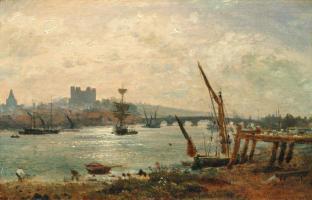
Around 1825. Frederick Nash (age 43). "Rochester Cathedral [Map] and Castle [Map].
Henrici Quinti, Angliæ Regis, Gesta, is a first-hand account of the Agincourt Campaign, and subsequent events to his death in 1422. The author of the first part was a Chaplain in King Henry's retinue who was present from King Henry's departure at Southampton in 1415, at the siege of Harfleur, the battle of Agincourt, and the celebrations on King Henry's return to London. The second part, by another writer, relates the events that took place including the negotiations at Troye, Henry's marriage and his death in 1422.
Available at Amazon in eBook and Paperback format.
John Cobham was appointed Constable of Rochester Castle.
William Saye was appointed Governor of Rochester Castle.